
The articlegameplay, story, development, reception
Gameplay
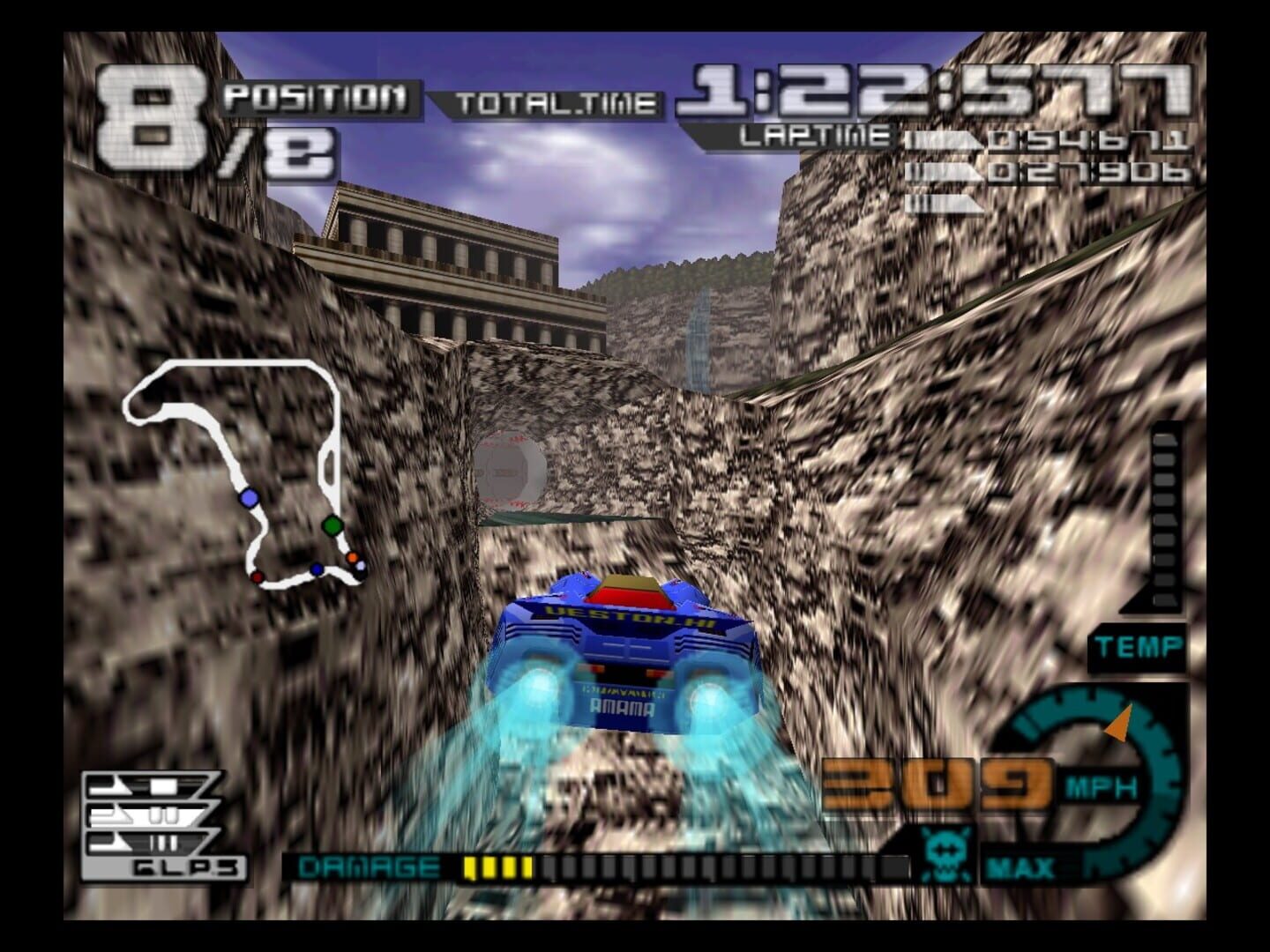
AeroGauge is a futuristic racing game in the vein of the Wipeout and F-Zero series, as well as Extreme-G, with the only major difference being that the racing is done in aircraft; the racers fly in futuristic Aero Machines on tracks consisting of banked turns, bridges, hills, spiraling tunnels, and alternate routes. There are four modes (a four-race grand prix, a single match, a time trial, and a two-player vs. mode) that can be played from a choice of six tracks, four of which are already unlocked and have varying levels of difficulty (the beginner Dug Rug, an ocean-themed level, the neon-colored China-themed Chinoispolis, and the metropolis Earth Cream Circuit for experts). All of them are playable at three different difficulty settings, which only determine the speed of the vehicles. In grand prix and single match, the player races against seven computer opponents.
AeroGauge features ten Aero Machines, five of which are available from the start. Each of the vehicles is rated based on speed, acceleration, shield, and agility. The white, old-school Mitia is the weakest car, Fusaha has the quickest descending and floating, Zero has the greatest handling, the orange Gazpecs is the fastest, and Interceptor has good movement ability and is meant for beginners. An N64 controller is also usable as a vehicle, although it must be unlocked.
Development
AeroGauge was presented at the 1997 Nintendo Space World event. The game's North American release date was initially set for February 1998, but it was delayed to April 2, then to May 1998 a day later as a result of manufacturing issues.
Reception
AeroGauge was met with mixed reception. The game held a 58% on the review aggregation website GameRankings based on 12 reviews. Chief among the criticisms were the extreme pop up, the absence of weapons and power-ups, the limited variety of tracks, and the excessively high difficulty, with controls that make it difficult to master even basic maneuvers and AI opponents which race so flawlessly that even a single mistake is enough to cost the player all chance of victory. Kraig Kujawa of Electronic Gaming Monthly said the pop-up is "so extreme in places that it can mess you up by inconveniently popping things up in front of you at inopportune times.
This adds a little frustration to a game that isn't too much fun to begin with." GamePro remarked, "Aero Gauge looks impressive at first, serving up wickedly fast hovercraft racing in 3D space, tight two-player split-screen battles, and tracks packed with thrilling loops and tunnels that harken back to the arcade classic Stun Runner. Unfortunately, the game's sparse features (a skimpy lineup of vehicles and tracks and no weapons) and serious draw-in problems quickly limit the fun."


