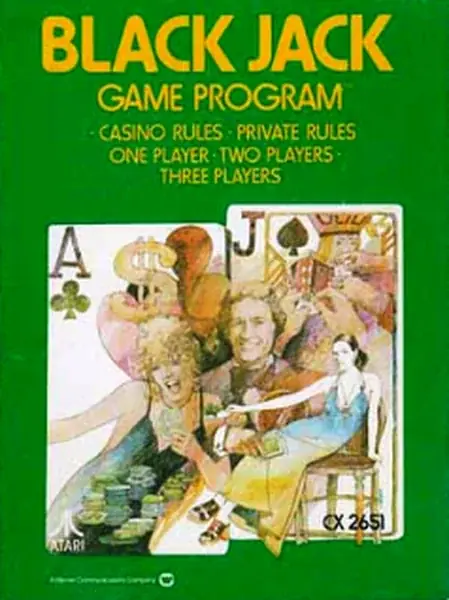
The articlegameplay, story, development, reception
Gameplay
Blackjack can be played by one to three players. All players start with 200 chips and can bet 1 to 25 chips each round. Each player is dealt two cards face-up, while the dealer is given two cards face down. Each card has a point value assigned.
Number cards have their face value, such as a five card being worth five points. Face cards are worth ten points, and an ace can be either be 1 or 11 points. The object of each round is to get 21 points or as close to 21 points without exceeding it. If a player is satisfied with their hand dealt to them, they can choose to stay.
If they want to add more points, they can request a hit and receive another card from the dealer. A player can continue to hit until they choose to stay or until they exceed 21 points and lose the round. The player wins the round if their hand has more points than the dealer's hand without exceeding 21 or if the dealer's hand exceeds 21 points. If the player wins with a "Blackjack" (an ace along with a face card or a 10 card), they earn one and a half times their bet.
A player's bet is either added or subtracted from their total score depending on if they won or lost the round. The game ends when one player earns 1000 chips, thus "breaking the bank", or if the player has no remaining chips.
The difficulty switches on the Atari 2600 can affect the gameplay. If the left difficulty switch is set to position B, the dealer shuffles the deck after every hand. If set to position A, the computer shuffles after dealing 34 cards. If the right difficulty switch is set to A, the dealer must hit a soft 17 or less and will stay on a hard 17.
If a player's hand equals 10 or 11 points, the player must double their bet before the first hit. On position B, the dealer will stay on 17 or more points, all ties default to a win for the dealer, and a player can win the game when they hit four times without going over 21 points.
Development
Blackjack was designed by Bob Whitehead. Whitehead was born in San Jose, California and graduated from San Jose University with a degree in computer mathematics. He joined the Atari, Inc. programming department in January 1977.
Whitehead began work on Blackjack following Star Ship (1977), his adaptation of the arcade game Starship 1 (1977) for the Atari 2600. Various blackjack games had been made before the Atari 2600 version, such as Los Alamos engineers producing a version of the game for the IBM 701 in the 1950s. Most home video games consoles available in the late 1970s had a blackjack game, such as the Fairchild Channel F console with Videocart-3 in 1976.
Whitehead explained that developers for the system wanted to create games they thought they would enjoy themselves, believing a gambling-themed game would be appealing to the staff. He jokingly described them as "teenagers between the ages 18 and 35." Halfway through development, Whitehead contemplated adding other card games along with blackjack to the game, but held back on the idea as it was important at the time to release more games for the system. He specifically made the game to be controlled with the paddle controllers as he felt the game would be able to use them appropriately, and wanted owners of the system to feel that enough games used the controllers to justify their cost.
Legacy
Blackjack was the first game to rewrite copy graphics on the fly, which would make the Atari 2600 display graphics beyond what it was built to do. Whitehead explained that the Atari 2600 was initially only intended to have a certain amount of object images on the screen, but as the television scans down the screen, the program could move these objects around. This technique was used in several later games for the system to show six-character score ranges.
Whitehead's desire to make more card games available was later realized with his game Casino, released in March 1979, which included variants on stud poker and solitaire, in addition to blackjack. Following the release of Casino, Blackjack was no longer highlighted in promotional material from Atari and was discontinued by the January 1982 Consumers Electronic Show. The game stayed on the market, with some remaining small sales figures still appearing as late as 1989.