
The articlegameplay, story, development, reception
Gameplay
In single-player mode, the player takes the role of Caleb in his quest for revenge against his former master by navigating levels in episodes, looking for an exit, until the boss level.
Blood's gameplay is similar to other classic FPS games like Doom: the player must activate switches or seek keys to go through the levels; some larger maps contain up to six different keys. Features include teleporters, traps such as crushing blocks, explosive barrels, lava pits, jumping puzzles, and combination lock doors.
Blood is one of the earliest FPS games to feature alternate or secondary attack modes for its weapons. Weapons include a flare gun, voodoo doll, and an aerosol canister that can be used as a flamethrower. It also features a power-up known as "Guns Akimbo", which allows the player to dual wield certain weapons temporarily. Blood also has "super secret" areas which contain rewards for discovering them.
Enemies include human members of the Cabal and creatures fighting for the demon Tchernobog. Enemies can use objects in the environment for cover. The game also features a lesser class of enemies (bats, rats, eels, possessed hands, etc.) often referred to as "nuisance enemies" that are not considered threats individually, but can be deadly in large numbers.
Blood, like many FPS games of the time, features multiplayer modes. When it was released, Internet play was not well established, so Blood used modem, LAN, or serial cable connections for multiplayer. Modem and serial cable connections only allow two player games, while an IPX network connection can support up to eight players. This can easily be achieved on a variety of platforms that support DOSBox and its IPX modes, coupled with VPN software such as Hamachi. Online multiplayer was also possible via the Total Entertainment Network and DWANGO.
The multiplayer modes consist of deathmatch, known in Blood as "Bloodbath", and cooperative play. Bloodbath matches can be played on specifically designed multiplayer maps or on the levels of the various episodes; the "frag limit" or "time limit" options are available to end matches, as well as the possibility to control respawn mode for weapons and power-ups. A feature of Bloodbath is "The Voice", an audio comment heard upon each frag, that punctuates the death of an opponent often in gory and irreverent terms. "The Voice" is that of Jace Hall, who was CEO of Monolith Productions at the time. Cooperative gameplay follows the lines of the single player campaign, allowing several players to work together in the levels of the different episodes.
Story
Blood takes place in an unspecified time period. The various levels contain elements from the 1920s, 1930s, and 1940s, in addition to futuristic and retro-futuristic technologies and a weird West theme. Many elements are anachronistic, including weapons and pop-culture references. The sequel, Blood II: The Chosen, retroactively dates the game to the year 1928.
The backstory is not delineated in the game itself, only on the Monolith website and a readme text document. The player takes on the role of Caleb, once the supreme commander of a cult called "The Cabal", followers of the forgotten demon Tchernobog. Known as a merciless gunfighter in the late 19th century American West, Caleb joined the Cabal in 1871 after meeting Ophelia Price, a woman whose husband and son may have been murdered by the members of the Cabal; it is implied that she later became Caleb's lover. Together they rose to the highest circle of the dark cult, "The Chosen", until all four members of The Chosen were betrayed and killed by Tchernobog for unspecified failures. Several years later, Caleb rises from his grave, seeking answers and vengeance.
In search of the gargoyle Cheogh, one of Tchernobog's minions, Caleb moves to the rail yard and station, where he boards the northbound "Phantom Express". He fights off the undead which swarm the train, finally stopping the train by blowing up the locomotive. Emerging from the wreckage, cutting through swarms of Cabal loyalists and other creatures, Caleb enters the "Great Temple". A teleporter in the temple leads Caleb to Cheogh's altar, where he finds Ophelia crucified, and he fights and slays Cheogh. Caleb finishes by lighting up Ophelia's funeral pyre to cremate her body.
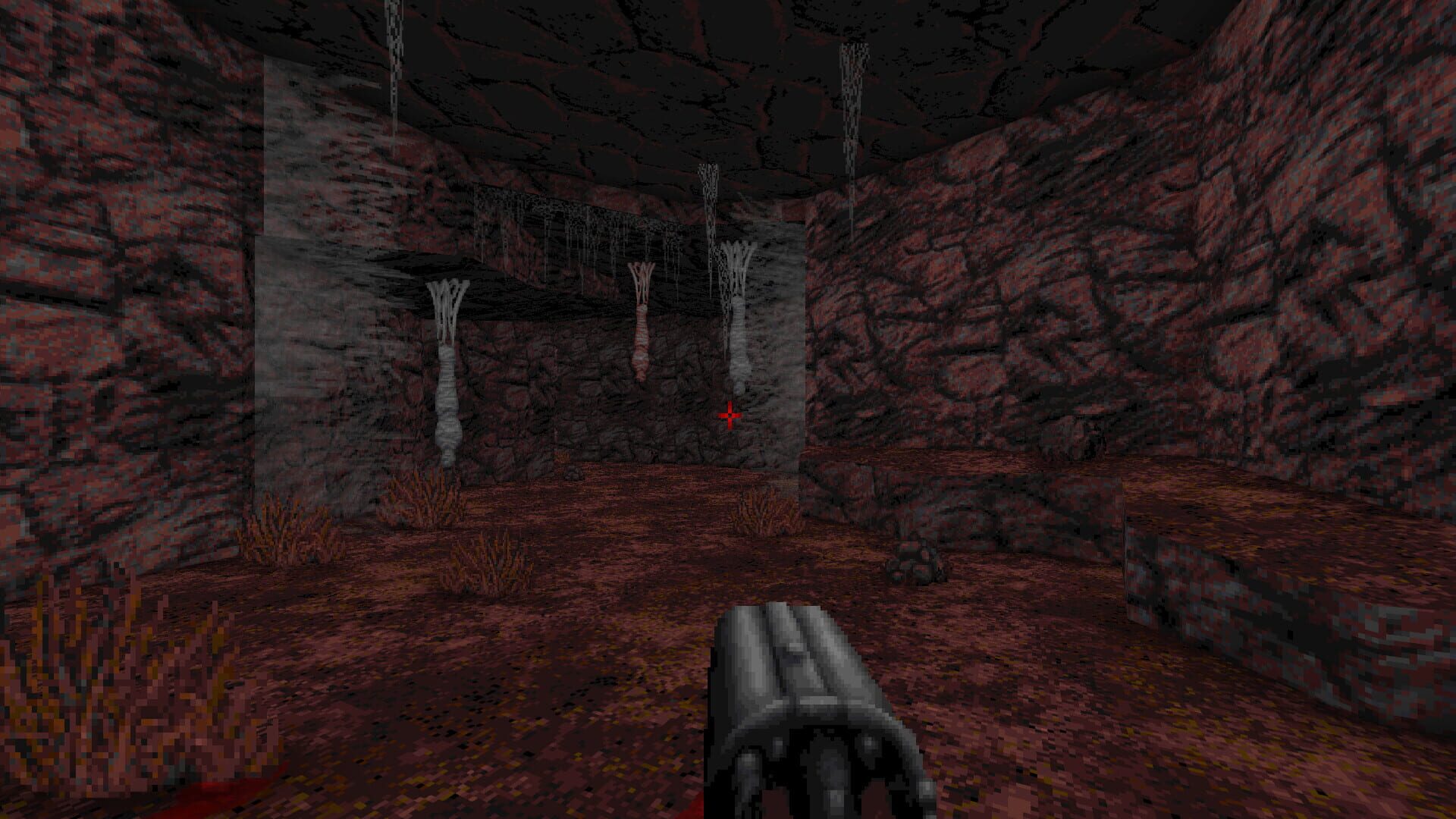
Caleb heads to the Arctic north on a large icebound wooden sailing ship. He disembarks at a lumber mill the Cabal has transformed into a crude human remains processing area. He makes his way into a mine in search of the mother spider Shial's lair. Navigating the Cabal infested tunnels, Caleb finds a dark stony cavern where he defeats Shial, crushing her with a stomp of his boot. He then rips out and consumes the heart of the webbed corpse of Gabriel, another of the betrayed Chosen, thus gaining the power of his fallen comrade.
Cerberus is promoted to Tchernobog's second in command. Caleb moves across an industrial facility, entering a nearby dam control installation located near Cerberus' cavern, then blows up the dam with explosives. The resulting flood makes Cerberus' hideout accessible. Caleb kills Cerberus, and upon finding no trace of Ishmael, fills Cerberus' stomach with bundles of TNT, and blows up the corpse.
Caleb heads for the "Hall of the Epiphany" where Tchernobog is waiting. There, before facing him, Caleb learns why "The Chosen" were cast down: Tchernobog knew Caleb would return to him, killing anyone he ran into to take his revenge and thus gaining immense power, something Tchernobog wants for himself. Caleb battles and destroys the demon. One of Tchernobog's followers approaches Caleb and declares him their new leader. Caleb shoots him and leaves the Hall of Epiphany.
Development
Development began at Q Studios, an independent developer funded by 3D Realms, in parallel with a number of other well-known titles. It started development in 1995. Following the success of Duke Nukem 3D, development progress was made public starting in June 1996 with weekly updates on their website. It was originally scheduled for release in early 1997.
Q Studios was acquired by Monolith in November 1996. On January 22, 1997, all rights had been sold to Monolith so that 3D Realms could focus efforts on Shadow Warrior, another Build engine game slated for release the same year. Ports for the PlayStation and Sega Saturn were planned but never completed.
Blood was one of two games (the other being Shadow Warrior) that took advantage of the Build engine's support for voxel objects in the game world. Blood used this for weapon and ammo pickups, power-ups, and occasionally decorations, such as the tombstones in the first level of episode one, "Cradle to Grave". The Build engine was enhanced for Blood to allow new lighting effects, real-time shadows, and simulated "rooms above rooms".
A central feature of Blood is an abundant (and often exaggerated) graphic violence, from which the game derives its name. Enemies can be blown to pieces, and the pieces often rain down on the player. Zombies' heads can be shot off and then kicked around like footballs, spewing fountains of blood. Enemies scream if set on fire or are otherwise injured, making sound an integral part of the violent atmosphere of Blood.
The levels themselves are designed with the same spirit, as corpses, torture victims, and several grotesque situations are witnessed in the game. Collectively, these features caused some public concern about Blood, leading to a censored re-release of the game.
Reception
Blood received "generally favorable" reviews from professional critics, according to review aggregator website Metacritic based on seven reviews. Critics especially praised the intricate and creative level designs, humorous wisecracks and pop culture references, over-the-top gore, variety of settings, and inventive, unconventional weaponry. GameSpot particularly noted that the voodoo doll "might be the coolest little accessory to ever grace the weapons belt of a first-person killing machine".
A few criticisms were voiced about the game, but did not find consensus among reviewers. For example, while GameSpot said the game "is just too damn hard", citing how quickly enemies can deal damage, Next Generation asserted that "the game is lengthy without being too tedious, and challenging without being too difficult". GamePro followed up its own criticisms by concluding: "Blood's flaws are easily swept aside when your guns start blasting and the bodies start falling".
GamingOnLinux reviewer Hamish Paul Wilson decided in a 2015 retrospective that Blood was easily the best of the three major Build engine games, stating that Blood was "one of the most underrated shooters of the whole decade. Blood arguably built more on the legacy of Duke Nukem 3D than Shadow Warrior did, taking its gameplay to sophisticated new heights and offering its referential overtones with an even greater degree of refinement". Player Attack described Blood in a 2011 article as "the best of the Build engine games after Duke Nukem 3D, with its combination of scary atmosphere, great level design and challenging gameplay putting it above the rest".
More than 350,000 copies of Blood have been downloaded. This number reached one million in its first six months of release. By 1998, the game sold 120,000 copies worldwide.
Legacy
Blood has received numerous fan homages and remakes, including Transfusion, ZBlood, BloodCM, and The Flesh Game, as well as community produced source ports such as BloodGDX, NBlood and Raze, and mods for other games such as the Bloom mod made for GZDoom. The game has also inspired several later boomer shooters such as Eternal Damnation, Viscerafest, Dread Templar, Coven, Nightmare Reaper, Project Warlock, Dusk, and most notably Cultic. It was also influential on the roguelike game Infra Arcana.
The manhwa series Priest created by Hyung Min-woo was inspired by Blood. An interview with Hyung in Priest, Vol. 3: Requiem for the Damned states that the comic was influenced by the game, which featured a similar horror-Western aesthetic and undead protagonist. The manhwa was adapted into the 2011 American horror film of the same name.
The 2014 horror film FPS: First Person Shooter features Stephan Weyte, the actor who played Caleb, as the voice of the protagonist.


