
The articlegameplay, story, development, reception
Gameplay
Centerfold Squares is a variation of reversi referred to as 'Double-Up' that is played on a ten by ten grid; four counters of two opposing colors are placed in the center in a two by two alternating pattern. The game is played against an AI of varying difficulty, and each player takes turns placing counters on the board next to an existing counter, and if a player surrounds an opposing counter with two counters of their own color, that counter then becomes their color. Centerfold Squares has special squares in the grid, which activate different effects when a counter is placed on them: red squares subtract points, green squares give extra points, and yellow squares allow the player to take another turn. There is also a '???'
button which takes up a player's turn in exchange for a random effect, such as large point changes or instant wins or losses. Points are earned through the player changing opposing counters to their color, and earning a set number of points (determined at the beginning of the round) will win the game. The points are then used to remove one of the black tiles covering a digitized image of a nude model - each tile has a set number of points required to remove it. If the AI wins, an already revealed tile is covered up.
Development
Centerfold Squares was retitled Centrefold Squares in Europe, and published by CDS Software. Centerfold Squares was published by Proein S.A in Spain. The Amiga version of Centerfold Squares was released around April 1988.
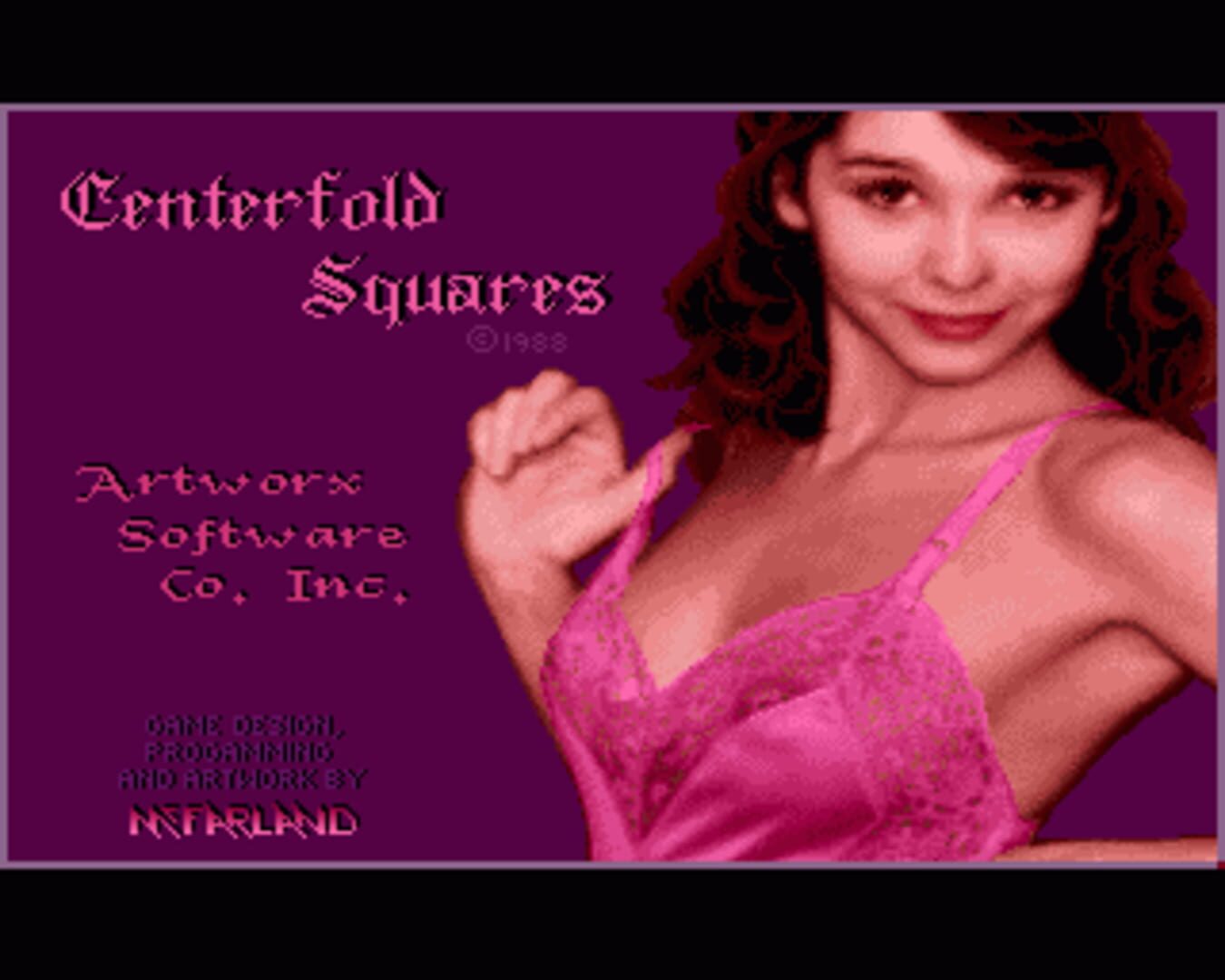
Centerfold Squares' digitized nude graphics were originally digitized in black and white, specifically 16 levels of grey, and subsequently colored digitally in a process referred to as 'Digitized Plus'. Doug McFarland, Centerfold Squares' designer, stated that camera filters were used "to achieve better contrast", and in addendum to the images being colored digitally, "all edges are retouched to eliminate any aliasing effects. The results are more vibrant colors, superior to conventional color digitizing." Centerfold Squares was originally planned to have ten female and two male models, but this was cancelled before release in lieu of twelve female models.
Reception
In a 1991 article covering the history of adult computer games by VideoGames & Computer Entertainment, Centerfold Squares was given as an example of adult games making use of advances in hardware capability; they stated that "Centerfold Squares began to rival newsstand men's magazines in eye appeal. A big reason more companies are now publishing sexy games is that the machines can finally generate the complex images needed to depict romance and sexuality."
Ahoy! reviewed the Amiga version of Centerfold Squares in an August 1988 issue, expressing that the game's sexual content is 'tasteful' as compared to other adult games, stating that "Bad taste and bad graphics, twin hobgoblins of "adult" computer games, are avoided by Centerfold Squares." Ahoy! praised Centerfold's graphics, calling them "a quantum leap ahead of any competing product", and expressed that the models in the game are attractive, stating that "The luminous skin tones, expressive faces, and physical beauty of the models is unimpeachable."


