The articlegameplay, story, development, reception
Gameplay
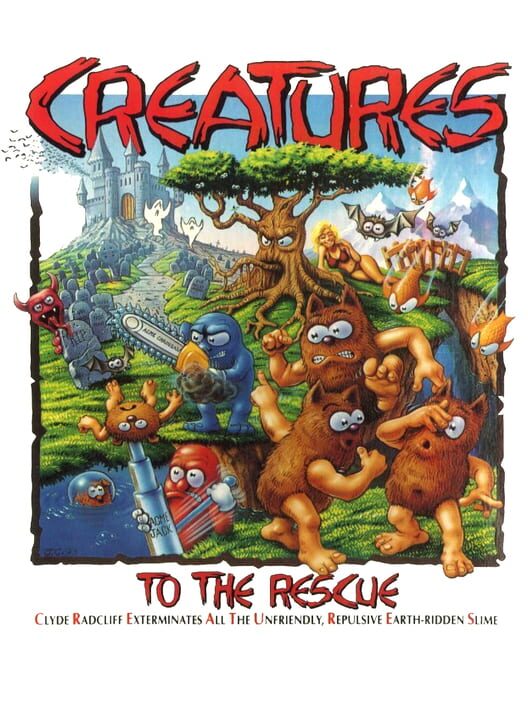
Basic gameplay consists of hatching some creatures, usually norns, and guiding them to reach maturity and to breed more creatures, with the goal of a more intelligent future population. Words can be taught to creatures by a learning computer (for verbs) or by repeating the name of the object while the creature is looking at it. After a creature understands language, the player can instruct their creature by typing in instructions, which the creature may choose to obey—the player gets the impression that the norns can understand the player, but do not want to follow the player's commands. The player cannot force creatures to do anything.
Addressing individual creatures by their names, and issuing specific commands, such as "Alice push toy", is recommended, as is following up with rewards if they obey: the player is represented by a disembodied hand in the world, and the hand can attempt to teach creatures by tickling them as a reward or punishing creatures by slapping them. (For Creatures Village, aimed at very young players, tickling is done by a feather wand, and punishment is represented by a squirt bottle.) Older norns can also teach concepts to younger norns. Norns may also express to the player how they are feeling.
The language aspect was incorporated to promote a relationship between norns and players, allowing players to anthropomorphise their creatures. Players usually actively administer their worlds, adding in objects to help their creatures thrive. A complete life cycle is modelled for the creatures—childhood, adolescence, adulthood, and senescence, each with their own particular needs. Breeding is depicted in the game as "a delicate affair", and is shown in the game by "a long kissing sound followed by a pop".
The gameplay is designed to foster an emotional bond between the player and their creatures. Death has real consequences—the individual norns do not return after they die. All creatures are bipedal, but there are some variant appearances that are genetically linked. Some alternate play styles include "wolfling runs", where the player may not intervene in their creatures' lives, or even norn torture.
Trying to selectively breed or engineer certain traits into the population is also popular, for example, coloured creatures, norns with a better immune system, or a less-aggressive grendel.
Norns
A Norn is an AIL (Artificial intelligent life) species, the development and survival of which constitute the main thematic elements of the program.
Norns are playful, all-trusting, naive creatures that love to explore. This is often the reason for their downfall, suffering, and death. They are more susceptible to disease in comparison to Ettins and Grendels, and in old age they may fall prey to a wasting disease that prevents them from absorbing certain nutrients.
Grand wished Norns to be endearing and for players to keep them as pets—that they should be independent and stubborn, like toddlers, that the design of the norn should be appealing to as many people as possible, and that the player should care about the norns. Reviewers have compared the Norns' visual design to the Mogwai of the Gremlins film series. The Shee originally created the Norns as a mixture of valet and pet. According to the Creatures Labs website, they spread across the galaxy through the Warp and evolved into various variations, including but not restricted to: Toxic Norn, Treehugger Norn and Magma Norns.
The spread of Norns throughout the galaxy is related to the mysterious disappearance of the Shee from Albia (from the point of view of the Norns). It may also be a sign of how the Shee fared in their attempt to find a habitable planet.
In the games, the Norns have their own simulated biochemistry, haploid genetics, and neural network to serve as a brain. From Creatures 2 onwards, Norns also possess organs determined by their genetics; mutation and injury can render these defunct, with typically fatal consequences. Each of these has grown somewhat over the course of the series, allowing the creatures to become more complex and intelligent. Norns are omnivores and eat a variety of foods, including carrots, lemons, seeds, insects, fish, honey, and other things.
The Norns that the player starts with require some degree of training and discipline from the player in order to make good decisions to maintain their health; however, later on they can evolve to be more independent and hardy, with better-developed instincts and a more robust biochemistry. The player can take advantage of this to breed certain colours or traits through artificial selection, and through many generations the changes can become quite pronounced.
Norns are very social animals, sometimes to the extent that they will prefer to play with other norns than to eat.
Shee
The Shee are a race of absent-minded scientists. They are the original inhabitants of Albia, and the creators of the Norns, Ettins, and Grendels.
The Shee are all inventors, and make most of their inventions to save time on tasks that would have taken but a few minutes otherwise.
Most of their discoveries are made by accident, and as such, they sequenced their own DNA and eliminated all genetic defects, before discovering the wheel.
Millennia ago, the Shee had left the disk-shaped world of Albia, as they desired to live on a "more spherical world". They created the Shee Ark, took along some Norns, Ettins, and various animals and plants, and set out for their new home. The Shee Ark, like all Shee spacecraft, was itself a living creature grown from scratch, and used "Bioenergy" (the energy of living things, used to balance the game) to perform its various functions.
Early concepts of the Shee had them as merely a more advanced life form than the Norns, not their creators.
Ettins
Ettins are a species in Creatures 2 and Creatures 3.
Ettins were created by the Shee to help them on their experiments, especially when using machinery. They made them like machines so much, they tend
Development
Originally conceived as a desktop pet with a brain, Grand later incorporated inspiration from The Planiverse to pitch a "little computer ewoks" game, like the game Little Computer People. Grand wanted players to have a rapport with their creatures, feeling that he should make the creatures seem "genuinely alive" to the player, showing "the 'right' kind of behaviour' in a variety of circumstances. To create this kind of behaviour, Grand felt it was necessary to program the creatures by simulating the building blocks of nature in a bottom-up approach, allowing the complex behaviour to emerge, rather than using a rule-based system approach. Grand later wished to include references to English and Norse mythology, to try to make the world more internally consistent, but found that the team wanted to make the game into a conventional adventure game. He later decided to scale back on the mythology aspects of the game, focusing instead on the artificial life point—eventually presenting the game as an artificial pet hobby, which provided some of the impetus to include genetics in the creatures.
Creatures was developed as a consumer product by Millennium, and was released by Mindscape in 1996. The program was instantly successful, and an online community of players soon formed, swapping Norns, creating new objects for Albia, sharing tips on how to play the game and anecdotes about unexpected evolutionary changes that they had seen, and even creating new breeds of Norn. At one point, the Creatures online community was the largest of its type.
In 1996, Creatures won an EMMA Award. Based on sales of 500,000 copies of Creatures from 1996 through to the second quarter of 1998, it was estimated that at that time, there was a possible global population of up to five million norns.
Development of Creatures 2 began in Q3 1997. In 1998, the video games division of Millennium was sold to Sony Entertainment while those working on alife and Creatures formed a new company called Cyberlife Technology. Along with continued work on the Creatures titles, the company did work for industry and the British Ministry of Defence, famously attempting to teach live organisms to fly virtual fighter jets. Creatures 2 was nominated in the Artificial Intelligence category of the Game Developers Conference's Spotlight Award.
In the late 1990s, Grand left Cyberlife to form Cyberlife Research and focus on the production of new alife technologies, including work on a robotic life form he called Lucy as well as writing books about his research. The remainder of the company was renamed Creature Labs, and focused on video game development.
Sequels to Creatures, including Creatures 2, Creatures 3 and the small-children's games Creatures Adventures and Creatures Playground, were released by Creature Labs in subsequent years. Creatures Adventures won an EMMA Award in 2000. Creatures Playground was exhibited at E3 and nominated for a BAFTA Award in 2000. The final major Creatures release, Docking Station, was made available for download from the company's web site in 2001.
Development was suspended on future Creatures games on March 20, 2003, when Creature Labs ceased operations, but development and trademark rights have since been purchased by Gameware Development, Ltd. Gameware has revived the Creatures Developer Network, the shop, the forums, the Docking Station server, and has released many before-purchasable tools and add-ons for free.
Gameware staff that previously worked on Creatures developed a convergent media game for the BBC called BAMZOOKi.
In 2004, the Creatures games have been re-released in combination packs under the names Creatures: The Albian Years (C1, C2), Creatures Exodus (C3, DS) and Creatures Village (CA, CP). The Albian Years, and Exodus include the separate games, whereas Village has merged Adventures and Playground into a single game. At this time, it was estimated that there were thousands of Creatures players.
Kutoka Interactive, a Canadian children's software company, has created releases of Creatures Exodus (Kutoka) and Creatures Village (Kutoka Kids) that are compatible with both Apple's Mac OS X and Windows XP. They were released on 30 September 2005, and can be purchased either directly from Kutoka or from other online stores.
In November 2009, GOG.com announced that they were offering Creatures: The Albian Years, Creatures Exodus and Creatures Village for sale on their site as digital downloads. In 2011, Creatures 3: Raised in Space, a PlayStation One game, was re-released on the PlayStation Plus service.
In 2011, Fishing Cactus announced they were developing Creatures 4, to be demonstrated at that year's Gamescom. A second demonstration was exhibited at Gamescom 2012. Creatures 4 is Fishing Cactus's most complex game to date. Creatures 4 appeared at the 2012 Paris Games Week.
1 Games as a distributor, and that the name of the game would be changed from Creatures 4 to Creatures Online. Another demo was shown at Gamescom 2013. Julien Hamaide, a developer of Creatures Online, presented about it at the Game/AI Conference 2014. In September 2015, Fishing Cactus halted the development of Creatures Online.
In 2016, Spil Games announced that they had bought the Creatures intellectual property from BigBen and were developing a free-to-play mobile game called Creatures Family to be released in 2017. In December 2021, Creatures 3, Docking Station, Creatures: The Albian Years and Creatures Village were released on the Steam games service.
Reception
As of May 2026, the Creatures Community, also referred to as CC, is still active online.
The CC hold a "Creatures Community Spirit Festival" abbreviated to CCSF every year, in order to celebrate the games and the community that has formed around them. The games were made to appeal to a wide audience, with players often ranging in age. The online community continues to archive and document the history and surrounding information of the game
Several reviews of the series emphasize that the player would need patience, and it was often recommended for players who were not parents.
The early games did not have specific goals, leading some reviewers to consider it a 'small scale genetic experiment' rather than a full game. One reviewer compared the game to a 'virtual fish tank', feeling that once the frustration of raising norns through their childhood was over and a breeding population had been established, the game had become boring.
Several reviewers compared Creatures favorably to Tamagotchi when the game first came out.
Between July and November 1997, over 100,000 copies of Creatures were sold in the American market. Windows Sources magazine gave the series a "Stellar Award".
Jay Schindler, a game reviewer, speculated if the game was meant to be entertainment or, instead, a simulation of parenthood. Schindler criticized the inability to scroll all the way around the world, as well as noted that raising a group of norns was much more difficult than raising a single norn, due to the fact that they could interact with each other with much greater ease than the player could interact with a norn.
Don Labriola, another game reviewer, wrote of Creatures that "no other program so successfully mirrors the joys and challenges of raising a child or pet."
In 2016, the Creatures series was featured by an academic study into science-themed video games as depicting an accurate model of evolution and natural selection, displaying three key features of the process.