The articlegameplay, story, development, reception
Gameplay
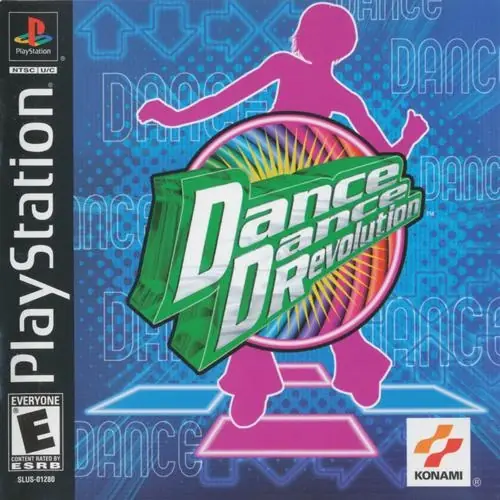
The objective of Dance Dance Revolution is to move one's feet to rhythms and patterns displayed on a screen.
Players must step to the beat, matching the arrows presented to them on screen by stepping on arrows on a dance pad. Arrows come from the bottom to the top towards a set of stationary arrows known as the "Step Zone". If they reach it, players step on the pad and the game will then judge the accuracy of the timing, ranging from "Perfect", "Great", "Good", "Boo", to "Miss". An on-screen life meter, known as the Dance Gauge, begins halfway full at the start of each song.
Perfect and Great steps slowly fill the Gauge, while Boo and Miss steps quickly deplete it. Good steps have no effect either way. If a player accumulates too many Boos or Misses, and the Dance Gauge becomes empty, the song fails and the game ends. The game also tracks a combo tally from 4 combos upward, which will break if players score Good or lower.
At the end of each song, players see their accumulated points, bonus points, and how many of each kind of step they made. They also get a letter grade that is dependent on the judgments received during play, ranging from SS, all steps Perfect, to E, failure, which is only seen in Couple mode when the other player passes. If players manage to pass all their songs a cumulative results screen is given, totaling the stats from all played stages.
The game offers three play styles: Single (one player plays on a single dance pad), Couple (two players play with a unified stepchart spread over two separate dance pads), and Double (one player plays on two dance pads, stepcharts are different compared to Single), the last of which requires a step code to be entered. After selecting a play style, players will be prompted to select a game mode out of three: Easy, Normal, and Hard. Normal and Hard are the main bulk of the game and offer different set of songs. Easy, which has the same song selection as Normal, limits players to one stage but enables them to play to the end of the song even if the dance meter is completely depleted.
After choosing a mode, players will be taken to the song selection, which takes the form of a jukebox-like menu of CDs that represent the available songs. On this screen, various step codes can be entered on the dance stage to adjust the game. Single Play offers two different difficulty levels per song. These levels, known as "Basic" and "Another", may be set while selecting play style or by entering step codes during the song selection.
Each difficulty is rated on a scale of 1 to 7, each labeled with a name: Simple (1), Average (2), Novice (3), Expert (4), Professional (5), Genuine (6), and Hero (7). Another step code enables the "Mirror" option, which rotates each arrows to their opposite directions. Players may play anywhere from one to five songs, depending on how many the arcade operator sets the machine to play each game. Players start with 6 song options and cannot choose the same song twice within the same credit.
If they manage to fill the dance meter to maximum in Final Stage while playing Basic difficulty in Single Play, players will be granted access to Extra Stage, where they may choose another song set to Another difficulty. A new song will also be added, which varies depending on whether players selected Normal or Hard modes.
During gameplay, 3D dancing characters appear in the background of each song. Different characters can be selected at the main title screen by standing on either the left or right arrow panels while pressing the select button.
An update, titled "Internet Ranking Version" and popularly known as "DDR 1.5", was released on November 18, 1998 and is by far the most common version of the game. As the name suggests, the game's main purpose is to rank scores online. After a playthrough ends, the game gives a code which can be inputted to the official website for high score purposes.
The game also adds two new songs and numerous different changes to the gameplay. A new addition is Versus Play, which requires two credits and a step code to activate. It is a two-player mode, similar to Couple, but rather than playing on a unified stepchart, each player plays their own stepchart, though they still have to select the same difficulty level. Two difficulty levels are added: "Maniac" for Single Play and "Another" for Double Play.
It is possible to access Extra Stage by clearing Final Stage on Single Another or Double Basic, which will lead Extra Stage to be played on Single Maniac and Double Another, respectively. The difficulty scale is increased to 8, labeled "Exorbitant", and some of the other labels are renamed; Moderate (2), Ordinary (3), Superior (4), Marvelous (5), and Paramount (7). Finally, arrows now disappear within the Step Zone if players score Perfect or Great (the original version made no distinction regardless of timing), which has since become a staple in the series.
Reception
In Japan, Game Machine listed Dance Dance Revolution on their December 1, 1998 issue as being the most-successful dedicated arcade game of the month. Along with its 2ndMix update, Dance Dance Revolution became the highest-grossing dedicated arcade game of 1999 in Japan. The game sold over 10,000 arcade cabinets by 1999.
The PlayStation version sold 1.27 million units in Japan and 135,048 units in the United States, for a combined 1,405,048 units sold.
Blake Fischer reviewed the PlayStation version of the game for Next Generation, rating it four stars out of five, and stated that "If you're looking for a fresh new experience with your PlayStation that's tons of fun and will make you the life of the party, this is your game. Just expect a rough learning curve."
On release, Famitsu magazine scored the PlayStation version of the game a 31 out of 40, and the Dreamcast version a 30 out of 40.
On release, Famitsu magazine scored the game a 34 out of 40. The successful DDR series began with the 1998/1999 release of this game, and its popularity can be attributed to the innovative connection between a dancing stage and the need for the player to move their body to match the instructions on the screen.
In 2022, The Strong National Museum of Play inducted Dance Dance Revolution to its World Video Game Hall of Fame.