The articlegameplay, story, development, reception
Gameplay
The interface used is a recoloring and smoothing of the song wheel interface first introduced in Dance Dance Revolution 5thMix, with the addition of changeable sort settings and a longer time limit. Core gameplay remained mostly the same on 6thMix and 7thMix, with the addition of Freeze Arrows and a new scoring system:
Freeze Arrows appear as green arrows with a long extension. K. is scored. G.
(no good) is scored. Freezes affect the life bar. Scores are calculated with 2 distinct scoring systems, the long-score system used to determine rankings, and an independent dance point system (known on later games as EX SCORE) now used to determine the grade.
All songs have a long-score ceiling of 50 million points, and a bonus score is tacked onto it based on the difficulty of the song and other factors. Rankings are given for the highest long-score accumulations a round. If a player plays more than three songs, then it only counts the last three played. If a song is played repeatedly among the three songs used for ranking, then the repeated songs carry no bonus score.
The dance-point system uses raw step values to determine the grade. A 'perfect' step adds two points, a 'great' step adds one point, a 'good' step is worth nothing, a 'boo' step takes away four points, and a 'miss' step takes away eight points. K.' G.'
freeze is worth nothing. The dance points are also tied to the life bar. As always, if a player takes too many bad steps and depletes the life bar, they will fail, and the game will end immediately. If the first song is in Light mode, then the game will allow a player to fail that song and continue, but will fail the player out if they fail a second song.
In two-player games, if one player fails, they can continue dancing, but it ceases to accumulate dance points for the failed player, accumulates score points at only 10 points per step, and automatically gives the failed player an 'E' for the song.
The grade is dependent on the number of dance points accumulated: 100% dance points is 'AAA', at least 93% is 'AA', at least 80% is 'A', at least 65% is 'B', at least 45% is 'C' and anything below 45% is a 'D'. If a net dance-point total of zero is obtained without depleting the life bar and, thus, failing, an 'E' is awarded. The final grade for the entire game is an average of the grades from the last three songs and not derived from the actual dance points scored.
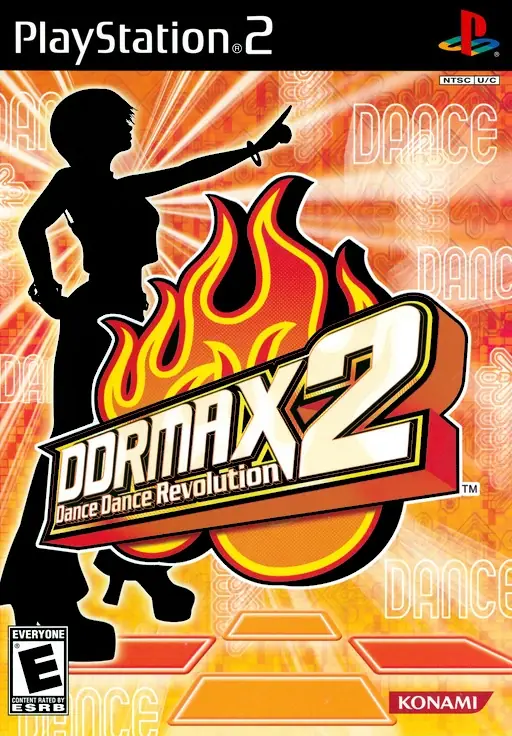
This 2-tiered scoring system is still utilized on DDRMax2, though the long-score system is reformed. For the long-score system in DDRMax2, it now has a maximum for each song of 10,000,000 multiplied by the foot rating for the routine. Maximum scores can range from 10 million to 100 million for individual songs. Bonus scores are abolished, though the new long-score system tends to be weighted so that errors early in a routine are not as costly as errors late.
The dance point system, which determines grade, remains unchanged. This scoring system would be kept for Dance Dance Revolution Extreme.
6thMix was intended to be the Next Generation of Dance Dance Revolution. As such, there are many changes. First, the difficulty levels were renamed. 'Basic' was renamed 'Light', 'Trick' was named 'Standard', and 'Maniac' was named 'Heavy'.
They are also given Japanese difficulty names in conjunction: 楽 (raku), 踊 (you), and 激 (geki), respectively. Their color codes—orange, fuchsia and green, respectively—remain the same. Also, all songs from previous versions have been removed in 6thMix (although the prototype version of this game had some songs from previous DDR versions), intending the game to start from scratch. Many past songs do return on 7thMix and later releases, however.
Dancing characters have been removed in 6thMix, 7thMix and Extreme. Instead, the arrows scroll over clips of full motion video, hence the game does not render any polygons. The screen refreshes at a full speed of 60 frames per second. In addition, the arrows themselves have been tweaked too, now having a rounded edge on their outer tip rather than the V-shaped cut used in all previous games.
These games retain the Song Wheel interface introduced in 5thMix, but add an easier method to enter modifiers. In previous versions, modifiers like "Sudden" or "Shuffle" required a combination of dance steps. Beginning in 6thMix, a player only needs to hold the Start button when they select a song to bring up a full menu of available modifiers, including the ability to speed up or slow down the scrolling of arrows, and a final chance to select the song difficulty they wish to play.
A new options menu accessed by holding down the Start button when selecting a song debuted on 6thMix, and is retained on future mixes.
Some of the available modifiers include Speed mods, which change the arrow speed. Boost, which causes the arrows to accelerate as they near the step zone, Appearance, which changes the appearance of the arrows. Turn mods modify the stepchart itself, Other affects the difficulty of the steps, Scroll changes the scroll direction of the arrows, and Freeze Arrows can also be turned off.
New to 6thMix is the "Extra Stage", where players are rewarded for meeting conditions set by the game. If a AA is scored on the final stage on Heavy mode, a message inviting the player to "Try Extra Stage" is shown instead of the Cleared graphic. For the Extra Stage, the song wheel is locked on "MAX 300", and the song is played with several forced modifiers, including 1.5x speed and Reverse. The song is also played in Pressure mode, where the dance gauge starts filled, and can only go down.
If the player scores a AA or higher on the Extra Stage the game again rewards them with "One More Extra Stage". This time, the song wheel is locked to "CANDY☆", an easier song but with more difficult Modifiers. The exact same modifiers are used, but the
Reception
The PlayStation 2 release of DDRMAX Dance Dance Revolution received favourable reviews. GameSpot gave it a 7 out of 10 rating. IGN gave it a 9.3 out of 10. Its sequel, DDRMAX2 Dance Dance Revolution, also received "generally positive" reviews according to video game review aggregator website Metacritic.
By July 2006, the PlayStation 2 version of DDRMAX2 Dance Dance Revolution 7thMix had sold 750,000 copies and earned $28 million in the United States. Next Generation ranked it as the 84th highest-selling game launched for the PlayStation 2, Xbox or GameCube between January 2000 and July 2006 in that country. Combined sales of Dance Dance Revolution released between those dates reached 5 million units in the United States by July 2006.