
The articlegameplay, story, development, reception
Gameplay
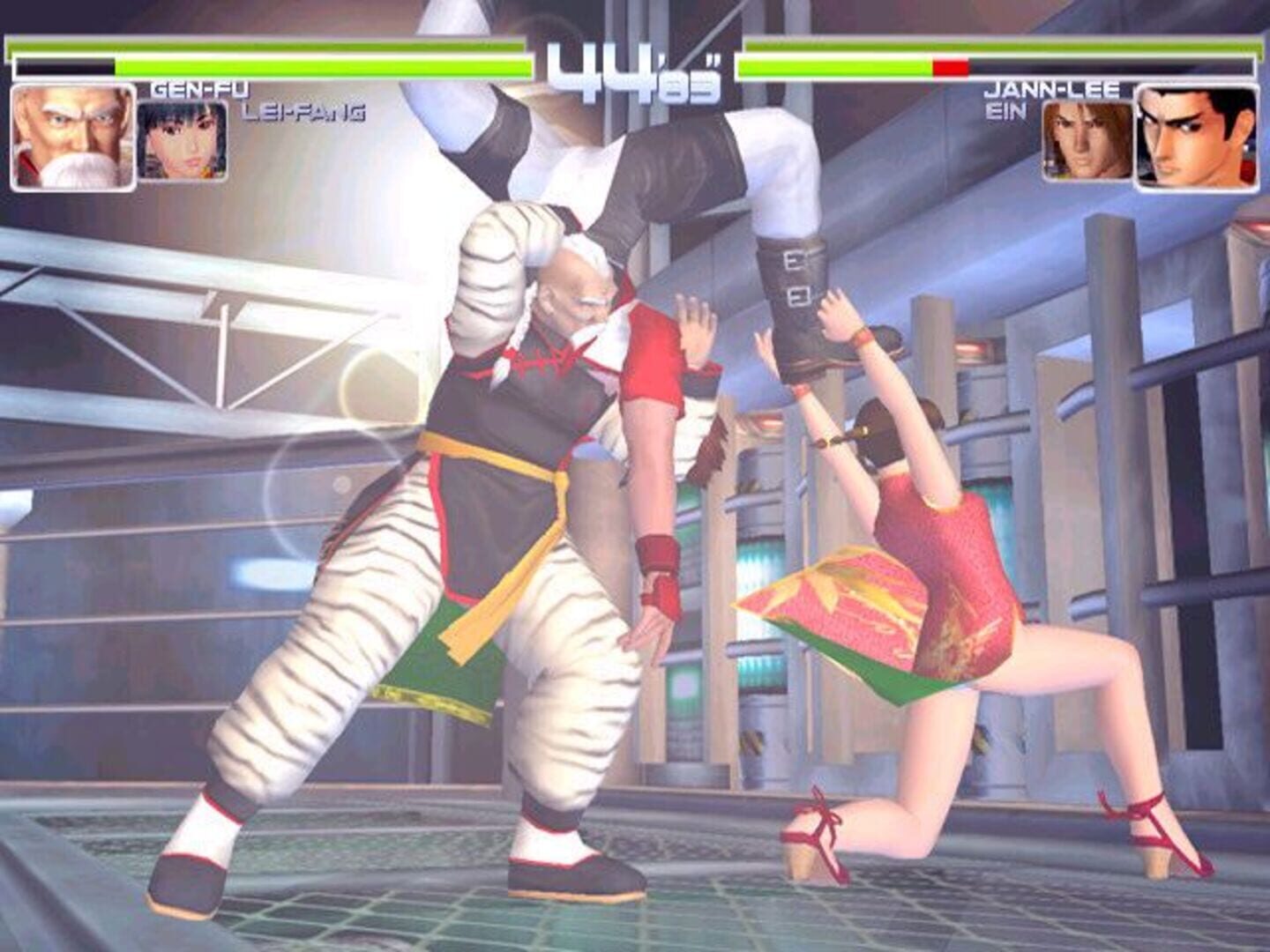
Dead or Alive 2 takes after its predecessor in gameplay, retaining its speed and reaction time-focused combat. The two kinds of hold, Offensive Hold and Defensive Hold, return; the latter are executed by holding back or forward on the directional pad along with the guard input to either force away or counter-damage an opponent. The "danger zones" from the original are removed in favor of more interactive areas.
One unique addition in DOA2 is that fights can occur on either water or ice; when a character is on such a surface, all non-knockdown, non-launching attacks will induce a stun on any successful hit. Walls and falls in the middle of stages are everywhere in the game. There are also some walls that are either electrified, or booby-trapped, clearly causing significantly more damage when a character is slammed into a wall by either a knockdown blow, a throw, or a hold, thereby encouraging such attacks to the wall. Many stages have multiple floors: to get to other floors of the stage, one character must be knocked off a ledge and fall into the next area. These falls deal usually high damage, but not enough to knock the opponent out.
DOA2 also introduced a new mode called Tag Battle Mode which implements a Tag team fighting system that allows players to choose two fighters to form a team, and fight against another team controlled by either the computer, or by other players. Tag Battle Mode allows characters to switch back and forth instantaneously for combo attacks and even attack simultaneously when timed correctly. Special throws unique to every possible pair, Tag Throws, do a great amount of damage to the opponent. There are no limitations for the choice of fighters, allowing for a multitude of unique gameplay styles.
Other notable features include computer animated cutscenes, allowing players to juggle each other into walls, propelling characters from landmarks for more damage, and upon completing the game, presenting the player with somewhat ambiguous endings for the character chosen using the game's standard engine.
Story
Fame Douglas, founder and CEO of DOATEC was killed at the end of the 20th century. He was renowned as the sponsor of the legendary Dead or Alive World Combat Championship. After his death, the world began to become chaotic. In the middle of the chaos, it was announced that the second Dead or Alive World Combat Championship will be held.
The purpose and significance of the tournament changed after Douglas' death. The promoter of the second Dead or Alive Championship, who is fond of conflicts and jealous of the strong, is responsible for Douglas's death. The new promoter, Victor Donovan, is more than a corrupt mastermind, but a man of pure evil. His involvement in the tournament began to bring a sense of terror to the world, resulting in the infamous tengu disaster.
Set less than a year later after the original tournament, an evil tengu known as Gohyakumine Bankotsubo, or just Tengu, escapes from the tengu world and threatens the human world's peace and stability. Tengu considers all functions of the human world to be insignificant, and claims that all disasters are nothing more than illusions he has brought about. Kasumi, who won the first tournament was captured by the DOATEC Super-human Development Project and was unwillingly used in the organization's attempt to develop a physical body with superhuman abilities. Kasumi escapes, but her clone "Kasumi X" was created while she was being held captive.
Kasumi's brother Hayate, previously injured by Raidou, was also captured and was unwillingly used as a subject of DOATEC's bio-weapon experiment, Epsilon. Modifications were made to Hayate's nervous system, but failed to produce an improvement in the project. As a result, the experiment became a failure.
Ryu Hayabusa (from Ninja Gaiden) enters the tournament vowing to seek and destroy the evil tengu. Though a dangerous, suicidal task for any ordinary man, Hayabusa owes it to himself and to mankind to confront his fate. Hayabusa tries to warn other competitors like Jann Lee about the dangers of the tournament, but finds them unwilling to backdown, so he proceeds to knock them out of the tournament. He later meets a competitor named Ein, who is actually the missing Hayate suffering from amnesia.
During their fight, Hayabusa defeats him and restores some semblance of his memory. Eventually, Hayabusa comes face to face with the evil Tengu. He defeats and kills Tengu, winning the tournament.
Development
The gameplay and graphics were enhanced and based on a better game engine than the one used in the first game, as all resources went into the characters and the stages. Running on the Sega NAOMI arcade board, it allowed the characters and stages to appear less angular and more detailed. Wanting to emulate gorgeous scenes of martial arts movies, Tomonobu Itagaki and Team Ninja went so far to invite professional martial artists to perform motion capture, making the characters' moves smoother, and developed multi-tiered stages where opponents can be knocked off edges of landmarks down to lower levels where the fight continues.
In a June 1999 interview with German magazine MAN!AC, producer Tomonobu Itagaki revealed that the development team consisted of approximately 40 people, fewer than ten of whom were programmers, with the remainder primarily responsible for design. He explained that the Sega NAOMI arcade hardware significantly accelerated development compared with the Sega Model 2 system used for the original game. Whereas testing a prototype on Model 2 required approximately a day to prepare a flash ROM and install it in an arcade cabinet, prototypes could be tested on NAOMI within two to three hours. Itagaki also stated that some character animations were created manually, while others employed motion capture, including performances by a female model. He cited the waterfall in The Legend of Zelda: Ocarina of Time as an inspiration for the game's waterfall stage.
During development, Team Ninja revised the game's control system, introducing a dedicated "Free" (F) button for defensive actions and movement. In September 1999, Dreamcast Magazine highlighted the new Free Step mechanic, which allowed fighters to move in eight directions around their opponents, encouraging players to make greater use of the interactive environments. The revised Defensive Hold system also allowed players to counter different types of attacks, although unsuccessful counters could leave them vulnerable.
Ahead of the September 1999 amusement-machine show, Team Ninja discussed the arcade version's presentation with Dreamcast Magazine, emphasizing its use of the NAOMI hardware for enhanced graphics and sound. The team described the game as effectively complete at the time of the demonstration.
Dead or Alive 2 features the song "Exciter" by Japanese punk band, Bomb Factory, in its opening sequence. Also used as background tracks are "Deadly Silence Beach" and "Clumsy Bird". Both "Exciter" and "Deadly Silence Beach" can be found on the self-titled mini-album, Bomb Factory, and on the Dead or Alive 2 Original Sound Trax ~PlayStation 2 Version~. "Clumsy Bird" can be found on the album, Break Up.
Reception
Dead or Alive 2 was "universally acclaimed", scoring 91% and 91/100 on GameRankings and Metacritic. In Japan, Famitsu scored the game a 34 out of 40.
Dead or Alive 2 brought more than a profit of 2 million dollars. In Japan, Game Machine listed Dead or Alive 2 on their December 15, 1999 issue as being the second most-successful arcade game of the month. The PlayStation 2 version would top the Japanese charts on release, coming in number 2 during Week 14 in 2000. The Dreamcast version also top the Japanese charts on release, coming in number 2 during Week 40 in 2000.
In Spain, the Dreamcast version of Dead or Alive 2 ranked second on video game retailer Centro Mail's sales chart in the September 2000 issue of Revista Oficial Dreamcast, before rising to first place in the October issue. 5 million units. The PlayStation 2 versions were re-issued as part of the low price-categorized "The Best" and "Platinum" line of games in 2001.
Dead or Alive 2 is considered one of the best fighting games in the genre in terms of gameplay and expanded game modes. On GameRankings, the Dreamcast version was met with universal acclaim, while the PS2 version was very well received, and received universal acclaim on Metacritic. Famitsu scored the Dreamcast version 32/40 and the PS2 version 34/40. Both versions were praised for its graphics, cutscenes and gameplay. Main criticism was the poor English voice dub used in the updated version for the PS2 titled DOA2: Hardcore, much like other English dubbed-Japanese video games.
For the original Dreamcast and PlayStation 2 versions, Greg Orlando of Next Generation rated it 5 stars out of 5, and stated that "You'd have to be Dead and Buried not be enjoy Dead or Alive 2. Gorgeous graphics, excellent gameplay, and some beautiful characters put this square in the running against Namco's Soul Calibur as the best Dreamcast fighting game." Jeff Lundrigan of Next Generation also rated it 5 stars out of 5, and stated that "This is a tremendous game and a must-have, but if you can choose between the two versions, PS2 enjoys an edge thanks to all the extras – just get used to squinting at the too-bright lights and nasty jaggies." 7 out of 10, giving praise to the gameplay, beautiful animation and environments, calling Dead or Alive 2 "the hardest hitting game in town" and "a must, must buy".
Mielke called the fast combat the best thing about Dead or Alive 2, also praising the game's Tag Battle mode and stating how "no other 3D (or even 2D) fighter matches DOA2 for sheer intensity and speed. This game is for hard-core gamers only." Overall, calling Dead or Alive 2 "superb" and "excellent".
For the Hardcore version, Jeff Lundrigan of Next Generation rated it 5 stars out of 5, and stated that "This is the best-looking, most full-featured, most packed-with-extras version of one of the best fighting games ever made. Buy it, period." 7 out of 10, calling DOA2: Hardcore "the best version around", stating how he always preferred Dead or Alive's speed, balance, character design, and levels, even if Tekken may be the majority choice. 9 out of 10, saying how the game "looks simply amazing", and that "the animation is smooth, but the character models are what really stand out".
Game Pro rated DOA2: Hardcore 5 out of 5, calling it a must have PlayStation 2 game for fighting enthusiasts. Hot Games called it "One of the best looking fighters so far for the PS2, it eclipses Street Fighter EX3 and Tekken Tag Tournament for beauty." and stated how "It's also a pick-up-and-play fighter, making it one of the most fun as well." GameSpy states how DoA2: Hardcore's innovative style of play, coupled with blazing fast graphics makes it a title to own.
M. Vargas of PSX Nation gave it an 8 out of 10, stating that DOA2: Hardcore "takes better advantage of the PS2 than Tekken Tag Tournament, IMHO, with incredible physics, realistic fighters and fast action not seen in any other modern brawler".
During the AIAS' 4th Annual Interactive Achievement Awards, Dead or Alive 2 was honored with the "Console Fighting Game of the Year" award, and also received a nomination in the "Animation" category. IGN awarded it "Best PS2 Fighting Game of 2000" during their Best of 2000 Awards. The game was nominated for "Best Fighting Game" at E3's Game Critics Awards. Hardcore was a runner-up for GameSpot's annual "Best Graphics, Technical" and "Best Fighting Game" awards among console games, but lost respectively to Shenmue and Capcom vs. SNK: Millennium Fight 2000.
Legacy
Dead or Alive 2 was notable for improving and popularizing the concept of multi-tiered environments, also known as stage transitions. The game took the concept to a new level, creating a more interactive and engaging gameplay experience. Its interactive multi-tiered environments offered all kinds of interactive features that made the game feel alive. The way the intensity of the action triples when knocking opponents off of edges such as cliffs or out of windows, then leaping down after them and continue fighting down below made the experience feel very dynamic, strategic and rewarding.
GamesRadar+ included Dead or Alive 2 on their list of best Dreamcast games, stating that "Dead or Alive's first sequel used separate graphics engines for its fighting and cut-scenes, allowing for unprecedented graphical fidelity." com ranked it as the ninth top fighting game of all time, "perhaps most important for introducing Itagaki's famous breast physics engine." In 2020, TheGamer ranked DOA2: Hardcore "2nd best launch game for the PS2", calling the combat "lightning fast, and easy to pick up with counters and reversals that work better than any other fighter", also stating how the character animations are "smooth and fluid and move around the 3D space more naturally than similar titles like Soul Calibur", and stating that it visually "looked a generation ahead of games like Tekken Tag Tournament and Street Fighter EX3."
Dead or Alive 2 appears in the 2002 film Run Ronnie Run, where the character, Jerry Trellis (portrayed by E.J. De la Pena), is shown playing the game as Kasumi in two different scenes and as Gen Fu in one scene. Near the end of the film, Jerry uses some of Kasumi's moves in a real fight. The game also appears in the 2002 film One Hour Photo, where the character, Jake Yorkin (portrayed by Dylan Smith), is playing the game in his bedroom.