
The articlegameplay, story, development, reception
Gameplay
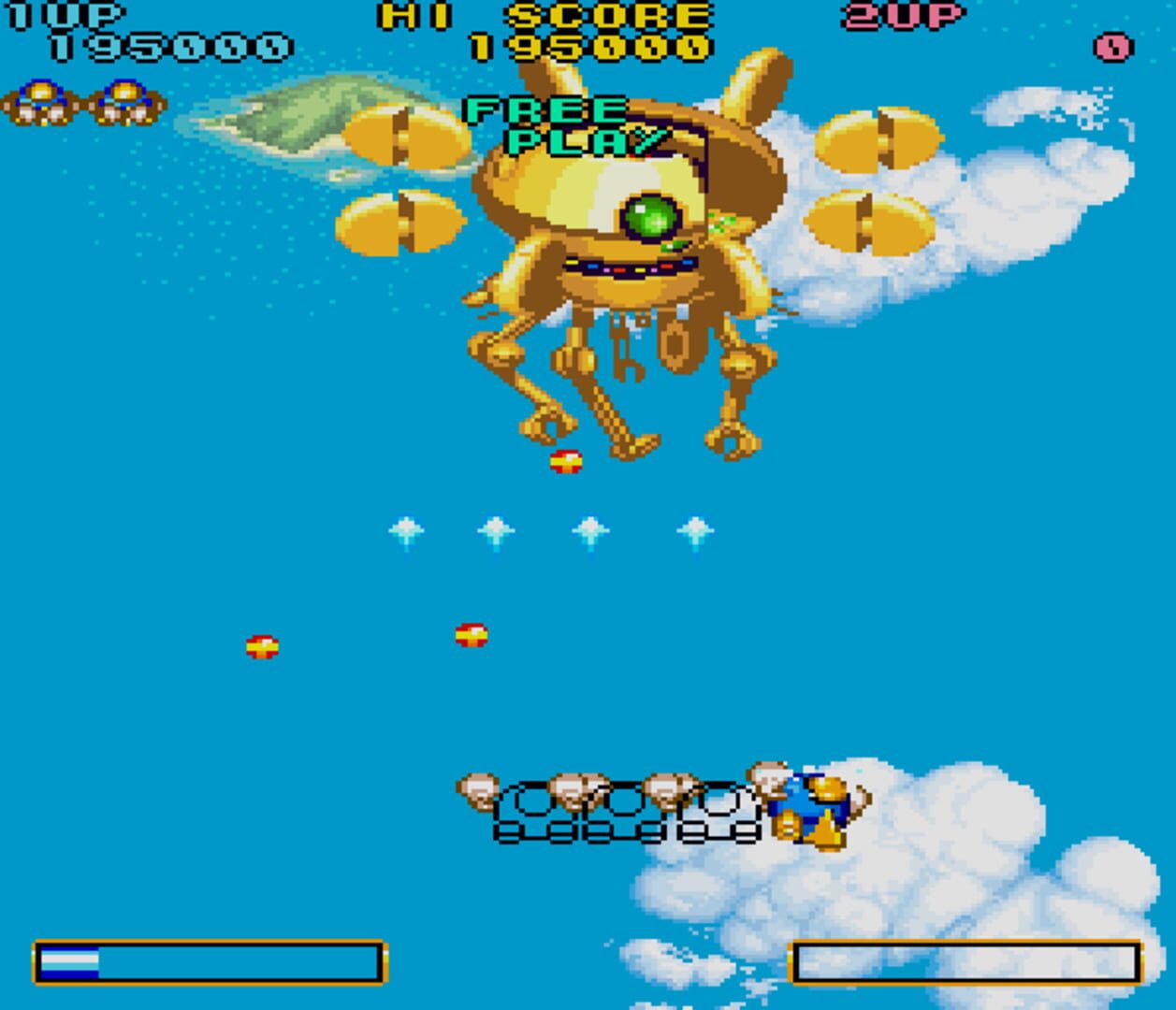
Detana!! TwinBee is a vertically scrolling shooter game following the same conventions established in the original TwinBee, where players assume the role of Light and Pastel (whose names are given in the audio drama TwinBee Paradise) taking control of TwinBee (P1) and WinBee (P2) across seven levels to defeat invading forces of the evil alien Iva and save planet Meru after receiving an SOS message sent by Princess Melora.
The control configuration differs between regions; in the Japanese version, one button is used to fire the gun at airborne enemies while the other is used to drop bombs to the ground, while both buttons are used to do shoot and drop bombs at the same time in the European version. Holding down the shot button will cause a power-meter at the bottom of the screen to fill up, allowing the player to fire a "Big Shot" attack when releasing the button. Power-up items consist of bells which can be uncovered by shooting the floating clouds, as well as items uncovered by destroying land enemies. As with TwinBee, players can shoot the floating bells to change their colors. Besides the five different colors from the original TwinBee (yellow, white, blue, green, and red), two new bells are introduced: a purple bell that provides a "tail shield", activating barriers around the player's ship and a black bell that decreases speed of the ship.
Mini-bells and the lucky star from the first TwinBee return as well. GwinBee, a ship similar to TwinBee and WinBee also appears, allowing players to combine their ship with GwinBee to fire wider fire beams. Two players can also align their ships side by side to achieve the same effect or align their ships vertically for a powerful five-way spread. If both players align their ships with GwinBee between them, he will spring out and destroy all on-screen enemies.
After the first loop is completed, players can replay it for a harder second loop. The game will be entirely over if the final stage is cleared again, but running out of lives results in a game over unless players insert more credits into the arcade machine to continue and receive a "free" power-up.
Development
Detana!! TwinBee was created by most of the same team that worked on several projects at Konami such as the Gradius series, with director Masato Ohsawa leading its development and Toru Shimomura served as sole programmer of the game while Hiroshi Matsuura also served as engineer. Ryouhei Shogaki, Hiroyuki Ashida and K. Ishimoto acted as co-designers.
Ha) in his first project as game designer, serving as character illustrator for subsequent installments of the TwinBee series. Konami Kukeiha Club members Hidenori Maezawa, Masae Nakashima and Michiru Yamane scored the soundtrack. Yamane said that she wrote the music as colorful and fun to match the "cute bee world" of the project.
Reception
In Japan, Game Machine listed Detana!! TwinBee as the third most popular arcade game of March 1991, while Micom BASIC Magazine listed it as the sixth most popular game of May 1991. Both Martin Gaksch and Heinrich Lenhardt of German magazine Power Play regarded the game to be a nice vertical-scrolling shooter with enjoyable candy-colored visuals. Maurizio Miccoli of Italian magazine Computer+Videogiochi gave the title a positive outlook.
Gamest gave it several awards for the 5th Gamest Grand Prize (1991), winning 3rd place in the Grand Prize, 1st place in the Best Shooting Award, 4th place in the Best Graphic Award, 3rd place in the Best VGM Award, 5th place in Player Popularity and 8th place in the Annual Hit Game. X applauded the X68000 conversion for its arcade-accurate graphics and sound, among other aspects. X but losing against other titles such as Parodius Da!.
The PC Engine port received positive reception from critics who reviewed it as an import title. Public reception was also positive: readers of PC Engine Fan voted to give Detana!! 79 out of 30 score, ranking at the number 19 spot in a poll, indicating a large popular following. Both Kaneda Kun and François Hermellin of Consoles + praised the PC Engine conversion for its colorful graphics, sympathetic music and impeccable gameplay but criticized the presentation.
Four reviewers of Famitsu gave the PC Engine version a score of 24 out of 40. Computer and Video Games's Frank O'Connor commended the PC Engine port for its arcade-accurate presentation and gameplay but criticized the music for being annoying. AllGame's Kyle Knight gave positive remarks to the imaginative boss designs and enjoyable gameplay but noted the audio design to be a mixed point on the PC Engine release. Olivier Prézeau of Joypad and Joystick's Jean-Marc Demoly praised the PC Engine port for its graphics, sound and controls as well.
Reviewing the Virtual Console re-release, Nintendo Life's Corbie Dillard praised its responsive controls, arcade-accurate visuals and upbeat soundtrack. IGN's Lucas M. Thomas commended its anime-inspired world and co-op play feature. Eurogamer's Dan Whitehead compared it with Xevious, stating it was not as good as MUSHA nor as cute as Fantasy Zone but regarded it as an appealing vertical-scrolling shooter for casual players.
A clone of Detana!! TwinBee for the Amiga titled Gunbee F-99 was published as a covermount alongside the December 1998 issue of Amiga Format magazine.