
The articlegameplay, story, development, reception
Gameplay
0 features similar gameplay to Disney Infinity. Each character can equip a "Pack" or a "Tool". Packs are items that are worn and can be equipped on a character's back, occasionally shown as some sort of backpack. Tools are items, such as rifles, that can be equipped in a character's hand.
Some aspects of the game, however, have been changed. In addition to ground movement, certain characters can fly and hover. The size of Toybox worlds and Playset has been increased, notably due to the inclusion of flying. Certain characters can climb walls, including the Hulk.
The level cap of playable characters has been expanded from Level 15 to Level 20. Characters can be "leveled up" by collecting sparks. A "Skill Tree" has been incorporated into the game and can be used to upgrade a character's abilities. The figures from the first game also receive additional abilities through the Skill Tree.
The choices made in the Skill Tree are semi-permanent, as players have the option to reset the Skill Tree choices by resetting their character to Level 0. Some characters can jump long distances, including Hulk. Each character plays differently from another, with characters being roughly divided into two categories, Ranged and Melee. Ranged characters fight from far distances, while Melee characters fight using close combat.
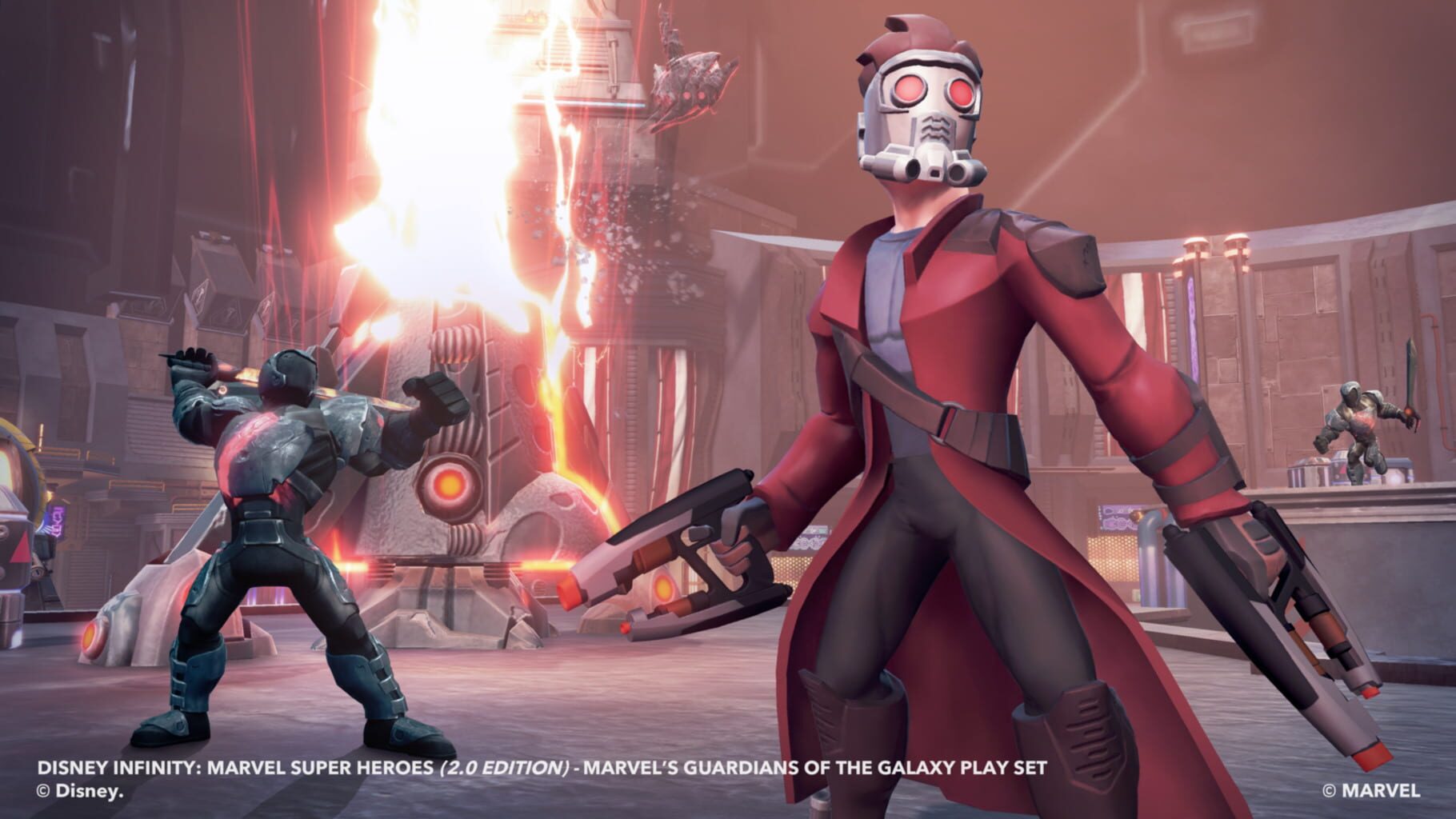
Signature moves can be unlocked as the player progresses. For example, Drax primarily utilizes short-ranged melee attacks to defeat enemies, while Star-Lord can use ranged pistols. As characters are leveled up, new abilities will be unlocked. Iron Man's ground slam and Hulk's Thunderclap abilities can be unlocked once players have enough Skill Points.
Characters' upgrades differ. Iron Man can upgrade his blasting capabilities, while Thor and Hulk can upgrade their strength, using the new Special Skills and Combat system. All upgrades, skills and progress applied to the character will be saved to the figurine. 0 replaces the roulette-based unlock system from Disney Infinity.
If a player is defeated in-game, they must wait a certain time frame until they can use the character they were using again. A map scanner has been implemented to allow players to get around worlds more easily. Mission givers are also present in the game. In order to web-sling players do not need to attach their webs to surroundings near by.
0.) In Playset mode, players can play open world multiple story modes based specifically on a certain franchise. Each Playset spans from 6–10 hours in length. These Playsets can be accessed by placing the Playset piece (also known as a crystal shard piece) on the Disney Infinity Base, a near field communication-enabled hexagonal platform that has two round spots to place figures (and use them in the game) and one hexagonal spot to place the Playset piece or Power Discs.
Only figures, usable in the game through near-field communication technology, that are from a Playset's corresponding franchise can be used in that Playset. Certain characters, including Nova, Iron Man, Rocket Raccoon and Hulk are playable in more than one Playset, by collecting tokens (called "Cross Over Tokens") scattered throughout levels. Once players have collected ten Cross Over Tokens for one character, that character can be used in another Playset and will unlock exclusive storylines. The Avengers Playset and the Spider-Man Playset take place in "Marvel Manhattan", a version of Manhattan that is 4x larger than The Incredibles Playset featured in the first Disney Infinity title.
The Incredibles Playset was the largest environment in Disney Infinity. While in Playset mode, players can uncover secret missions and new goods that can be used in the Toybox. Bendis penned the stories and dialogue of all future Marvel Playsets. Local multiplayer can be accessed through split screen.
The latter game mode, Toybox mode is a sandbox mode that allows players to create their own games and worlds, using items unlocked in Playset mode. Certain characters, including Tinker Bell, cannot be played inside Playset mode and only in Toybox mode. Toybox mode supports local and online multiplayer. In Toybox mode, players are given a "Magic Wand", which can be used to place items around the sandbox, customize items and access the Toy Shop (a virtual shop where players can purchase new items for use in the Toybox).
The Magic Wand can also be used to set commands on objects, using "Game Logic". Creativi-Toys, objects in the Toybox, can be set to make Game Logic return in the game, with 75 new additions. For example, a player can set a party cannon to shoot confetti if they connect the cannon to a button. Players can also restrict access to certain packs and tools in the Toybox, including the Magic Wand.
The Toy Shop replaces the Toy Spinner from the first game. Items that can be used in Toybox mode can be unlocked through Playset mode. In an attempt to make Toybox building easier, the game features improved and enhanced Toybox editor tools (including in-game "brushes", that automatically create scenery for players, including cities, dungeons and race tracks). Templates, pre-built mini-games when placed into a world or "Auto Creators" are also present in the game.
Templates range from Cliff-side beat 'em up Battle Arenas (similar to Super Smash Bros.) to obstacle courses. Players can then tweak and change Templates to their liking. In order to add some Templates into the Toybox, players must decide the length, width and height of a box, that will house and generate the desired structure.
A Challenge Maker has also been implemented into the game, allowing players to create structured games. Result screens were also added for competitive play Toyboxes. 0 is the Text Creator, which allows players to write their ow
Story
The game follows multiple plots, with each Playset having its own.
The Avengers Playset centers on Loki and MODOK attempting to rebuild the Casket of Ancient Winters, with the aid of the Frost Giants, in order to freeze New York City.
The Spider-Man Playset, which is inspired by Ultimate Spider-Man, centers on Green Goblin and Mysterio cloning the Venom symbiote and launching a symbiote invasion.
The Guardians of the Galaxy Playset, which is inspired by the Guardians of the Galaxy film in terms of design, centers on the Guardians stealing an Infinity Stone from Ronan the Accuser. Ronan follows the Guardians to the planet Knowhere. With the help of Cosmo the Spacedog and The Collector the Guardians must protect Knowhere from Ronan and the Sakaaran fleet. The Guardians of the Galaxy eventually make way onto Ronan's ship, the Dark Aster, to defeat him once and for all.
Development
Disney Infinity was originally described to be a "platform that's always growing and will ultimately have something for everyone," and that the Infinity platform is open to expanding. When Disney Infinity was yet to be released, Avalanche Software CEO, John Blackburn stated that discussions about the inclusion of Star Wars and Marvel characters in the game, took place. On that subject Blackburn said "I hope so! As a developer, I so want that.
When Disney bought Lucasfilm, I was like, 'Holy crap! This is awesome!' But at this point in time, there's been some discussions about that, there's just been no decisions made." In February 2014, Avalanche Software began hiring game testers for a potential Disney Infinity sequel.
0.
Avalanche Software started working with Marvel Entertainment, after it was acquired by Disney in 2009, about developing a game featuring Marvel superheroes, in 2011. 0's executive producer, John Vignocchi commented: "As soon as the acquisition happened we started having conversations about Marvel. I giggle that I know the date, because I checked in via Foursquare at Marvel. So that's how I knew, that was the first time we sat down with Joe Quesada."
Avalanche developed a demo in October 2013, which featured the Marvel superhero Iron Man flying through a rudimentary city. The demo was later released to the public almost a year later.
Since the game was set to include Marvel characters, Brian Michael Bendis, a comic book writer, was brought on to write original story material. This would allow the game's developers to provide more deep and immersive storylines. With a more complex combat system, Ninja Theory was brought on the development team in February 2014, to fulfill the concept.
On March 13, 2013, Marvel Entertainment released a teaser trailer featuring characters from Disney Infinity interacting with Captain America's shield. D23, the official Disney fan club, originally reported that the game would be released in August 2013. This statement was later removed, as representatives of the site said "we erroneously reported about the launch of the next chapter of Disney Infinity. This information was incorrect. More news about Disney Infinity will be shared on April 30, and we hope you will check back for that update."
On April 30, 2014, Disney announced a follow-up game, to Disney Infinity, Disney Infinity 2.0, at Pacific Theatres' Arc-Light Cinerama Done, in Hollywood, for release on the Xbox 360, PlayStation 3, Wii U, iOS, Microsoft Windows, Xbox One, and PlayStation 4 in Q4 2014, featuring characters from the Marvel Comics universe. The announcement was also broadcast live online through a webcast. The unveiling included appearances by Clark Gregg, who appears as Agent Coulson in Agents of S.H.I.E.L.D., and Samuel L. Jackson, who appears as Nick Fury in Marvel Super Heroes and many films in the Marvel Cinematic Universe. Jackson was in-character as Fury, in a video where he discusses "Project Infinity."
Marvel Entertainment chief creative officer Joe Quesada was also at the unveiling, declaring that the comic book characters are "uniquely Marvel but still fit within the game". At Sony's Electronic Entertainment Expo 2014 conference it was revealed that the game would be released for the PlayStation Vita and PlayStation TV, in 2015. The PlayStation Vita version of the game would play like the PlayStation 3 version. The Guardians of the Galaxy Playset was revealed on July 23, 2014, and it was confirmed Studio Gobo (the studio that developed the Pirates of the Caribbean Playset for Disney Infinity) developed the Playset.
0. Developers re-imagined Marvel characters in this art style. John Vignocchi said on the redesigns, "it was a really interesting process. Working with Joe Quesada and the creative team and Marvel -- getting them to understand what the visual aesthetic of 'Disney Infinity' is, that is, they're not the characters themselves, but toy versions of those characters, and reimagining some of Marvel's most iconic superheroes in that art style was a daunting, but very fun task for this team."
Each character goes through multiple stages of development, including how they will look in the game and what their figurine's pose will be. The developers specifically designed the Venom character to be on par with Hulk when it came to size and mass. On Venom's design John Vignocchi said "we hulked him out a bit. in fact, the character is the only one that comes close to the Incredible Hulk in the game (designers wanted another brute to offer) and when fully powered up, stands on equal footing with the green beast."
0, unlike the first game. The Disney Infinity team wanted to focus on a more diverse array of characters, as said by John Vignocchi "we're not planning on doing the crystal characters again. Our focus this time around – rather than create a whole series of chase characters, we wanted to make sure that we had a wider variety of characters," he said. "What we decided to do instead was really put our horsepower into creating different characters as opposed to variants.
We think our fans appreciate having a character like Star-Lord or Rocket Raccoon as opposed to another version of Mickey Mouse." The game has been designed to be less violent, in order to appeal to a wider audience. Despite this, a Crystal variation of Sorcerer's Apprentice Mickey Mouse would be released.
When designing the game, Avalanche Software focused not only on the inclusion of the NFC-enabled Marvel figurines, but improving the Toybox mode (especially for
Reception
Upon release, Disney Infinity 2.0 received mixed to positive reviews from game critics. Review aggregator website Metacritic gave the PlayStation 4 version of the game 71/100.
0's Playset mode was criticized. The Toybox was praised for its new additions by both David Roberts of GamesRadar and Randolph Ramsay of GameSpot. Roberts, however panned the game's "awkward combat, boring, repetitive quests and obtuse controls." He also described the Avengers Playset as being too empty and bland.
0's technical hiccups and the need to unlock toys in the Toybox, which made some of his time playing the game adverse. Brandon Jones of GameTrailers praised the easier-to-use Toybox tools, but was disappointed by a lack of diversity from the game's Playsets. Subsequently, Daniel Krupa of IGN commended the game's improved combat, which made characters more interesting, and the more accessible Toybox mode. He, like Roberts and Ramsay, criticized the game's lack of variety in its Playset mode, repetitive missions and "lifeless" version of New York City.
Andrew Reiner of Game Informer thought that though The Avengers, Guardians of the Galaxy and Spider-Man Playsets were "miserable adventures," the characters' controls were done well and that the character animations were well done. 0's Playsets, calling it "cringe-worthy." He also cited that the dubstep music featured in the Spider-Man Playset was poorly done. Blake Peterson of Game Revolution gave the game a more commendatory review, explaining that the game's improved combat, stronger level design (compared to the first game), expanded Toybox options, and the ability to personalize characters, were some of the major things that made the game worthwhile.
0's bad driving mechanics, poor player training within Toybox mode and high cost to unlock content. Steve Hannley of Hardcore Gamer also gave the game a positive review, scoring it a 4/5, saying: "Toy Box mode has been notably upgraded and overall gameplay is more polished, while increased depth will have players of all ages coming back for more," yet criticized the "repetitive" Play Sets.
At the 2014 National Academy of Video Game Trade Reviewers (NAVGTR) awards Disney Infinity 2.0 was nominated for the Game, Franchise Family category. It was nominated in the 2015 Kids' Choice Awards for "Most Addicting Game", but lost to Minecraft. During the 18th Annual D.I.C.E. Awards, the Academy of Interactive Arts & Sciences nominated Disney Infinity 2.0 for "Family Game of the Year".
2 million copies of the game would be sold. He also forecast that the Marvel Playsets and figurines would double in sales, due to strong international appeal of super heroes. Prior to the game's release, Disney was initially surprised by the popularity of the Venom figurine. Disney has cited the character's design and abilities as its source of high sales.
Rocket Raccoon was the best-selling character, since becoming available to pre-order in July 2014. The Rocket figurine sold almost twice as much as the Mike Wazowski and Elsa figurines from the first game. Those two figurines were the best-selling characters of Disney Infinity. The Rocket Raccoon figurine was later reported to have tripled in sales, but Disney declined to provide actual sales figures.
Groot was the third selling character, only behind Venom.
Disney expects Disney Infinity and Disney Infinity 2.0 to generate $1 billion in sales.


