
The articlegameplay, story, development, reception
Gameplay
At the commencement of Legends, players were prompted to create their own character, with customizable gender, appearance and name along with the choice of warrior, rogue or mage as character class. Players could zoom in from the world map and view the road near the top of the screen that represents their mission progress. Walking along the path takes their character from one node to the next: each node represents a point of potential conflict, and visiting the next node costs a predetermined number of energy points, though the player's store of energy will recover over time. Combat scenarios were turn-based and dependent on agility statistics, with two opposing squads of fighting characters lined up against each other.
Players may target enemy units with a variety of different attacks, although special moves require the expenditure of mana. Player characters may consume potions to recover hit points. The end of each battle yields in-game currency and item rewards such as armor and weapons which can be equipped in the inventory menu. The abilities of the player character may be improved through their skill tree, which was advanced by the character's level progression.
Story
Dragon Age Legends was set in Kaiten, a city-state located in the same region as Dragon Age II, the Free Marches. It plot runs parallel to that of Dragon Age II and is considered to be part of the Dragon Age universe's canon. The player assumed the role of an ally of Ravi, the Viscount of Kaiten, who beseeches the player character to help save his son Eiton from danger. Ravi became the ruler of Kaiten after he vanquished his demon-possessed uncle Khedra 13 years before the events of Legends.
Development
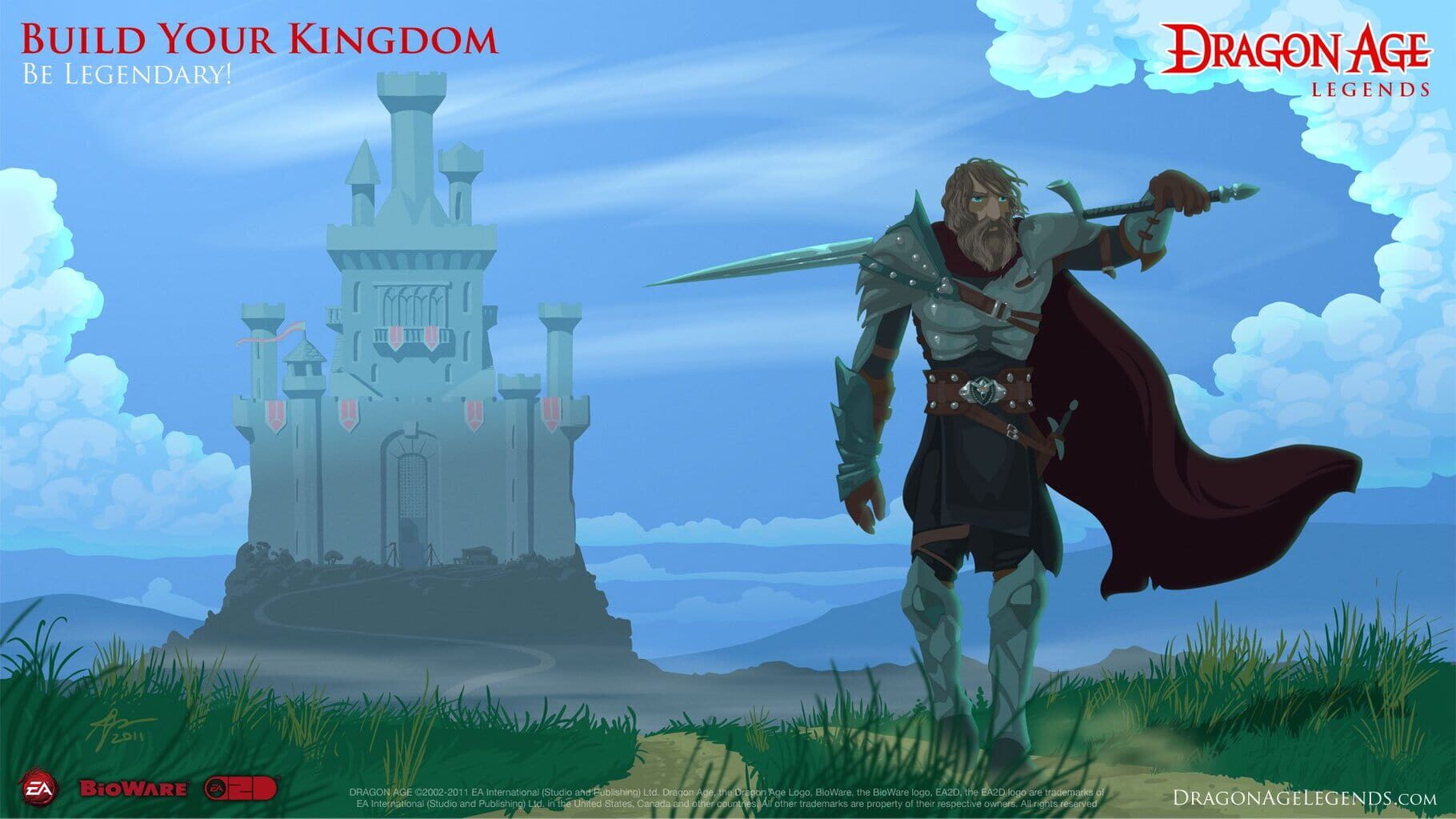
Legends was developed as a Flash game by a team from EA2D (later reformed as BioWare San Francisco), which was led by video game designers Soren Johnson and Ethan Levy. It was officially announced in November 2010 for a February 2011 release. It was promoted as "companion gaming", or a social glue for friends to "quest, loot, share rewards and grow a kingdom", with a major incentive being the opportunity to unlocking additional content in Dragon Age II by playing Legends.
The game was open to the public for beta testing via registration on its official website shortly after its announcement. A closed beta on Facebook commenced on February 1, 2011. As part of the game's marketing campaign, the game's key art, press releases, and blog posts were promoted on various platforms. EA offered the "BioWare Signature pack" as a tie-in incentive for players who buy and log in to Dragon Age II by March 15, 2011, which granted players Hawke, the player character of Dragon Age II, as a companion, along with other in-game items and exclusive bonuses.
Reception
Kotaku had recommended Legends as one of the best games to play on the Facebook platform before it updated its list on June 21, 2012, following the deactivation of Legends from the platform. Stephen Totilo from Kotaku enjoyed playing Legends; he initially expressed skepticism that Legends was nothing more than a marketing ploy due to the nature of Facebook games being heavily reliant on promotional efforts through chain letters and word of mouth on social media. Totilo found the overall gameplay experience to be pleasant and was impressed by the amount of gameplay options available. He praised the game's combat as "swift and fun" and felt that its social media elements never became "obnoxious", although he felt that enemy AI was weak. Nicole Tanner from IGN called it "one of the best games on Facebook" at the time of its release.
Conversely, Alec Meer from Rock, Paper, Shotgun was highly critical of Legends, and called it a "modern reworking of the old coin-op side-scrolling beat 'em/shoot 'em ups" which shamelessly made money off customers who are fans of the Dragon Age series. Meer noted that the alternative to not spending real money in Legends were the unnecessarily long wait times. Meer opined that the entirety of Legends was essentially an advertisement one needs to pay to keep watching, and questioned whether "compulsion is the same as legitimately being entertained". Meer concluded that while he was supportive of good quality social games or freemium games, he was overall unimpressed by the gameplay features presented in Legends, which he called a "slovenly, cheating, cynical wolf in RPG's clothing".


