
The articlegameplay, story, development, reception
Gameplay
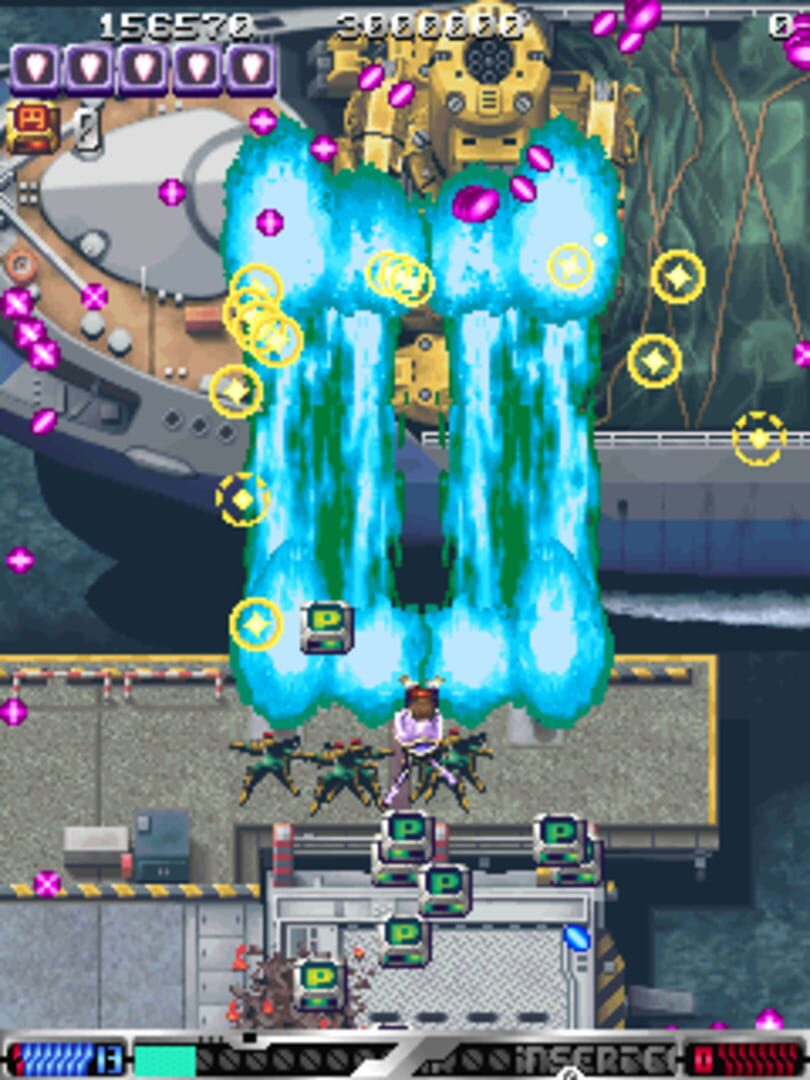
De. is a science fiction-themed, vertically scrolling bullet hell game similar to DoDonPachi. Players assume the role of one of the three playable characters (Yūsuke Sagami, Jb-5th and Irori Mimasaka) through five increasingly difficult stages. The plot involves ESPer Lady Garra and her Yaksa syndicate launching an attack to remove opposing forces and take over Tokyo.
Unlike most Cave shoot 'em ups, the characters only possess a shot attack but players can hold down the fire button to reduce movement. A unique gameplay mechanic is the power gauge, which gives players a force field that acts as a shield. Activating the force field renders the player's character invincible, turning enemy bullets into power-up and gold blocks, until the shield button is released and drains the power gauge. Releasing the shield buttons unleashes a powerful psychic blast capable of obliterating enemies and bullets on-screen.
Development
ESP Ra.De. was developed in conjunction with Dangun Feveron (1998) by a small crew of nine members: art director Junya Inoue, designers Akira Wakabayashi, Atsushi Aburano, Riichiro Nitta and Yūko Nakamura, programmers Ryuichi Yabuki, Satoshi Kōyama and Tsuneki Ikeda, and composer Masahiro Kusunoki. The team recounted its creation process and history through various publications.
Reception
In Japan, Game Machine listed ESP Ra.De. on their June 15, 1998 issue as being the fifth most-popular arcade game for the previous two weeks. Player One's François Daniel and Reyda Seddiki regarded its power gauge mechanic as unique compared to competing shoot 'em ups. Hardcore Gaming 101's Nick Zverloff stated that the game's scoring system was convoluted and complicated but praised the stylistic presentation, Inoue's artwork and audio design, regarding the title as "one of Cave's underrated classics" but found Irori's voice to be annoying.
Famitsu's four reviewers praised the inclusion of "Super Easy" and "Irori's Room" modes in the Psi version, as well as the addition of a new playable character. Nintendo Life's Mark MSX compared its visual style with both Akira and Ghost in the Shell, while finding its gameplay and scoring mechanics to be departures from DoDonPachi but commended the Psi version for addressing issues with the original scoring mechanic, the new playable character, user interface and extra modes but criticized the lack of an "arranged" mode and additional music options.


