Ludography
60/100
Players14 ratings
Fighter's History cover

1993 · Fighting

Fighter's History

Nintendo console exclusive

Fighter's History is a 1993 arcade fighting game developed and published by Data East. It's the inaugural game in the Fighter's History series. The main unique feature of the Fighter's History is its weak point system, which allows the player to temporarily stun an opponent by repeatedly hitting their weak point.

Fighter's History became infamous for being the subject of a lawsuit against Data East by Capcom, who claimed the game is too similar to its hit title, Street Fighter II, and as such is copyright infringement on its property. The case was found in Data East's favor however, as the court found that the copied elements were scenes a faire, elements necessary for depicting the scenario. The game was later ported to the Super Nintendo Entertainment System in 1994, and followed by a sequel Karnov's Revenge for Neo Geo.

There are three different gameplay modes are available. CPU Battle is the traditional arcade mode, where the player select a character and try to complete the game by beating all of the other fighters. In survival mode, the player select a team of five characters to go up against another team. And finally versus mode, where the player can go up against his friends.

Released
1993
Platforms
ArcadeSNES
Genres
Fighting
Developers
—
Publishers
Data East
Perspective
Side view
Themes
Action
Country
Japan
Languages
EnglishJapanese
Time to beat
0hmain story

About

Fighter's History is a 1993 fighting game developed and published by Data East for arcades. It is the first installment in the Fighter's History series. The main unique feature of the Fighter's History is its weak point system, which allows the player to temporarily stun an opponent by repeatedly hitting their weak point.

Fighter's History was the subject of a lawsuit against Data East by Capcom, who claimed the game infringed on the copyright of its game Street Fighter II. The case was found in Data East's favor, as the court found that the copied elements were scènes à faire, elements necessary for depicting the scenario. Fighter's History was ported to the Super Nintendo Entertainment System in 1994, and followed by a sequel, Karnov's Revenge, for the Neo Geo.

Keywords

  • martial arts
  • hand-to-hand combat
  • high score
  • clone
  • retroachievements

Media

The articlegameplay, story, development, reception

Gameplay

Fighter's History uses a six-button control configuration similar to Street Fighter II and its iterations, with three punch buttons and three kick buttons, each for different strength levels (light, medium, and heavy). There are a total of nine playable characters, as well as two non-playable boss characters at the end of the single-player tournament. The final boss and sponsor of the tournament is revealed to be Karnov, the protagonist of the Data East action game of the same name.

The main unique feature Fighter's History is its "weak point system". By repeatedly hitting an opponent's weak point, the player can temporarily stun them once per round, leaving the opponent open for an attack. The location of an opponent's weak spot varies with each character and is usually represented by a specific article of clothing (i.e.: a headband, a vest, a mask). After an opponent's weak point is exposed, hitting it will also cause the opponent to sustain greater damage when the weak point is repeatedly struck afterward.

Reception

In Japan, Game Machine listed Fighter's History on their May 1, 1993 issue as being the second most-successful table arcade unit of the month. Play Meter listed Fighter's History to be the twenty-seventh most-popular arcade game at the time.

Electronic Gaming Monthly reviewers commented that the graphics are average, but praised the controls as exceptional for a fighting game. Nintendo Power wasn't impressed with the SNES version, stating that the lack of originality fails to make Fighter's History stand out from other games, and criticized the poor sound. GamePro gave the SNES version a negative review, calling the game "an unremarkable [Street Fighter] knock-off with solid but slow game play", and heavily criticizing the "bland" character design.

Chris Shive of Hardcore Gamer called the SNES version as "[a] bootleg Street Fighter II" in his Data East Classic Collection review. The reviewer was unimpressed with the core gameplay that doesn't much differ from other contemporary fighting games, although he added that the game is quite fun nonetheless.
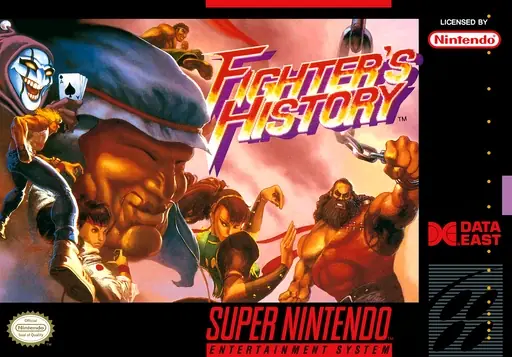
Releases by platformdates and regions as published

Releases by platform
PlatformReleasedRegions
Arcade19 March 1993Worldwide
SNES27 March 1994Japan · North America 1 August 1994 · Korea 31 December 1994

Title IDsone per regional release, with its latest update

Title ids and disc serials by release
PlatformTitle IDRegionLatest update
SNESSHVC-YHJapan—
SNS-YHNorth America—

Box artone per regional release we hold art for

Editions and related releases

Included in
Data East Classic CollectionData East Collection 116bit-Collection Data East Vol. 1Polymega Collection Vol. 2: Karate Champ
Ported as
Johnny Turbo's Arcade: Fighter's History

Games like this

Collections4 collections

Platform libraries

Years

Reception and records

Description adapted from its source, CC BY-SA 4.0.