
The articlegameplay, story, development, reception
Gameplay
Like previous games in the series, Final Fantasy X is presented in a third-person perspective, with players directly navigating the main character, Tidus, around the world to interact with objects and people. Unlike previous games, however, the world and town maps have been fully integrated, with terrain outside of cities rendered to scale. As Tidus explores the world, he randomly encounters enemies. When an enemy is encountered, the environment switches to a turn-based battle area where characters and enemies await their turn to attack.
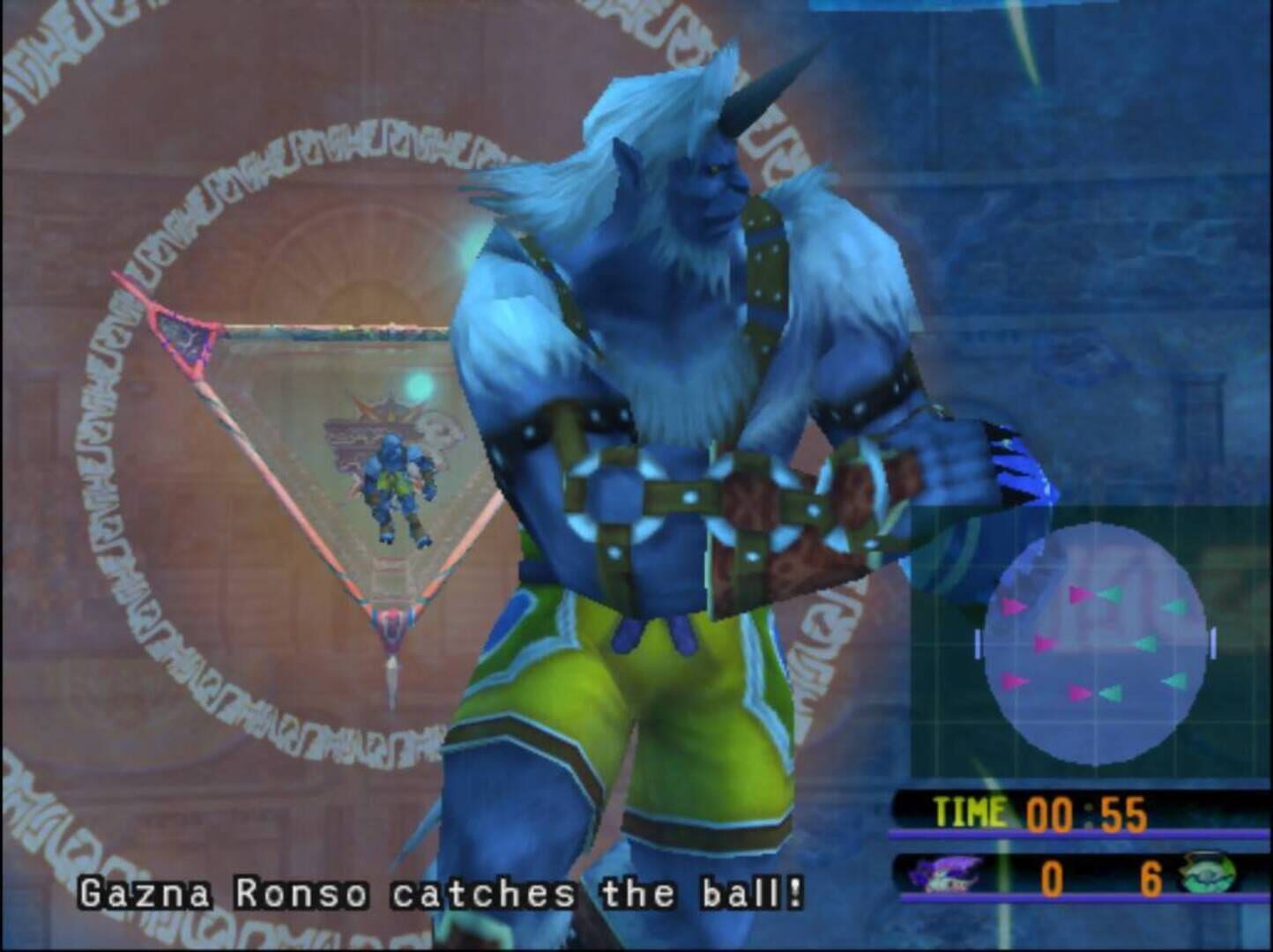
The gameplay of Final Fantasy X differs from that of previous Final Fantasy games in its lack of a top-down perspective world map. Earlier games featured a miniature representation of the expansive areas between towns and other distinct locations, used for long-distance traveling. In the game, almost all the locations are essentially continuous and never fade out to a world map. Regional connections are mostly linear, forming a single path through the game's locations, though an airship becomes available late in the game, giving the player the ability to navigate Spira faster. Like previous games in the series, Final Fantasy X features numerous minigames, including the underwater sport blitzball.
Story
Final Fantasy X is set in the fictional world of Spira, consisting of one large landmass divided into three subcontinents, surrounded by small tropical islands. It features diverse climates, ranging from the tropical Besaid and Kilika islands, to the temperate Mi'ihen region, to the frigid Macalania and Mt. Gagazet areas. Spira is very different from the mainly European-style worlds found in previous Final Fantasy games, being much more closely modeled on Southeast Asia, most notably with respect to vegetation, topography, architecture, and names.
Spira features a variety of races, though predominantly populated by humans. Among them are the Al Bhed, a technologically advanced but disenfranchised sub-group of humans with distinctive green eyes and unique language. The Guado are less human in appearance, with elongated fingers and other arboreal features. Still less human are the lion-like Ronso and the frog-like Hypello.
Development
4 million in 2025 dollars) with a crew of over 100 people, most of whom worked on previous games in the series. Executive producer Hironobu Sakaguchi has stated that although he had concerns about the transition from 2D to 3D backgrounds, the voice acting, and the transition to real-time story-telling, the success of the Final Fantasy series can be attributed to constantly challenging the development team to try new things. Producer Yoshinori Kitase was also the chief director of Final Fantasy X, while the direction of events, maps and battles was split up between Motomu Toriyama, Takayoshi Nakazato and Toshiro Tsuchida, respectively. The development of the script for the game took three to four months, with the same amount of time dedicated to the voice recording afterwards.
Tetsuya Nomura and Kazushige Nojima collaborated with Daisuke Watanabe, Toriyama and Kitase on writing the scenario for Final Fantasy X. Nojima was particularly concerned with establishing a connection in the relationship between player and main character. Thus, he penned the story such that the player's progress through the world and growing knowledge about it is reflected in Tidus' own understanding and narration.
Reception
Final Fantasy X received critical acclaim from video game critics. The Japanese video game magazine Famitsu and Famitsu PS2 awarded the game a near-perfect 39/40 score. Another Japanese gaming magazine, The Play Station, gave the game a score of 29/30. Famitsu, Famitsu PS2, and The Play Station expressed particularly favorable responses toward the game's storyline, graphics, and movies.
The game maintains a 92 out of 100 on Metacritic. Producer Shinji Hashimoto said that the overall reception to the game was "excellent", having received praise and awards from critics.
Legacy
Due to its commercial and critical success, Square Enix released a direct sequel to Final Fantasy X in 2003, titled Final Fantasy X-2. The sequel is set two years after the conclusion of Final Fantasy X, establishing new conflicts and dilemmas and resolving loose ends left by the original game. 4 million units versus over 8 million units, it can still be considered a commercial success. As a result of the title's popularity, Yoshinori Kitase and Kazushige Nojima decided to establish a plot-related connection between Final Fantasy X and Final Fantasy VII, another well-received Final Fantasy game.
In 2013, after the release of the HD Remaster, Nojima said that he would like to see a second sequel to X, and if there were demand for it, it could happen. The minigame of blitzball has made it into other games, such as its sequel, and was mentioned as a possibility for Final Fantasy XIV: A Realm Reborn.


