The articlegameplay, story, development, reception
Gameplay
Fireball is similar to Breakout in that the player uses a ball (a fireball, hence the name) to break up walls made of bricks by hitting the bricks with the ball, with the shape of the walls changing as the player progresses. Gameplay differs from Breakout, however, in that rather than just being a bat, the player controls an animated juggler who can catch up to two balls (one in each hand) and throw them upward. It also differs from the traditional Breakout format in that six fireballs may be kept in the air at any one time, and the bricks to be destroyed in each level are arranged in varying shapes and patterns. As with Breakout and Circus Atari, Fireball is controlled with a rotary paddle controller. Switches on the Atari console adjust the difficulty by changing the collision detection around the fireballs.
Additional balls can be freed from within blocks, or released onto the screen when the player presses the action button. Scoring is increased by increasing the number of balls in play. If any of the fireballs fall to the bottom of the screen, the juggler is pulled off stage by a vaudeville hook.
Development
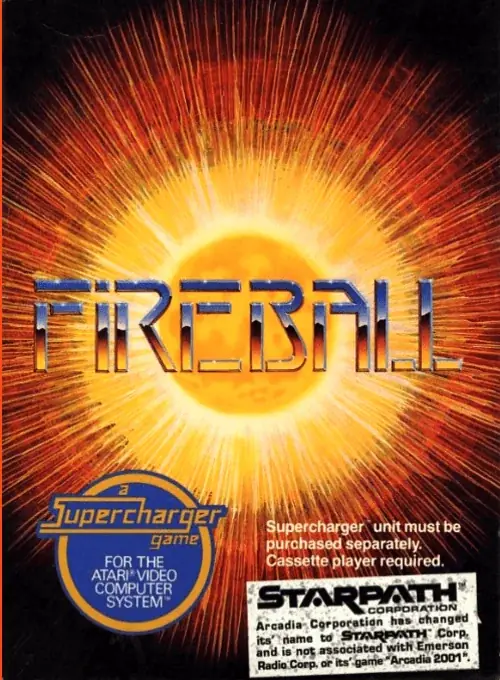
Fireball was one of the four 1982 launch titles for the Starpath Supercharger. Starpath, originally named Arcadia, was founded by former Atari Director of Research Bob Brown and former Atari engineer Craig Nelson. The 1977 Atari VCS game console was limited compared to the consoles and lower-end home computers that were released up to 1982, but it remained the market leader. The Supercharger plugged into the Atari VCS cartridge slot and loaded games from inexpensive cassette tapes (similar to early home computers) into its over 6,000 bytes of random access memory (RAM), a significant jump from the console's internal 128 bytes.
Because each Atari game "paints" its graphics onto the screen in sync with the electron beam of a tube television, the low system RAM caused many Atari games to draw graphical elements at half the machine's vertical resolution. Starpath's titles like Fireball were written to use the full resolution of the console.
Reception
The contemporary reception was generally positive. The British TV Gamer magazine described it as "very similar to other Breakout games" though they also called it "challenging and entertaining". In a 1983 Miami Herald review entitled "Fireball is not hot enough", Rick Vogt gave it a rating of "B" both for children and for adult players. The German TeleMatch magazine gave it a positive review, praising its gameplay as an evolution of similar games going back to Pong and Fireball's detailed graphics, while criticising its "monoton [monotonous]" sound effects.
Vidiot magazine described it as "the best variation on the Breakout theme yet". Phil Wiswell, writing for the December 1982 issue of Games, selected Fireball as one of the top games for the VCS. The 1984 Software Encyclopedia was broadly positive, giving it 7/10.