
The articlegameplay, story, development, reception
Gameplay
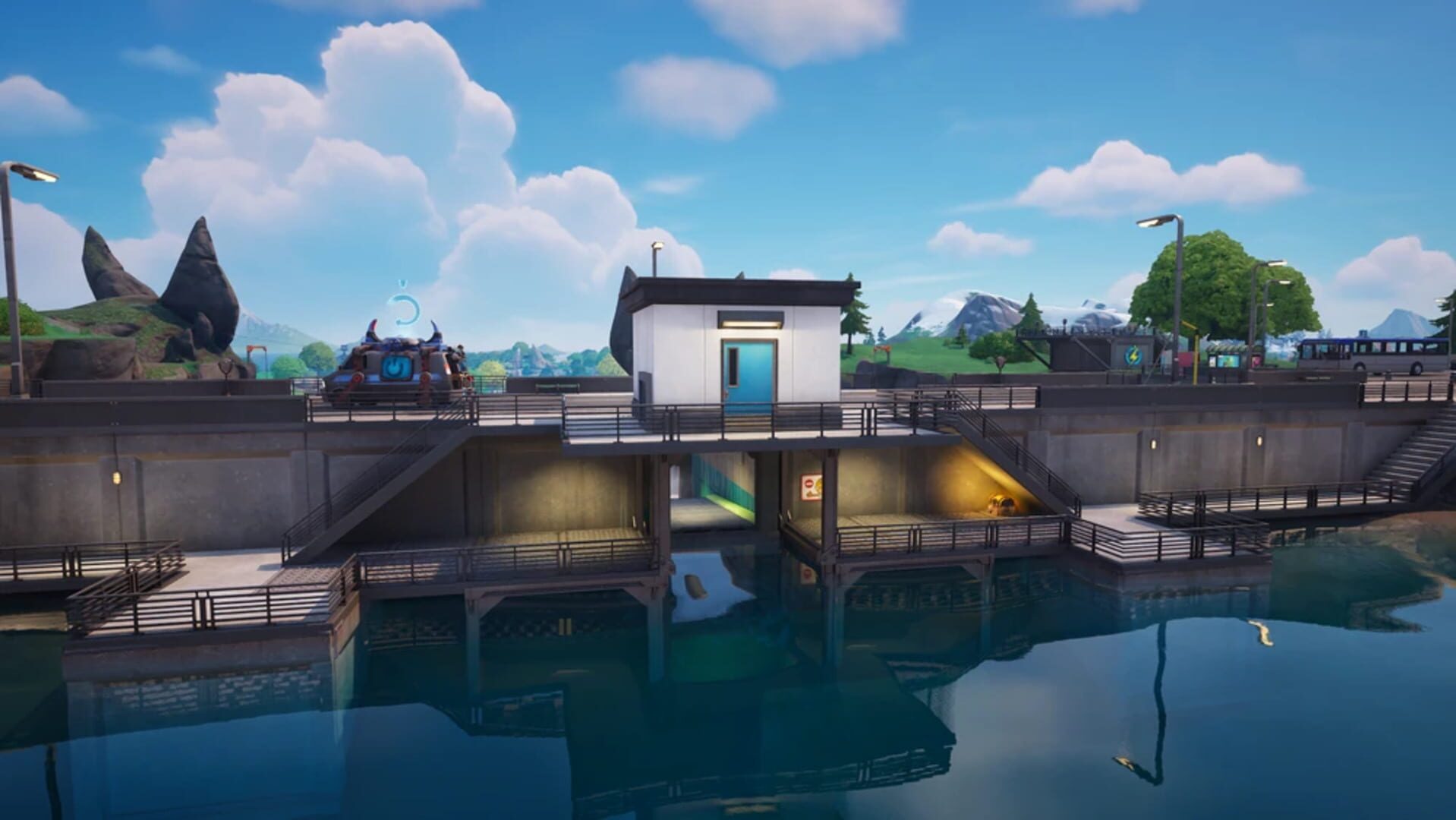
The core gameplay of Fortnite Battle Royale follows the standard structure of the battle royale genre, played from a third-person perspective. Matches typically consist of up to 100 players, either competing individually or in squads of two, three, or four. Each round begins with players skydiving from a flying "Battle Bus" and landing on the island map. The island features a fixed layout with various named landmarks and points of interest.
These locations contain randomly scattered chests that hold weapons, shields, and other combat resources. Only five items at a time can be stored in the inventory. Weapons are divided into rarities that dictate how much damage they inflict: Common, Uncommon, Rare, Epic, Legendary, Mythic, and Exotic.
The primary objective is to be the last player or team remaining, achieved by either eliminating opponents or avoiding them. In solo play, players are immediately eliminated once their health is fully depleted, but in squad modes, they become incapacitated and may be revived by teammates. Originally, eliminated players were removed from the match entirely, but an update in April 2019 introduced "Reboot Vans" that allow teammates to revive a fallen player. These vans are scarce and typically placed in exposed locations, making the act of reviving a teammate a risk.
Throughout the match, the playable area of the island, represented by the eye of a storm, gradually shrinks, and players outside the safe zone take increasing damage over time. This directs the surviving players into tighter spaces, forcing player encounters. Hostile non-player characters (NPCs), introduced in February 2020, can be defeated for additional or improved loot, while friendly NPCs, added in December 2020, offer services such as selling items, healing players, or temporarily joining the player as AI-controlled allies.
Fortnite Battle Royale's main distinction from other battle royale games is the building system. Using the pickaxe, the only item given at the start of each game, nearly every object in the environment can be destroyed and harvested for materials—wood, stone, and metal—which players use to construct temporary structures like walls, ramps, floors, and roofs. These structures can serve to navigate the terrain, block incoming fire, or hinder enemy movement. Lighter materials allow for quick builds but are easily destroyed, while stronger materials are more durable but slower to place.
Fortnite Battle Royale is free-to-play and monetized via microtransactions, allowing players to purchase "V-Bucks," a shared currency also usable in another Fortnite gamemode, Save the World. Players can earn V-Bucks in Save the World by completing missions and daily objectives, then spend them in Battle Royale on cosmetic upgrades—such as outfits, gliders (items from which player characters hang when descending onto the island), emotes (discrete dance moves), backpacks, and pickaxes—in the Item Shop, which features a daily rotation of purchasable cosmetics. The game is structured into chapters, each containing several seasons that typically last ten weeks. Every season introduces a new set of cosmetic items available through a "Battle Pass", which players progress through by gaining experience via gameplay or completing different challenges.
A selection of rewards is free, but purchasing the full Battle Pass with V-Bucks grants access to all tiered rewards, and players can also spend V-Bucks to skip tiers. In December 2020, Epic launched the "Fortnite Crew" subscription, providing members with the latest Battle Pass, a monthly V-Bucks stipend, and exclusive cosmetic content.
Epic Games has continuously added new features to Fortnite Battle Royale, including weapons, vehicles, and items. The company can deploy spontaneous software updates called hotfixes to quickly adjust gameplay elements such as weapon stats and item spawn rates. Items may also be cycled out of the game in a process known as "vaulting" if they are unbalanced or unpopular. In December 2018, Epic simultaneously launched Fortnite Creative, a mode allowing players to create anything they wanted, and "The Block", a rotating showcase of community-made creations added to the Battle Royale island.
One year later, Epic released the "Battle Lab" mode, which allowed players to design custom battle royale experiences, but this was removed due to the expanded capabilities of Creative mode. In April 2020, Epic introduced "Party Royale," a separate, combat-free map designed for social interaction and live events, where players can use non-lethal items such as paint guns and vehicles. Before September 2019, matchmaking was primarily determined by platform and region, but an update introduced skill-based matchmaking, using internal metrics to evaluate player performance and match them with similarly skilled players. Epic also added AI-controlled bots into regular matches, allowing new or less experienced players to practice mechanics and strategies more comfortably.
Epic Games has introduced several distinct game modes to Fortnite since 2022.
"Zero Build" was introduced in March 2022. This mode removed the traditional building mechanics and added an "overshield" feature, giving an additional regenerating set of HP. Initially replacing standard Battle Royale during the first week of Chapter 3 Season 2, Zero Build became a permanent standalone option in April 2022. Epic later added the "Zero Builds Trials"—a series of objectives in the "Zero Build" mode that awarded cosmetics upon completion—in April 2022.
A "Ranked" mode was introduced for both standard and Zero Build gameplay across all team sizes in May 2023, adjusting matchmaking based on player performance. Ranked mode was eventually extended to newer game types.
"Fortnite Reload" launched in June 2024, featuring a map rotation of smaller islands, with 40-player matches, limited weapon selection, and automatic revival upon death (respawning) except in the final moments. It supports one
Development
Fortnite had first been announced by Epic Games in 2011, considered to be a combination of Minecraft and Left 4 Dead, with four players cooperating to scavenge resources and build fortifications, traps, weapons, and other objects to survive attacks from monsters. The game experienced a prolonged development period due to external industry pressures, including a shift toward a games-as-a-service model, and internal changes within Epic, such as a shift in focus to their first free-to-play title, Paragon. During this time, Epic reached an agreement with Tencent, granting the company approximately 40% ownership in exchange for support in transitioning to a games-as-a-service model and access to the Chinese video game market. In June 2017, Epic confirmed that Fortnite was planned for release in 2018, with a paid early access period starting one month later.
The game was otherwise intended to be a free-to-play title supported by microtransactions. Upon entering early access, the game featured its primary gameplay mode, "Save the World", in which teams of up to four players worked cooperatively to survive and complete objectives on procedurally generated maps.
During the later parts of Fortnite's development, PlayerUnknown's Battlegrounds was released in early access on personal computers in March 2017 and quickly became a popular and successful example of the battle royale genre. In mid-2017, Epic Games' CCO Donald Mustard, CEO Tim Sweeney, and two other executives were traveling by Uber to a meeting with Disney in California to discuss potential opportunities when they decided to create a battle royale mode for Fortnite. During the three-hour ride, Mustard wrote a one-page design document that they intended to present to Disney; the idea for the Battle Bus came from seeing a school bus during the ride. According to Mustard, the Epic team "loved Battle Royale games like [Battlegrounds]", and began exploring how a similar mode could be integrated into Fortnite's engine. Development of the mode was kept separate from the main player-versus-environment content to allow experimentation without affecting game balance.
The development of Fortnite Battle Royale was led by Eric Williamson, with Zack Estep serving as production lead. Their objective was to develop the new mode quickly based on the existing "Save the World" mode, putting off any complex features that weren't already in place as to launch the new mode as soon as possible; while they explored such potential ideas, they held off inclusion until after the main mode was launched. Development began in July 2017, after "Save the World" was released, and lasted about two months, with assistance from the Unreal Tournament team. Battle Royale's differences from "Save the World" included a more limited progression for weapons, a small subset of traps, and a smoother, more natural terrain for the maps.
They aimed for matches lasting no longer than 25 minutes, which influenced decisions about which elements from "Save the World" would be excluded. They had included Fortnite Battle Royale's building mechanic for fortifications, unsure how players would use it since the safe zone would continue shrinking, but found quickly that the mechanic helped to distinguish the game from Battlegrounds and was used by expert players frequently to win matches. Epic later added features to help players build temporary bases more easily.
In those two months of development, Epic initially planned to include the Battle Royale mode within the paid version of Fortnite and announced this publicly in early September 2017. Two weeks before the mode's release, Epic chose to launch it as a separate free-to-play title, concerned that including it in the paid version would hinder its growth. Epic formally announced this decision about a week after the initial announcement of Battle Royale, offering refunds to those who had purchased early access in anticipation of the new mode. Fortnite Battle Royale was officially released on September 26, 2017 on PC (Windows & Mac), PlayStation 4, and Xbox One. This release, which beat out Battlegrounds to consoles, caused some concern with Battlegrounds developer Bluehole, as they had been working closely with Epic for Unreal Engine support in Battlegrounds, and were worried that Fortnite might be able to include planned features to their Battle Royale mode before they could release them in Battlegrounds.
By early 2018, Fortnite Battle Royale had become popular, and Epic assigned a dedicated development team to focus on improvements for the mode. Due to the substantial player-base and the fact that Fortnite Battle Royale was marketed as a "game-as-a-service" product, the team experienced extensive working hours dedicated to patching, receiving over 3,000 tickets every day, up from 20–40 before the game's growth. Additionally, Epic acknowledged that its focus on Fortnite had resulted in decreased player activity in some of its other games, leading to reduced development for those titles, particularly Paragon. In January 2018, Epic announced that Paragon would be shut down by April of that year and that all players would receive refunds.
Similarly, Epic announced it had halted development of the planned free-to-play Unreal Tournament game, transitioning its team to work on Fortnite, although the game would remain available, playable, and open to user modifications. Players on a Fortnite-dedicated Reddit forum had expressed concerns that a similar fate could befall the Save the World mode of Fortnite, as the mode had not received the same level of updates and improvements as Battle Royale since its release.
According to Mustard, from the outset of Fortnite Battle Royale's development, Epic intended to include a narrative, with a long-term story planned by Mustard. However, they recognized that most players were primarily focused on the core mechanics of the game. As a result, they chose to present players as observers of in-game events rather
Reception
Fortnite Battle Royale received generally positive reviews from critics. Daniel Tack of Game Informer called it "immediately understandable" and praised its replayability, stating that the unpredictable nature of each match gave the game a lasting appeal. Michael Higham of GameSpot observed that its lighthearted presentation and building tools made for a "uniquely chaotic" experience, though he noted the gameplay relied more on improvisation than precision. Austen Goslin of IGN described Fortnite Battle Royale as "a chaotic and fun system" and remarked that its speed and simplicity helped distinguish it from other battle royale games.
The building system drew both praise and criticism. Higham argued that it "always gives you the opportunity to improvise," enabling players to create cover or elevation mid-fight, and Goslin wrote that "Fortnite is more about building than it is about shooting." Dave Aubrey of Pocket Gamer pointed out that the constantly shrinking play area often made permanent structures impractical, saying "settling down and building a nice fort… isn't really practical." While Gavin Lane of Nintendo Life admired the flexibility of construction, he argued that the interface was difficult to grasp for new players, and the lack of tutorials could make early matches confusing.
Critics had differing views on map design and pacing. Higham described the island as lacking "sophistication in physical layouts," saying that loot placement could feel uneven between locations. Goslin appreciated the distinct visual identity of the named locations, and felt that even with a single map, variation emerged through player behavior. Ford James of GamesRadar+ emphasized how often Fortnite's structure and meta changed, pointing out that "nothing stays the same… weapons come and go, items are vaulted, and tactics shift month to month."
Opinions were also mixed on the game's free-to-play model. While Goslin called the Battle Pass "a neat structure" that rewarded consistent play, James expressed concern about social pressure, especially among younger players, arguing that "if kids don't spend real money… they'll be ridiculed." com criticized the price of premium skins, stating that "for the most expensive outfits, we still exceed €20". Most reviewers agreed that monetization was cosmetic-only, but not all felt it was unobtrusive.
The technical performance across platforms was generally seen as stable, with caveats. On the Nintendo Switch, Aubrey and Tommaso Pugliese from Multiplayer.it found that the game "runs relatively well" at 30 frames per second, despite reduced graphical fidelity. Lane described the absence of motion-assisted aiming and found the handheld experience limited by resolution and input precision, but concluded that "performance is perfectly acceptable." Across platforms, critics emphasized that Fortnite's mechanics remained functional and recognizable, even when visual quality varied.
Fortnite Battle Royale attracted non-traditional video game players, drawing comparisons by analysts to World of Warcraft and Minecraft. It gained over 10 million players within two weeks of release. By March 2018, the player base exceeded 45 million, and three months later, in June 2018, Epic Games reported over 125 million players, with 40 million active monthly. By November, Fortnite Battle Royale had over 200 million registered accounts.
At the 2019 Game Developers Conference, Tim Sweeney announced 250 million players, with 35% female, the highest known percentage for a shooter game. By May 2020, registered players exceeded 350 million. By the end of 2020, total revenue from Fortnite, including Battle Royale surpassed $9 billion.
Platform-specific launches generated immediate user increases, with the Nintendo Switch version receiving over 2 million downloads within one day. The Android version reached over 15 million downloads in three weeks. During the release of Season 5 in July 2018, Akamai Technologies recorded traffic nearing 37 terabytes per second, the highest for any video game they had observed. 5 million downloads.
In November 2018, Fortnite became available in South Korea's PC bangs (internet cafes). 4 million in February 2018. In February 2018, analysis firm SuperData estimated Fortnite Battle Royale earned over $126 million, exceeding Battlegrounds' $103 million. March revenues surpassed $223 million.
By April 2018, Fortnite led Battlegrounds in both revenue and player count across all platforms.
Revenues reached $296 million in April and $318 million in May. By July 2018, cumulative revenue exceeded $1 billion. 2 million daily prior to Season 5 in July 2018, increasing to $2 million daily afterward. 4 billion in 2018, the highest annual revenue for a free-to-play title.
8 billion due to market stabilization but remained the highest for the year. Epic Games was valued at $825 million in 2012 at the time of Tencent's investment. 5 billion. 5 billion valuation by the end of 2018 if Fortnite reached $2 billion in annual revenue.
Partially due to the influx of revenue from Fortnite Battle Royale, Epic reduced its portion of sales it collected from the Unreal Engine Marketplace from 30% to 12% in July 2018, applying that retroactively to past sales.
Journalists attributed Fortnite Battle Royale's success over PlayerUnknown's Battlegrounds to several factors. In addition to being free-to-play and available on consoles, Fortnite was released wh