The articlegameplay, story, development, reception
Gameplay
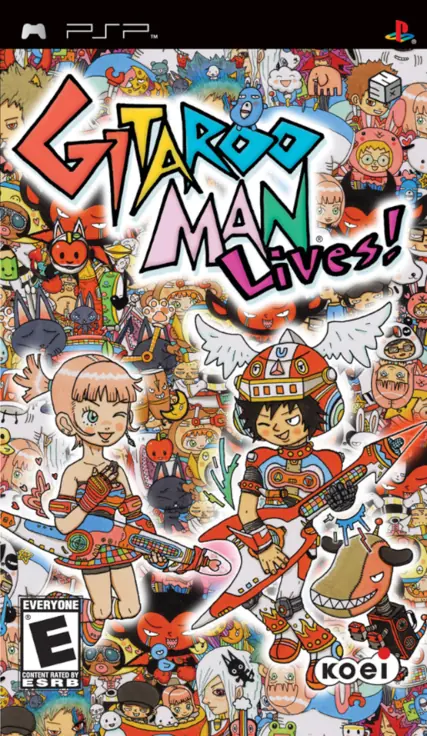
Gitaroo Man is a rhythm game in which the player character, U-1, faces against various opponents in musical battles. In each level, both the player and opponent has a life bar, with the player tasked with depleting the opponent's life bar and reaching the end of the song without running out of life. With some exceptions, each level consists of three main phases; Charge, Attack, and Guard, followed by the Harmony and End phases at the end of the level. During the Charge and Attack phases, players follow a "trace line" using the analog stick, upon which red "phase bars" will appear.
By pressing and holding down the button at the start of a phase, timing it to its appearance at the center of the screen, and releasing the button at the end, the player plays music. In the Charge phase, successful notes restore the player's health, whereas in the Attack phase, successful notes damage the opponents whilst missed notes will hurt the player. During the guard phase, players must hit corresponding buttons as they reach the center of the screen to avoid attacks from the opponent, taking damage should they miss. Unlike the player's life, which ends the game if depleted, the opponent's life bar indicates the progress of the player.
Most levels are split up into different sections, which can have multiple variations on each playthrough, and the player must damage the opponent enough to move onto the next section. Otherwise, they will have to repeat the section until enough damage is dealt. At the end of a level, players play through the Harmony phase, which is similar to the Attack phase, and keep on playing til the End phase, at which point the player will no longer take damage. After each level, players are given a rank based on their performance, with good ranks earning items for the collection, which unlocks character bios.
Masters' Play is an additional mode unlocked after clearing the game once. In this mode, gameplay is harder as more complex notes appear, the "trace line" becomes more complex with more twists and turns and thus harder to follow and players take more damage from mistakes. Versus Mode is a game for up four players, where players battle against each other in two teams playing Gitaroo Man's parts and his opponent's parts respectively. Not all songs are available in the mode, and some songs are altered to provide better balance for both players compared to the single player mode. The PSP version additionally features Duet Mode, in which two players can play co-operatively ad-hoc in two exclusive new levels; "Metal Header" and "Toda Pasion".
Story
Gitaroo Man follows a young boy named U-1 who is often picked on by his rival Kazuya and passed over by the girl of his dreams, Pico. One day, as U-1 is suddenly attacked, his talking dog Puma transforms and gives him a weapon known as the Last Gitaroo, which transforms U-1 into the legendary warrior Gitaroo Man. After defeating many enemies, sent by Prince Zowie of the Gravillian Empire, and obtaining their Gitaroos, Puma brings a reluctant U-1 to Planet Gitaroo, which had been invaded by the Gravillian Empire. Upon arriving there, U-1 befriends a girl named Kirah, only to later discover that she is Zowie's gladiator.
Refusing to fight her, U-1 uses the power of music to convince Kirah to stand up against Zowie. Obtaining all eight Gitaroos, U-1 becomes the True Gitaroo Man and defeats Zowie, after which he returns home as a more confident person.
Reception
According to the game's designer Keiichi Yano, the game was commercially successful in the United States, where it sold more copies than it did in Japan.
Edge awarded the game a score of 7 out of 10; the game was later included in that magazine's staff- and reader-voted "Top 100 Games" list published in July 2007. Despite a number of positive reviews, the North American and European versions of Gitaroo Man were produced in very low quantities by Koei and, as a result, have become somewhat rare; it is regarded as a cult video game. Around November 2005 in North America, copies of Gitaroo Man began popping up in GameStop game stores. This was due to a reprint by GameQuestDirect, similar to their previous reprints of PlayStation RPGs Persona 2 and Rhapsody: A Musical Adventure, both of which were previously very rare. The game was also reissued in Europe around this time.
Blake Fischer reviewed the PlayStation 2 version of the game for Next Generation, rating it four stars out of five, and stated that "The genius here isn't in any bold gameplay innovations; it's that it delivers a fun, well-rounded package that is beautifully crafted." It was a runner-up for GameSpot's annual "Best Music on PlayStation 2" and "Best Game No One Played on PlayStation 2" awards.
Received IGN's award for Best PSP Music Game of 2006.