The articlegameplay, story, development, reception
Gameplay
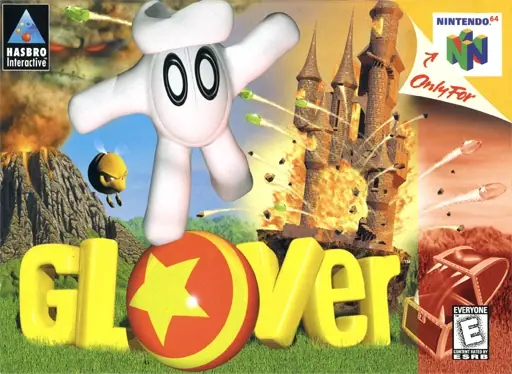
Players control a glove named Glover. The main objective is to maneuver the ball toward the goal in each stage. Once all three stages and the boss stage are cleared, a crystal ball can be restored back to the castle. There are six worlds, each containing three stages, a boss stage, and a bonus stage accessed by collecting all the Garib cards in a given world.
When Glover is in contact with the ball, he can roll, bounce, throw, slap, dribble, walk on top of the ball, and use it as a trampoline. Without the ball, Glover can do both regular and double jumps, cartwheel, fist slam, locate the ball and garibs, and grab the ball. While walking on the ball, the controls are reversed. On easy difficulty, walking on the ball is automatic while moving the ball across water.
Story
The story takes place in a fictional land known as the Crystal Kingdom, where a wizard rules from his Crystal Castle, which is surrounded by six portals leading into other worlds, including the lost city of Atlantis, a circus park, a pirate's domain, a horror-themed fortress, a prehistoric era, and outer space. The life force of the kingdom is maintained by seven magical crystals that rest atop the spires of Crystal Castle. The wizard is accompanied by the magical, sentient gloves Glover and Glovel, who assist him in creating strange potions and spells.
One day, the wizard accidentally mixes the wrong batch of potions in his cauldron, causing a large explosion that turns the wizard into a statue, sends him falling down the tower, and sends his gloves flying. The left glove, Glovel, lands in the cauldron while the right glove, Glover, flies out the window and lands onto the ground outside the castle. The explosion also shakes the crystals from the spires, causing the land to become dark and foreboding. Before they could shatter upon impact, Glover quickly casts magic to turn the crystals into rubber balls.
Development
Glover was developed by Interactive Studios and published by Hasbro Interactive. The game was originally announced at E3 1998; in August 1998, it was reported that the game was 60% completed. Two months later (in October), the game was reported to be 70% completed. During late in development, it was reported that Glover would have required the character to cross water.
According to designer Rich Albon, the collectible Garib cards in the game got their name from an in-office joke: "The studio was doing a port for a Japanese company at around the time of Glover and they got a faxed bug report (yes, a faxed bug report!) which had one item that read, 'There is a problem with the Garib.' No one knew what a Garib was – there was no reference to it in the in game or in the code. So it kind of became an office meme: anything without a name became a Garib."
Reception
For the Nintendo 64 version, Glover received generally positive reviews by critics. Matt Casamassina of IGN praised the Nintendo 64 version, specifically on its gameplay and sound. They wrote that the music matched the levels "perfectly". John Broady of GameSpot recommended the game for patient players in search of a challenge.
Paul Hales of PC Zone gave it a 67%, stating: "It's all good, clean, harmless fun in reasonably 3D rendered landscapes." Edge magazine gave the game a seven out of ten, stating that it was not all that original, but also stated that the game provides regular surprises that make it an entertaining game.
Legacy
In July 1999, Interactive Studios announced a sequel titled Glover 2 was being developed after the first one was released. The game was set to continue where the story of the first game left off and would have a more complete story that would unravel as the game progressed. Gameplay features of Glover 2 would have been similar to the original game with enhancements for hand/ball physics, enhanced graphics, and a new multiplayer mode. The game was expected to release in mid-1999 for the Nintendo 64, then PlayStation and Dreamcast the following year, but was cancelled along with Frogger 2's Nintendo 64 port.
com acquired a prototype cartridge of the game and had released a ROM hack of it. On February 25, 2015, James Steele, a former Interactive Studios programmer, released a blog entry detailing the reasoning of the cancellation of the game. An employee at Hasbro doubled the amount of produced cartridges, leaving the company with roughly half-a-million dollars' worth of stock that could not be sold and forcing Glover 2 to be cancelled. The game was around 80–85% completed before development ceased.