
The articlegameplay, story, development, reception
Gameplay
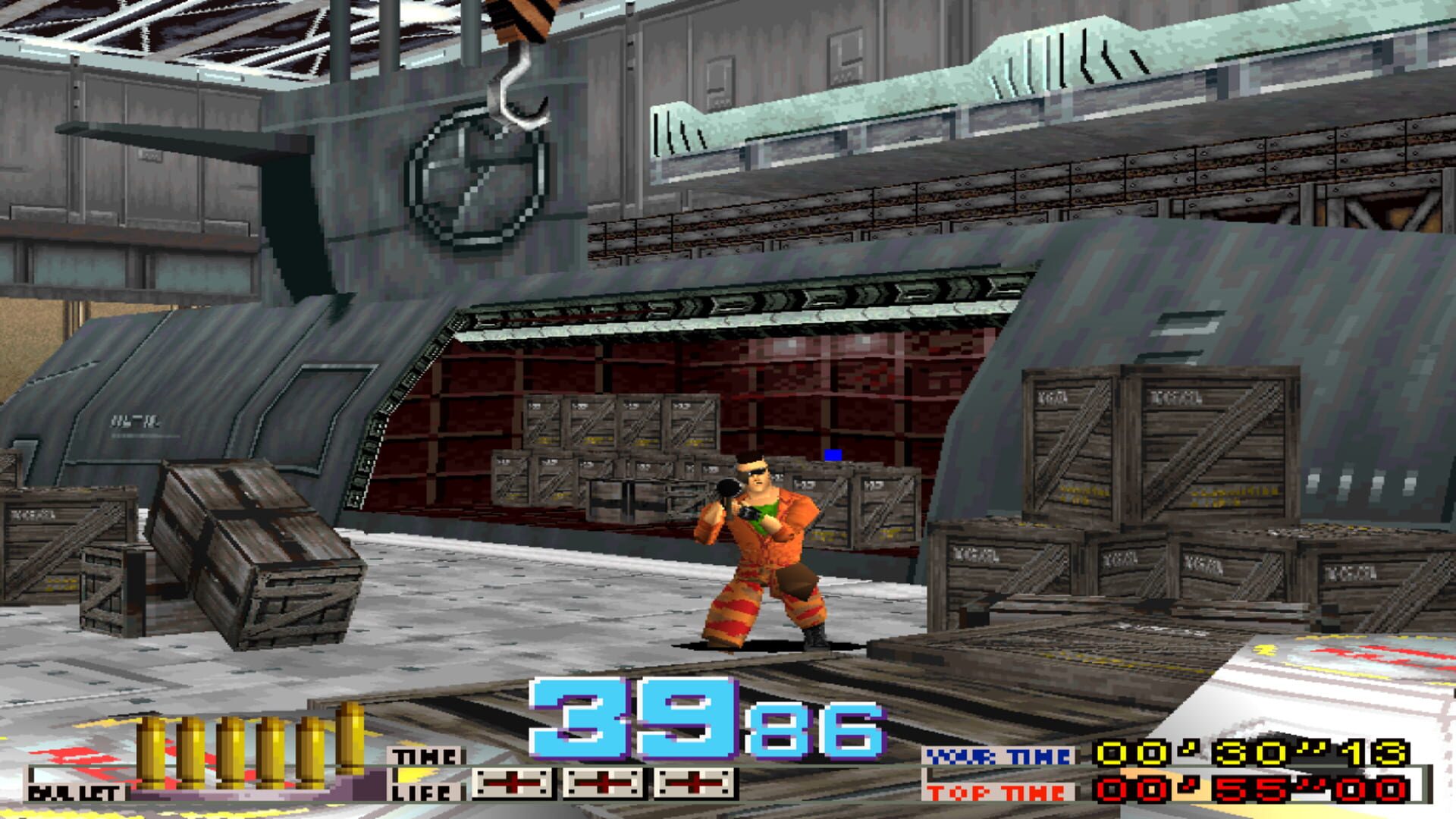
Players use two attached light guns (in the case of the DS, a pen or in the case of the iOS version, touching the screen) to hit targets onscreen; missions require speed, quick judgment or pinpoint accuracy. The game consists of non-violent shooting contests where players are tasked with challenges such as shooting player-colored bulls-eyes, cardboard criminals, and other inanimate objects, not shooting bombs and cardboard cutouts of civilians (much like in Namco's first light-gun game, Steel Gunners), and protecting characters Dr. Don and Dr. Dan, among other miscellaneous challenges, similar to games like Police Trainer, and Area 51: Site 4 - and players choose the desired difficulty level (Practice, Beginner, Advanced, and Very Hard in the first game, or Training, Beginner, Advanced, and Insane in the second game onwards) which will determine how many stages must be finished to complete the game, as well as their overall difficulty.
Players are shown four missions in each grouping, and may attempt them in any order; they usually have only three lives for the entire game, but this may depend on the cabinet settings. Most stages have unlimited bullets, but some have a limited amount of ammo. Players lose lives if they fail to fulfill the stage quota, or shoot Do Not Shoot targets, such as Bombs, Civilians or the opponent's colour targets.
There are six different types of stages in the game: Accuracy, where both players must shoot the designated areas with the highest points, Intelligence, where they must count to sixteen (by shooting the numbers), Memory, where they must match two cards by shooting two matching cards, Simulation, where they are required to shoot the cardboard robbers but not civilians (in the Japanese theme of this type, they must shoot cardboard ninjas, but not geishas), Visual Acuity, where they are required to shoot the target which matches what is displayed, and Speed, where they are required to shoot targets of their designated colors (depending players play from left or right); in the arcade version, both light guns must also be calibrated before the crosshairs on the screen shall move.
Upon completing all stages, players will have their performance ranked. Point Blank 1 & 2's ranking is based on how many points have been accumulated, lives remaining, and how many continues have been used, and will advise the player to advance up to a higher difficulty, try out head to head with a friend, return to a lower difficulty, or to practice more. Point Blank 3 and DS ranks numerous aspects of a player's performance such as concentration, accuracy, judgement etc., and then presents them with an overall letter grade.
Reception
In Japan, it was the seventh highest-grossing dedicated arcade game of 1995. According to Electronic Gaming Monthly, Point Blank was a "cult favorite" in U.S. arcades.
The PlayStation version was the third best-selling video game in Japan for the week ending August 10, 1997.
Reviews for the PlayStation version were positive, with critics especially praising the great variety of the stages. Dan Hsu and John Ricciardi of Electronic Gaming Monthly (EGM) both wrote that it was the best light gun game they had ever played, and they and their two co-reviewers lauded the gameplay's engagement, longevity, and additional PlayStation content, especially the quest mode. Point Blank tied with the PlayStation version of Resident Evil 2 for EGM's "Game of the Month". Next Generation was less impressed with the quest mode, commenting that "It's nice to know that Namco wants to add value to the overall package, but it seems a bit forced, and players will tire of it well before they're finished."
They instead considered the competitive two-player mode the highlight, and concluded that "Overall, Point Blank is in no way perfect for a single player, but people looking for a two-player gun game will not be disappointed." GameSpot summed up, "Namco's managed to capture and apply the addictive elements of puzzle and shooting games, creating a title that is so enjoyable and difficult to put down you won't be bothered by the audiovisual shortcomings." GamePro said the endless variety keeps the player from getting bored, resulting in "a lighthearted shooter that will entertain you for a surprisingly long time." 0 in each of the remaining categories (graphics, sound, and funfactor).
In 1997, Electronic Gaming Monthly listed Point Blank as the 7th best arcade game of all time. Official U.S. PlayStation Magazine referred to characters Dr. Dan and Dr. Don as "an underrated dynamic duo" in September 2004.