
The articlegameplay, story, development, reception
Gameplay
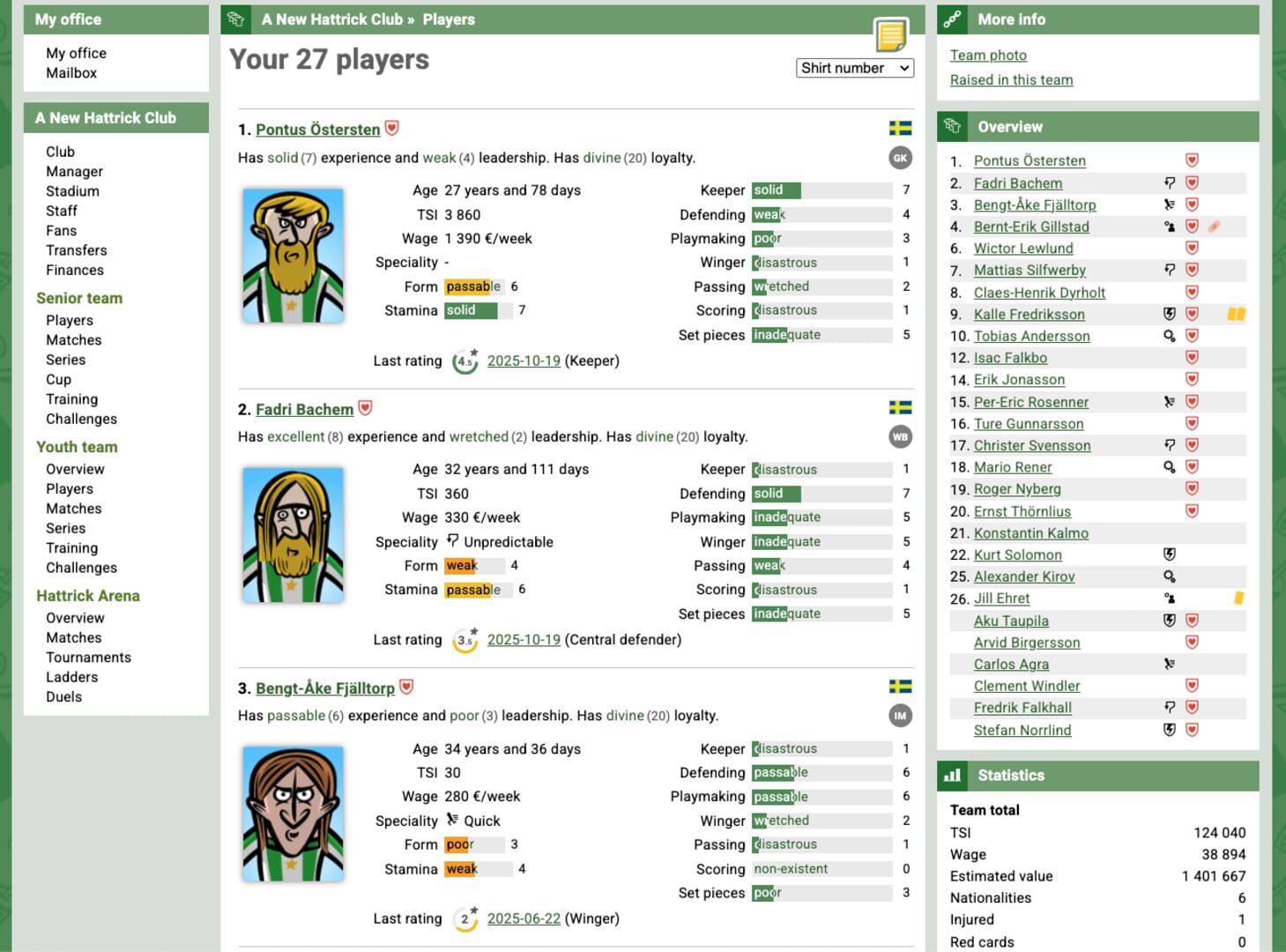
Gameplay revolves around managing a football team, tasking the player with buying and selling players, setting the team's lineup, or expanding the arena to the perfect size, with each player having a team of their own. Many types of teams exist within Hattrick, with team types shaped by the training program set up by the player, as well as the formations played. Each included country has a league, which is divided into series. The series below the main divisions are also groups, where teams play each other in two legs, the number of sets and groups are defined according to the number of users in the country.
Each included country also has a national cup that is played by all teams through a knockout system. The winners of the top division and cup of each country gain spots in the Hattrick Masters.
Development
In April 2012, Hattrick Holdings was purchased by Zattikka, a casual gaming developer based in the United Kingdom, as part of its strategy to acquire established but "under-exploited" online games. As a preparation for the sale to Zattikka, the developers declared that they would not improve core features of the game for the foreseeable future (for example, postponing the announced new staff system), but instead focus on improving the experience for newer players coming into the game, as well as attracting new members and adding things, such as Hattrick gears, that users can pay for. The philosophy to not be able to pay for success still stands. In August 2013 the former owner group of Hattrick (which includes HT-Johan and HT-Daniel) reached an agreement with Zattikka to buy back the game.
Reception
Hattrick has been studied academically, for example being used in a University of Helsinki case study into whether online simulation games, such as Hattrick, could be used as a business model for online betting and gambling businesses. The conclusion was "Online gambling on simulated sport events is a very interesting proposition with good prospects in the future; further research and piloting projects are however needed before one can give any conclusive answer to the actual future value of such services."
It has also been used as the basis for a Lund University academic paper, "Time Extraction from Real-time Generated Football Reports", presented at the Nordic Conference of Computational Linguistics in Tartu, Estonia in 2007.


