The articlegameplay, story, development, reception
Gameplay
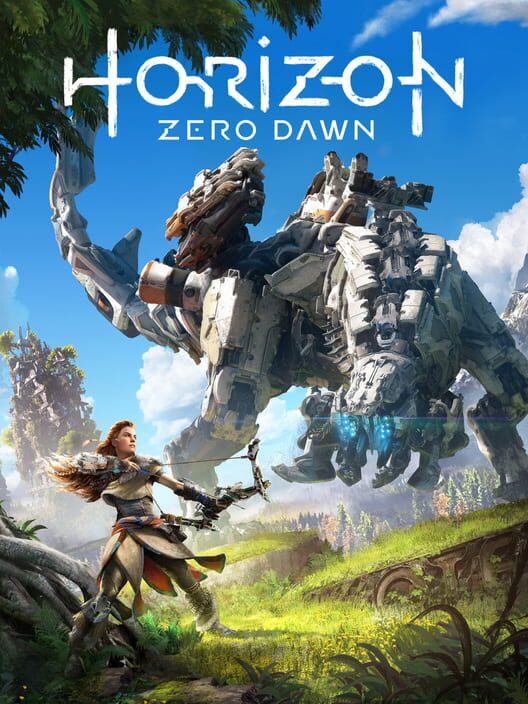
Horizon Zero Dawn is an action role-playing game played from a third-person view. The player controls Aloy, a huntress who ventures through a post-apocalyptic land ruled by machine creatures. These machines and human enemies, like bandits and cultists, are the game's main types of enemies. Aloy can dodge, sprint, slide, or roll to evade her enemies.
Armed with a spear for melee combat, Aloy can also shoot enemies with bows and arrows, set traps such as tripwires, harpoon them to the ground to restrict their movement, or slingshot explosives at them. Different ammunition types offer specialised utility. For example, some arrows help the player dismantle a machine's offensive capabilities by tearing off specific components and disabling weapons, while others can burn or stun enemies. Weapons can also be modified to enhance their qualities such as increasing their damage output or improving their handling.
The player can also hide in foliage to ambush nearby enemies, and distract enemies by throwing rocks or whistling. Aloy wears a Focus, a small earpiece that scans machines to identify their location, susceptibilities, level, and the nature of loot they will drop. Information about these machines is then stored in an in-game journal. Machines are categorised into different classes, including Acquisition, Combat, Recon, and Transport, each of which determines their behaviour and response to the player.
Horizon Zero Dawn features an open world that can be freely explored by players. The player uses campfires to save their progress and travel quickly to other locations across the map. Aloy can hack a selection of machines with her spear, some of which can be turned into makeshift mounts. Scaling and hacking large giraffe-like machines known as Tallnecks reveal locations of interest around the map.
Exploring underground ruins unlocks additional machines to hack. The main questline handles the major mysteries regarding Aloy's origins and side quests flesh out the world's culture and answer smaller questions. Players can choose from several responses when communicating with non-player characters (NPC), allowing them to shape Aloy's personality during social interactions. The player can also complete optional activities, such as raiding bandit camps, completing hunting challenges, and clearing combat trials in areas of heightened difficulty.
The player can find a variety of collectables throughout the game, such as vantages that offer visual information of a past civilisation, metal flowers that contain poetry, and old relics, such as ancient mugs and tribal artefacts.
During exploration, players collect natural resources and machine parts to craft ammo, traps, and potions. Hunting animals also provides materials to craft upgrades that allow Aloy to carry more arrows and consumables. The player can visit merchants to sell unwanted scraps, and purchase additional weapons and outfits. Aloy earns experience points (XP) by completing quests and activities.
While individual kills provide a baseline amount of XP, the game rewards skilful play, such as stealth takedowns or headshots, with bonus XP. Once enough XP is accumulated, the player earns Skill Points for upgrading Aloy's abilities. Skills are divided into three categories, allowing players to separately upgrade Aloy's stealth abilities, enhance her combat effectiveness, and improve her healing and gathering capabilities. Through upgrades, Aloy can perform additional feats such as aiming a bow in slow motion, shooting multiple arrows at once, or collecting more resources from each defeated enemy.
The player receives rarer variants of the same weapon as they progress the game, allowing access to more ammo types and providing more modification slots.
Story
The story is set in a post-apocalyptic Western United States in the 31st century. Humans live in scattered, primitive tribes with varying levels of technological development. Their technologically-advanced predecessors are remembered as the "Old Ones". Large robotic machines dominate the Earth.
For the most part, they coexist peacefully with humans, who occasionally hunt them for parts. However, a phenomenon known as the "Derangement" caused machines to become more aggressive toward humans, and caused larger and deadlier machines to appear. The surviving humans are divided into distinct cultures, ranging from the mountain-dwelling, matriarchal Nora hunter-gatherers to the Carja, an empire of desert-dwelling city builders.
Aloy is cast out from the Nora tribe at birth and raised by a fellow outcast, Rost. As a child, she obtains a "Focus", an augmented reality device that gives her special perceptive abilities. Curious about her origins, Aloy undergoes years of training to win the "Proving", a tournament that will compel the Nora tribe's matriarchs to reveal her past. Aloy wins the competition, but masked cultists suddenly attack.
Rost sacrifices himself to save Aloy from the cult leader, Helis. When Aloy awakens, the matriarchs explain she was found as an infant before a sealed door within the Nora's sacred mountain. They allow Aloy to leave their lands to pursue the cultists. Aloy learns the cultists are a splinter faction called the Eclipse and that she was targeted for her resemblance to an ancient scientist named Elisabet Sobeck.
Exploring the ruins of Faro Automated Solutions, Aloy discovers that the past civilisation was destroyed a thousand years ago when Faro lost control of its self-replicating, biomass-consuming military machines. Sobeck spearheaded "Zero Dawn", a project to create an automated terraforming system to eventually deactivate the machines and restore life to Earth.
Aloy is contacted by Sylens, a secretive figure interested in uncovering the fate of the ancients. He guides her to a decommissioned military base beneath the Citadel, the centre of Eclipse power. Aloy learns that Zero Dawn was an underground network of cloning facilities and databases controlled by a single artificial intelligence, GAIA. After the extinction of life, GAIA successfully deactivated the Faro machines and built her own animalistic machines to restore the biosphere.
She then reseeded life on Earth using stored DNA, intending to teach the new humans not to repeat past mistakes. However, Ted Faro sabotaged the subsystem containing humanity's history (and thus his culpability for the destruction), reducing the new generation to a tribal society. Aloy also discovers that the Eclipse are secretly controlled by HADES, another of GAIA's subsystems originally designed to enact a controlled extinction if the terraforming process failed.
After obtaining a registry to open the door in the Nora mountain, Aloy is captured by Helis but escapes with Sylens's help. She returns to the Nora, helps them defeat the Eclipse, and finally unlocks the mountain's door. Inside, a recording from GAIA reveals that a transmission of unknown origin caused HADES to go rogue. GAIA attempted to stop HADES by self-destructing, but failed and lost control of her terraforming network, causing the machines to become aggressive.
As a contingency, GAIA created a clone of Sobeck in the form of Aloy to one day destroy HADES and restore her functions. Aloy retrieves the master override needed to destroy HADES. Sylens admits he originally founded the Eclipse, tempted by HADES's promises of knowledge, but now realises the AI intends to reactivate the Faro machines and extinguish all life again.
Aloy, aided by her allies, defends Meridian, the capital city of the Carja kingdom, against an Eclipse siege using awakened Faro machines. She kills Helis, and fights off the corrupted machines. She stabs HADES with the master override, ending the war. Aloy journeys to Sobeck's childhood home to mourn her predecessor. In a post-credits scene, Sylens captures the fleeing entity of HADES, intending to interrogate it to find out who sent the signal that awakened it.
Development
Guerrilla Games began developing Horizon following the release of Killzone 3 in 2011. In late 2010, Guerrilla solicited ideas from everyone in the studio as to what their next game would be. There were few guidelines other than no puzzle or racing games. Around 40 pitches were made, and among these was Horizon Zero Dawn, pitched by art director Jan-Bart van Beek, which game director Mathijs de Jonge considered "the most risky" of the concepts.
Guerrilla co-founder and managing director Hermen Hulst said a big part of the decision was to move away from the dystopian, gritty tone of the Killzone franchise to a game that was more beautiful and vibrant. Horizon was also chosen because their parent company Sony did not have a western role-playing video game (RPG) in its portfolio at the time. The concept was defined by three pillars: a lush, documentary-style nature setting, robotic dinosaurs, and a red-headed lead character. Development was put on hold briefly when the game Enslaved: Odyssey to the West (2010) released, as it featured a similar post-apocalyptic setting and red-headed protagonist.
According to Hulst, the team began prototyping a different project for six months before deciding to pitch Horizon to Sony again, driven by their desire to produce something that was "radically different". Lambert Wolterbeek Muller served as Lead Producer, while Michiel van der Leeuw and Misja Baas oversaw the technical and art directions, respectively.
A small team of 10–20 built prototypes of the game. After Killzone Shadow Fall was completed in late 2013, the remainder of the staff joined Horizon. Guerrilla had roughly 270 internal employees to work on the game, while using 18 different outsourcing companies worldwide. Virtuos, based in Singapore, dedicated 65 employees for over two years to build different machine types and bandit settlements.
Other contributors included 3Lateral (Serbia) for facial animation, Territory Studios (New York) for interface design, Audiomotion (London) for motion capture, and Kokku (Brazil) and XPEC Art Center (Taipei) for environmental assets and robotic models. To ensure consistency, Guerrilla provided a large library of reference photos to the outsourcing teams. Horizon had an estimated budget of over €45 million.
Unlike many role-playing games that emphasise player choice, Horizon prioritised a more curated, personal story, borrowing the scope and interactive dialogue of RPGs while embracing cinematic storytelling commonly found in action-adventure games. To strengthen its RPG credentials, Guerrilla recruited talent from franchises like The Elder Scrolls and The Witcher. Horizon was designed to be an accessible experience, and the team avoided adding deep role-playing systems to the game. Traditional character stats for Aloy were removed, and the team adopted a simple user interface design.
The team was inspired by Fallout 3 (2008), an RPG emphasising emergent gameplay that gives the player agency and freedom to perform actions beyond the developers' original intent. Gameplay was designed to be challenging, especially when the player ventures off the beaten path, and combat was divided into three stages: "prepare", "engage" and "escape". Original designs had the protagonist using a rifle, but this was changed to tribal weaponry because high-tech gunfire felt conceptually wrong for the setting.
Horizon was Guerrilla's first open world game. Van Beek said they had to change their design philosophy from "designing rollercoaster rides" with Killzone to creating full "theme parks" with Horizon. Guerrilla studied the gameplay structure of other open world games, such as The Elder Scrolls V: Skyrim (2011), to determine the density of the game's world. The team wanted to give the player more options for how they approached objectives.
Guerrilla designed the game's stealth mechanics to evoke the sensation of a hunt rather than a traditional stealth experience. To achieve this, the artificial intelligence (AI) controlling the enemies was programmed to be lenient during the player's initial detection, but deliberately made it difficult for Aloy to fade back into hiding once fully discovered. This design choice was intended to encourage the player to commit to combat encounters rather than repeatedly fleeing to reset enemy aggravation. Machines were initially the only enemy type in the game, and human enemies were added to introduce more combat variety and show different tribal cultures.
The team had to significantly scale back the size of the game world after they realised they could not fill the entire map with content. A plan to support cooperative multiplayer was scrapped.
Initial work focused on how different human tribes would interact with the machines of the world, which in turn dictated the style of their clothing, architecture, and tools. A major goal for the team was to treat the machines as a natural part of the ecosystem, and show that the tribes viewed them as a standard part of their daily lives and environment. The game's concept explores the juxtaposition between the danger and beauty of the world, particularly analysing the concept of humanity not being the dominant species. It also explores the integration of nature and technology, depicting a world where nature itself has become technological.
The game's weapons were designed to reflect the primitive and technologically regressed nature of the surviving civilisation. The developers created distinct cultures like the matriarchal Nora and the patriarchal, technology-embracing Carja to represent diverse worldviews. In extrapolating the game world, Guerrilla collaborated with anthropologists and researched the formation of tribal cultures. Jared Diamond's books, Guns, Germs, and Steel (1997) and Collapse: How Societies Choose to Fail or Succeed (2005) were the team's main sources of inspiration.
Despite being set centuries into the future, characters in the game mostly speak plain English, and the team av
Reception
Horizon Zero Dawn received "generally favourable" reception according to the review aggregator website Metacritic, while 94% of critics recommended the game according to OpenCritic. Critics generally agreed that it was visually impressive with a familiar gameplay design.
The combat received generally positive reviews. Dan Silver from The Guardian described combat as "endurably exhilarating", and liked how each machine required different tactical approaches. Peter Brown from GameSpot found the machine design to be creative and liked how the game gradually introduced more complex variants as the player became more proficient in combat. Their distinct attack patterns were also praised for contributing to combat variety.
Several critics wrote that these machine combat encounters created a lot of emergent yet memorable moments, and fighting against larger machines was considered to be a satisfying experience as they tend to push the player to use all gadgets available to them. Several reviewers also noted that combat in the game can be demanding. Phillip Kollar from Polygon compared the cadence of gameplay alternating between crafting, combat and collecting materials to Monster Hunter, and found Horizon to be more approachable. Melee combat and combat encounters with human enemies, however, were singled out as weaker parts of the game.
The game's world design received praise. Writing for The Verge, Andrew Webster praised Guerrilla's attempts at worldbuilding, noticing that each tribe has a unique visual identity reflected in their architecture and clothing design. Kollar observed that Horizon was the result of a team being allowed to do something new, adding that it had more personality when compared with Guerrilla's past works. Jeff Marchiafava from Game Informer noted that the world provided "a remarkable sense of discovery", praising its diverse biomes, machine types and human settlements, while Justin Clark from Slant Magazine wrote that the game had the "most vibrant and beautifully envisioned open worlds in a video game to date".
The game's wealth of content and the variety of its activities were also praised. Despite noting the novelty of the game's setting and finding it to be graphically impressive, many reviewers wrote that Zero Dawn did not deviate from the design established by other contemporary open-world games. Webster described it as a "greatest hits" collection of mechanics, while Silver felt the game fell short of being "seminal" due to a lack of innovation. Its implementation of RPG elements, such as predictable side quests, a rudimentary crafting system, and an often-cluttered inventory, was also criticised for being unrefined.
Silver from The Guardian and Sammy Barker from Push Square wrote that the game did not actually allow the player to have much agency in the role they play because it follows a very fixed, predetermined path, with Silver suggesting that the RPG mechanics were "lip service to genre expectations".
The game's story received praise by critics. Webster wrote that the game's central mystery kept him engaged despite the slower opening hours, and added that the story was both "personal" and "epic". Kollar was frequently surprised by its narrative, and liked how the game set up future adventures while being self-contained on its own. Several reviewers praised how the game integrated modern-day tribal conflicts and politics in a story about the mysteries of the past.
Brown praised Aloy's character development and the story's exploration of themes about nature and technology. He described the central mystery to be "fascinating", though he found the quality of the side content to be inferior in comparison. Silver found the story to be compelling, but disliked the game's reliance on "extraneous exposition" as well as audio and text files to convey the narrative. Aloy was observed to be perfectly coupled with the story in that she offered the curiosity to seek out its many mysteries.
Barker described her as a determined yet vulnerable character, comparing her to Katniss Everdeen, Hermione Granger, and Lara Croft. Burch's performance was also praised, with Sam Machkovech from Ars Technica calling her performance "emotionally well-rounded".
The game received some criticism for the similarities between the tribes and Native Americans, but having Aloy, a white female, as the lead protagonist. Dia Lacina, a Native American writer, argued that some of the terminologies used within the game were also considered to be disrespectful. Gonzales said the terminology was discussed during the creative process to make sure that the team was being sensitive to the cultural concerns of the audience. He added that the team did not base the tribes on one group; instead, they looked at people from all around the world and different time periods. Four reviewers in Famitsu complimented the game, with Ranbu Yoshida saying that while it was overall high quality, the game did not break any new ground.
==== Horizon Zero Dawn Remastered ====
Horizon Zero Dawn Remastered received "generally favourable" reception, according to Metacritic, and according to OpenCritic, 89% of critics recommended the game. Critics praised the graphical improvements, the updated character animations, and the technical performance. Criticisms included questioning whether the remaster was necessary, technical and animation issues, and the price for players who did not previously own the game. Empire's Matt Kamen felt that the remaster created a more immersive experience where Aloy feels like a natural part of an "overgrown world" and IGN Benelux's Niels Hassfeld said that Nixxes addressed criticisms of the original game's stiff facial expressions which brought character interactions closer to the quality seen in Forbidden West. TechRadar's Lloyd Coombes noted that actions such as firing a bow or deploying a Tripcaster feel more "kinetic" thanks to the DualSense controller's adaptive triggers and TheGamer's Jade Ki
Legacy
Guerrilla announced a sequel titled Horizon Forbidden West in June 2020 at the PlayStation 5 reveal event. The game was released on 18 February 2022 for PlayStation 4 and PlayStation 5, and was ported to Windows on 21 March 2024 The story takes place six months after the conclusion of Zero Dawn. In the game, Aloy ventures into the Forbidden West and uncovers the origin of the extinction signal that triggers the activation of HADES. Ashly Burch reprises her role as Aloy, while Carrie-Anne Moss and Angela Bassett are among the new cast members.
Guerilla enlisted UK-based Studio Gobo as a co-development partner in January 2023 to expand the Horizon universe. Lego Horizon Adventures was announced on 7 June 2024 and released on 14 November for Nintendo Switch, PlayStation 5, and Windows. Key cast members from Zero Dawn return to reprise their roles, but the role of Sylens was recast following the death of Lance Reddick in March 2023, with Tim Russ playing the character in the game. Lego Horizon Adventures reshapes the story of Zero Dawn in an upbeat and family-friendly way, with the team significantly downplaying the apocalyptic story.
In January 2025, Sony announced that a film adaptation of the game was in the works at PlayStation Productions and Columbia Pictures. PlayStation Productions president Asad Qizilbash stated that the company had a working script and were searching for a director, and that the company was planning to start shooting the film in 2026 for release in 2027.
A tabletop game, Horizon Zero Dawn: The Board Game, was announced as being in development in August 2018 by Steamforged Games. The game was funded on Kickstarter in less than two hours and began shipping out in November 2020. An expansion named "The Sacred Land" was released on 14 September 2021. In March 2020, it was announced that Titan Comics would release a comic book series, including a prequel issue for Free Comic Book Day.
The story takes place after the events of the game. The four-issue comic book miniseries called Horizon Zero Dawn: The Sunhawk was supposed to release its first issue in July, but was slightly delayed by the COVID-19 pandemic and released monthly between August and November. A second four-issue miniseries called Horizon Zero Dawn: Liberation was released starting with the first issue in July 2021 and concluded in January 2022. Its story takes place during the events of the game.
The comics were co-created and written by Anne Toole, one of the writers for the game.
In May 2022, it was announced that a live action television series adaptation was in development at PlayStation Productions and Sony Pictures Television for Netflix, with Steve Blackman writing and producing the series under his Irish Cowboy production banner. Aloy was expected to be the main character. By January 2024, writing was underway on the series. The series was no longer moving forward by that June after a January 2023 HR complaint was made public, in which twelve former Umbrella Academy (2019–2024) writers and support staffers accused Blackman of "toxic, bullying, manipulative, and retaliatory behavior".