
The articlegameplay, story, development, reception
Gameplay
The player must complete a number of minigames composed of repeative quick time events, simple puzzles, and guessing games. Most of them use either 2D or 2.5D graphics and have the character of Hugo controlled with keyboard or joystick input as he uses a variety of means of transportation to traverse through levels. Hugo will typically start each scenario with three lives, triggering a relevant cutscene when any is lost. During the games Hugo (voiced in Danish by Michael Brockdorf and German by Michael Habeck, Oliver Grimm and Oliver Baier) and Scylla (voiced in Danish by Winnie Engell and in German by Karin Kernke) communicate with the player with digitized speech, and can also knock on (or scratch) the screen from the inside, breaking the fourth wall.
In order of release:
"Labyrinth": Hugo must find his way through an underground labyrinth, avoiding dynamite and mined wagons before a box of TNT destroys the maze. Completing the main section will have Hugo cross a dangerous hanging bridge before facing three doors, one of which leads to a treasure room. It has first appeared in Skærmtrolden Hugo (the original Hugo game released for the Commodore 64, Amiga and MS-DOS in 1990-1991), and was then reused in Hugo Gold, Hugo Die Geburtstagsparty, and in a remade form in Hugo Retro Mania.
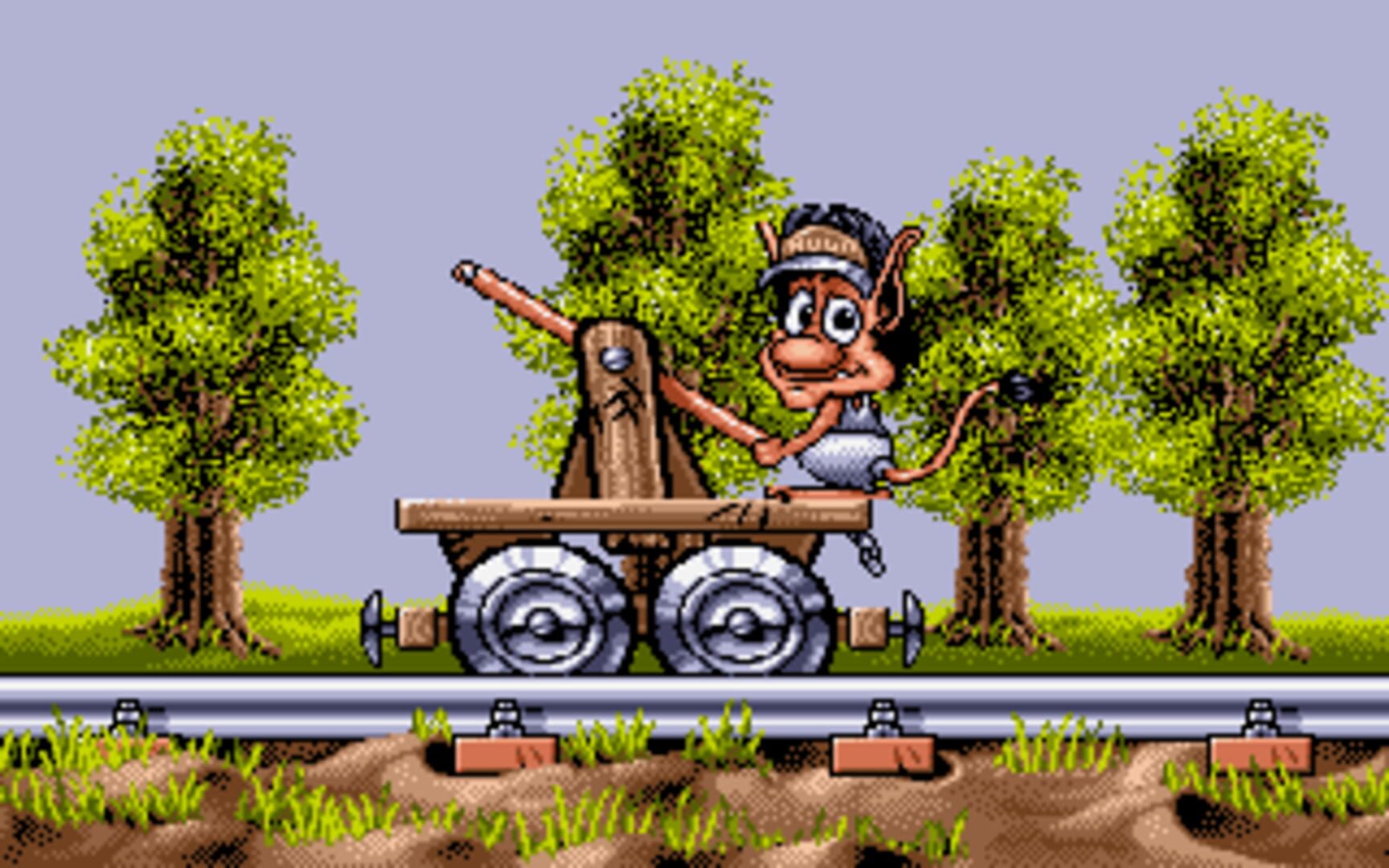
"Handcar" (or "Train"): Hugo finds an old track leading to Scylla's lair. The player helps the troll and his handcar reach their destination by changing tracks, dodging oncoming steam locomotives, and collecting bags of gold. It was featured in Hugo - På Nye Eventyr and Hugo I/II (PC), Hugo Gold, Hugo XL, Hugo Die Geburtstagsparty, Hugo Classic 1 (PC), Hugo (PlayStation), and in a remade form in Hugo Troll Race.
"Plane": Hugo flies a biplane through a fierce thunderstorm summoned by Scylla towards her lair, avoiding lightning clouds and bomb-carrying balloons while collecting gold. It was featured in Hugo - På Nye Eventyr Del 2 and Hugo I/II (PC), and was remade for Hugo Gold, Hugo XL, Hugo Safari, Hugo Classic 1 and Hugo (PlayStation). It was also featured in a remade form in Hugo: The Magic Journey.
"Forest": Hugo wanders through the forest in a search for Scylla's hiding place while avoiding traps set up by the witch, who also sends a storm cloud over the forest once she finds out that he is on his way (the entire forest turns dark and evil). It was featured in Hugo - På Nye Eventyr Del 2 and Hugo I/II (PC), Hugo Gold, Hugo XL, Hugo Classic 1 and Hugo for (PlayStation). It was remade for Hugo Rainforest with all new graphics and different obstacles (similar to these in Swamp), and scrolling left and not right. This version was also included in Hugo Classic 4.
"Mountaineering" (or "Mountain"): Hugo runs up around a mountain on a cliff path to the witch lair at the peak while dodging huge rolling stones and chasms and trying to collect bags of gold. It was featured in Hugo - På Nye Eventyr, Hugo I/II (PC), Hugo Gold, Hugo XL, Hugo Safari, Hugo Classic 1, and Hugo (PlayStation).
"Minetrack": Scylla hides in an abandoned mine and Hugo barrels down a mine shaft in search of an entry to her lair, avoiding obstacles in the ceiling and corridors and collecting gold. It was featured in Hugo 6, Hugo Die Geburtstagsparty, Hugo Classic 4 and Hugo 2 (PlayStation).
"Scuba": Hugo dives through a river, avoiding water creatures and collecting treasure chests. He has to keep surfacing to replenish his air, and to always turn the right way to avoid waterfalls. It was featured in Hugo 3, Hugo Gold, Hugo XL and Hugo (PlayStation).
"Ice Cavern": Hugo found a secret back entrance to the witch's lair, but he first needs to cross a large chasm by jumping through moving ice pillars while collecting three magic items, whose order must be memorized correctly to open the door upon reaching it. He also needs to constantly keep moving as to avoid triggering the traps. It was featured in Hugo 3 (PC), Hugo Gold, Hugo 2 (PlayStation), Hugo Platin and Hugo Die Geburtstagsparty.
"Lumberjack": Hugo floats downstream on floating logs, hopping between logs to avoid branches and collect sacks of gold. If Hugo stays on a log for too long, he will lose balance. It was featured in Hugo 3, Hugo Gold, Hugo XL and Hugo (PlayStation).
"Skateboard": Hugo skates down a wooden half-pipe while avoiding boulders, bridge holes and beaver dams, and collecting bags of gold. It was featured in Hugo 3, Hugo Gold, Hugo XL, Hugo Die Geburtstagsparty and Hugo (PlayStation). It was also completely remade for Hugo Troll Race 2.
"Balloon": Hugo steers a hot-air balloon down by a river canyon to Scylla's hideout while avoiding obstacles. When his balloon punctures, Hugo has to make an emergency landing at the bottom of a ravine without touching the cliffs. It was featured in Hugo 4, Hugo Platin and Hugo Classic 2 (PC).
"Dolmen Cave": A revised "Labyrinth" scenario where Hugo navigates a haunted underground maze to reach the mountaintop and enter Scylla's lair there from below. The player must find the right path quickly, avoiding dangers, to reach the lift before Scylla floods the maze and drowns him. It was featured in Hugo 4, Hugo Platin, Hugo Die Geburtstagsparty and Hugo Classic 2 (PC).
"Moor" (or "Swamp"): Scylla's cave is surrounded by a spooky swamp that Hugo must while avoiding mud holes and birds while being chased by a flock of bats, before solving a puzzle to open the gate to the witch's hideout. It was featured in Hugo 6, Hugo Classic 4, and Hugo 2 (PlayStation).
"Snowboard": Hugo snowboards down a hill, following track towards Scylla's lair, but the witch knows Hugo's plans and has caused an avalanche, adding a ticking clock to the game. The path often splits, leaving some dead ends and passing through fast and slow slopes as Hugo swings on his snowboard to avoid rolling giant snowballs while collecting gold. It was introduced in Hugo 4, then was remade twice, first for both Hugo Platin and Hugo Classic 2, and then for Hugo 2 (PlayStation).
"Nimbus" (or
Story
In the games' usual story, a wicked witch named Scylla (often named differently in various countries, including Afskylia in the original Danish version) arrives at the home of Hugo the troll and once again kidnaps his wife Hugoline and their three young children (Rit, Rat and Rut) because she needs them for a magical beauty treatment. Hugo must undergo a series of dangerous adventures reach and rescue Hugolina and the children and perhaps even eliminate the hateful and cruel Scylla to bring peace to the Troll Forest. The witch, however, is well prepared for Hugo as she watches his progress through a crystal ball and casts spells to stop him, having previously placed all sorts of devious traps in the various paths leading to one of her several "skull cave" lairs. Typically, if Hugo reaches Scylla's hideout, the witch will personally meet the troll in confidence that he cannot win and now she must be defeated in one way or another to truly finish the game. Some versions also feature alternative ending sequences that may not even feature Scylla.
The PlayStation Hugo 2 release is unique in that the game's story continues from where the first one left off, where Hugo's family has been rescued but the evil Scylla has fled and now is back for revenge. As Hugo is returning home in an old airplane with his loved ones the after celebrations, Scylla flies to her main castle, where she casts a spell to gain power over the clouds to take Hugolina again and destroy the plane. Hugo's children all parachute down before his plane crash lands in the snowy mountains. Once again, Hugo needs to again overcome many dangers that lie before him to save his wife from the witch who as always will use all her cunning and dark magic to stop him. This time, he will also need to first find each of his three missing children while on his way.
The mobile version Hugo 2 / Hugo 2½ is distinctive as well. In it, Scylla has captured Hugo himself, and now he must get away from her and reunite with Hugolina.
Development
Two Amiga games, Hugo (originally titled Hugo - På Nye Eventyr: Del 1) and its sequel, Hugo 2 (originally Hugo - På Nye Eventyr: Del 2) were originally released in 1991 and 1992, and then ported to MS-DOS in 1992–1993. They were re-released as a 1994 compilation, Hugo (Hugo På Nye Eventyr), ported to the PC as Hugo 3 (international title) in 1995. Both games were similar to the children's television show of the same title where the contestant would try to completes arcade sequences to collect points and avoid obstacles using a phone, and the ending minigames are identical to the ones seen on TV.
Later Windows releases have included Hugo 4 (1996, originally Hugo: Äventyret Går Vidare), Hugo 5 (1997), and Hugo 6: Wild River (1998), as well as their updated compilations Hugo Gold (1998), Hugo Platin (1999) and Hugo XL (1999). Furthermore, several of the releases were partially incorporated into 2000's Hugo - Die Geburtstagsparty and Hugo Safari (both of which were also based on newer Hugo works) and the Hugo Classic Collection (compiling the first titles). The latter consisted of seven or eight releases (depending on country), including Hugo Classic 1-4 based on the original series (in addition to Hugo Classic 5-6 based on the Hugo: Jungle Island series).
The two PlayStation games, which reused the titles Hugo (1998) and Hugo 2 (1999), are partial remakes of the computer games. They feature the same scenarios but with improved graphics and sound (including musical tracks for each stage), plus a rendered opening animation in the second game. An early concept was more ambitious, promising "a new storyline for Hugo and special new scenarios using both 2D and 3D technology".
Hugo was also ported by Laguna and Infogrames to the Game Boy as Hugo 2 in 1997. This version features simplified graphics and gameplay and was later ported to the Game Boy Color by Bit Managers and Infogrames in 1999 under the title Hugo 2½.
Reception
The games received mixed and often negative reviews. According to Francisco Delgada from Spanish magazine pcmanía, while Hugo is "not a bad game", it is "a bit bland and repetitive, especially since the video game version only differs from television [game] in its difficulty". Arkadiusz Matczyński from Polish magazine Świat Gier Komputerowych recommended it as a "fantastic" game for younger Amiga users, but noted the more mature audience might get bored quickly.
PlayStation reviews were often much harsher. Mike Goldsmith from Arcade wrote about the PlayStation releases: "Advertised as being 'designed for children aged 6+', Hugo will come off as simplistic at best, patronising at worst - a real shame given the quality of edutainment titles that could be ported from PC and Mac". German magazine Maniac called them some of the worst PlayStation games. In 2003, PlanetStation, having previously given both Hugo and Hugo 2 the lowest possible score of 1 star, included Hugo among the five worst games from the 50 issues of the magazines.
Retrospectively, PlayStation Official Magazine listed Hugo, described as "bloody rubbish", atop its list of worst PlayStation characters. In 2012, Game Informer made a Replay-section retro video poking fun at the PlayStation Hugo and Bubsy 3D.
Nevertheless, the series was a massive commercial success. The first PC game has remained Germany's #1 best-selling PC floppy disk game for a long time in 1995, including in March, June, July, October, and November, as well as the #1 best-selling Amiga 500 game of September 1996, while Hugo 3 landed #2 upon its premiere in 1996. Previously, Hugo has been one of the best-selling computer games in Spain in 1992. In August 1998, Hugo 2 for the Game Boy received a "Gold" sales award from the Verband der Unterhaltungssoftware Deutschland (VUD), indicating sales of at least 100,000 units across Germany, Austria and Switzerland.
It was the #2 best-selling GB game in Germany in September 1999. As such, Hugo Gold has been featured as a Classic of the Month at the Computerspielemuseum Berlin.
Legacy
dk). Its story involves finding treasures in a mine and rescuing Hugolina from Afskylia/Scylla. It was followed by Hugo 2 partially based on "Ice Cavern" in 2018. The 2019's Hugo's Adventure features elements from the airplane and ropes minigames.
Hugo Carts, inspired by the mine track scenario but having Hugo and Hugolina work together against Scylla, was released in 2021. Another slot game, Hugo Legacy, featuring mine track inspired theme along with a symbolic version of the rope endgame, was released in 2023.