
1991 · Activision · Action-adventure · Adventure
Hunter
Hunter is a 3D action-adventure game in which the player navigates around a series of islands. Hunter was developed by Paul Holmes and Martin Walker (music), and it was released by Activision for the Amiga and Atari ST home computers in 1991. The combination of the game's 3D graphics and sandbox-type gameplay has been subsequently compared to the Grand Theft Auto series and similar sandbox games, such as Far Cry 2.
- Released
- 1991
- Platforms
- AmigaAtari STAtari ST/STE
- Genres
- Action-adventureAdventureArcade
- Developers
- Activision
- Publishers
- Activision
- Modes
- Single-player
- Perspective
- Third person
- Themes
- ActionSandboxOpen world
- Country
- United Kingdom
About
Hunter is an early 3D action-adventure game in which the player navigates around a series of islands. Hunter was developed by Paul Holmes and Martin Walker (music), and was released by Activision for the Amiga and Atari ST home computers in 1991.
›Story
ADAPT TO SURVIVE. SEEK TO DESTROY
The Hunter is alone behind enemy lines. With the versatility to make best use of range of options, and the expertise to complete dangerous mission, the Hunter is a breed apart.
Keywords
- modern warfare
- 3d
- shark
- tank
- modern military
- useable vehicles
Media
The articlegameplay, story, development, reception
Gameplay
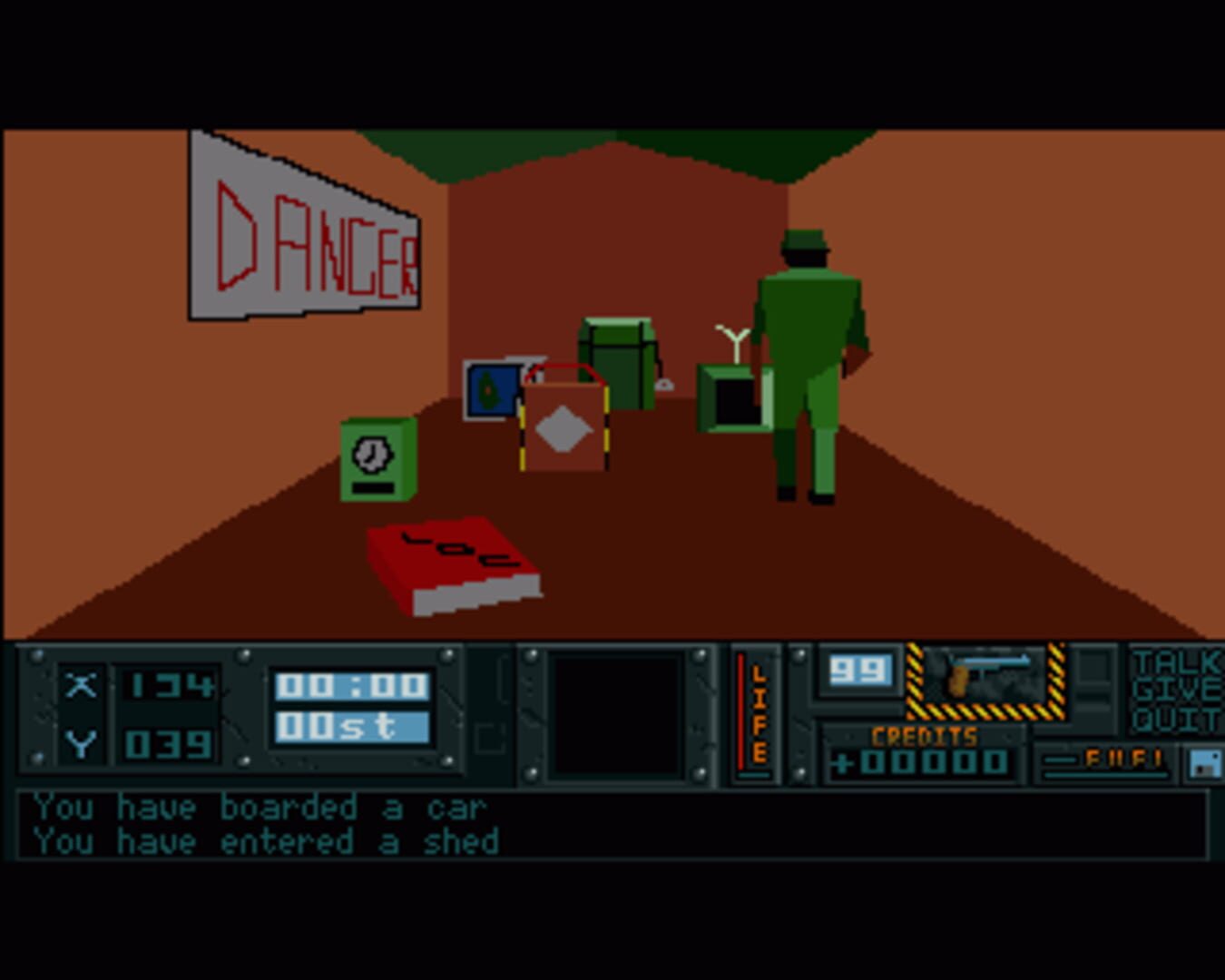
The player controls a soldier in a large three-dimensional world and can move by walking, swimming or using various vehicles ranging from cars to tanks to surfboards. The player may also enter and explore a variety of buildings.
Other in-game characters include enemy soldiers, civilians and animals such as seagulls, sharks and cows. The player has a range of weapons. Surrounding terrain can be surveyed with aerial observation units and radar. Food and money can be used to bribe and gather information from other characters. Target coordinates can be recorded into a log book, and the player's position in the game world can be seen on an overlaying map.
Development
Hunter began development in February 1990, and was originally planned for a February 1991 release date, but was delayed to August. The December 1990 issue of British gaming magazine The One previewed Hunter's development. Hunter's maps are randomly generated each time the game is played, and are created using fractal geometry. After the map is generated, pre-made 3D objects are randomly placed in the game environment.
Hunter is 64 kilobytes large, and has a total of 182 pre-made 3D objects. The code for Hunter's 3D environments was written by Paul Holmes, and was originally intended for a game by CRL Group before they went defunct and the game was cancelled. This code, while used as a base, was "substantially rewritten" according to The One; the code relied on the Amiga's blitter chip, but due to Hunter's planned Atari ST release, this needed to be reworked. Holmes created software that mimiced the Amiga's blitter chip that was compatible with Atari ST hardware; the program turned out to run faster than the Amiga's blitter.
Reception
Hunter received very positive reviews (ranging from 85 to 95 points out of 100) in various game magazines. Although occasional graphical glitches and simplistic animation were noted, most of the reviewers considered Hunter one of the first serious takes on 3D gaming. The game was characterized as an innovative addition to 3D vector games and a bold step forward.
What gathered most attention, however, was the scope of the game and the freedom of movement inside the game world:
Releases by platformdates and regions as published
Games like this
 70
Pocket Tanks
2001 · Android, Windows +2
Arcade · Modern warfare
 78
Battlezone
1980 · Apple II, Arcade +13
Arcade · Modern warfare
 68
Just Cause 4
2018 · PlayStation 4, Windows +1
Action-adventure · Adventure

Crazy Taxi: World Tour
2027 · Nintendo Switch 2, PlayStation 5 +2
Adventure · Arcade
 70
Pax Dei
2024 · Windows
Adventure · Often paired
 63
Grand Theft Auto: The Trilogy - The Definitive Edition
2021 · Bundle · Android, Nintendo Switch +6
Action-adventure · Adventure

Tokyo Wars
1996 · Arcade
Arcade · Modern warfare
 82
Grand Theft Auto: Episodes from Liberty City
2009 · Bundle · PlayStation 3, Windows +1
Adventure
Collections1 collection
Platform libraries
- Atari ST gamesCommercial games
Description adapted from its source, CC BY-SA 4.0.