Ludography
30/100
Players2 ratings
78/100
Critics2 reviews
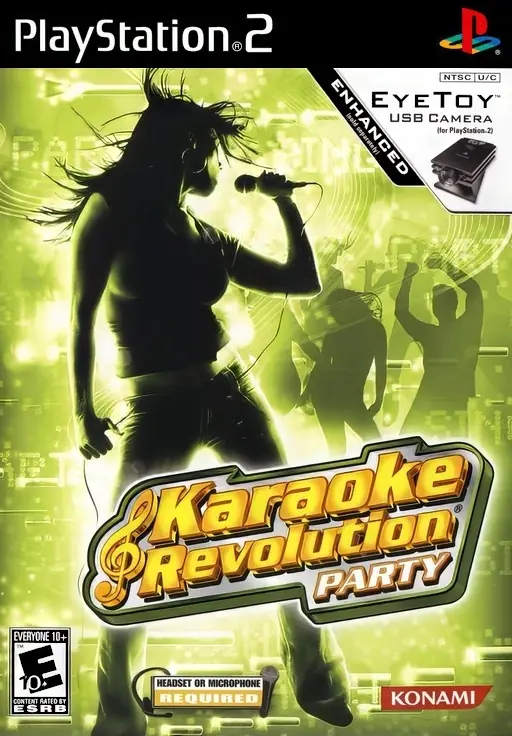
Karaoke Revolution Party cover

2005 · Harmonix Music Systems · Rhythm · Simulation

Karaoke Revolution Party

Along with singing the songs, Karaoke Revolution Party also requires players to hit their marks on the pads as well as the notes on the screen. Along with the trademark vocal lines that scroll across the screen there are now occasional directional arrows to tell gamers when to jump on a particular direction. This is far from the aerobic insanity of the DDR games which can easily build up a sweat as dancers frantically try to keep putting their feet in the right place. Instead, the mode offers more of a light choreography addition to the game. Instead of the usual three dozen songs that the previous games have included, KRP sports 50 tracks that include some classics like "Sweet Caroline" and "Do You Really Want To Hurt Me" as well as modern hits like "Crazy in Love" and "I Don't Wanna Be."

Also known as
Karaoke Stage 2
Released
8 December 2005
Platforms
GameCubePlayStation 2Xbox
Genres
RhythmSimulation
Developers
Harmonix Music Systems
Publishers
Konami
Modes
MultiplayerSingle-player
Themes
Party
Age ratings
ESRB E10+
Languages
EnglishFrenchGermanSpanishItalian

About

Karaoke Revolution and its sequels are music video games for the PlayStation 2, PlayStation 3, GameCube, Wii, Xbox, and Xbox 360, developed by Harmonix, Blitz Games, Secret Level, Inc., and Hijinx Studios and published by Konami in its Bemani line of music games. The original concept for the game was created by Scott Hawkins and Sneaky Rabbit Studios. Technology and concepts from the game were subsequently incorporated into Harmonix's game Rock Band.

The Japanese versions of the game are developed by Konami themselves. The gameplay also differs significantly. Rather than a game per se, it is merely a karaoke system for the PlayStation 2, with no judgments.

The game does not attempt to understand the singer's words, but instead detects their pitch. As such, singers can hum to a song or sing different lyrics without penalty. The game adapts to the player singing in a different octave than the song, to accommodate players whose vocal ranges do not fit the song.

The songs in the game are covers of pop hits frequently sung in karaoke bars. This contrasts with the SingStar series from Sony Computer Entertainment Europe, which features only original artist recordings along with the music videos. However, the 2009 remake of the game (titled Karaoke Revolution, just like the original) features all master tracks.

Keywords

  • karaoke
  • music and rhythm
  • eyetoy support
  • xbox live
  • on disc dlc
  • gamecube microphone support

Media

The articlegameplay, story, development, reception

Gameplay

The player is depicted as a character on-screen performing at a public location. The words to the song scroll bottom to top at the bottom of the screen, above a piano roll representation of the relative pitches at which they are to be sung (the game calls these "note tubes"). At the left end of this area, a "pitch star" shows the pitch which the player is singing and provides feedback on whether they're hitting the notes. A "crowd meter" shows the mood of the crowd as the player sings; if they do a good job of hitting notes on-pitch then the crowd will cheer more loudly and clap in rhythm with the song, and the scene will become more vividly animated. If the crowd meter falls all the way to the lowest rating, the audience will boo the character off-stage and the game is over.

Each song is divided into approximately 30 to 50 "phrases". A meter will fill up and turn from red to green for each phrase, based on how well the player sings the right notes; if the player can fill the meter to green, they will score more points, and getting several greens in a row will create a "combo" and award a 2x score multiplier until the player fails to make green on another phrase. This blue meter resembles how long you should hold the note for and at what pitch. The game can be set at higher difficulties which make this meter larger and require the player to hit the right notes more precisely to fill it to green.

Since maximum scores for each song are normalized 50,000 regardless of difficulty, overall scores on songs can be compared. To achieve the gold record for a song, 12,500 points must be achieved. To achieve the platinum record for a song, 20,000 points must be achieved. Winning records will unlock additional characters, outfits, and songs.

In Karaoke Revolution Party, Karaoke Revolution Country, Karaoke Revolution Presents: American Idol, and American Idol Encore, 50,000 points (a perfect score) earns a diamond record. In Karaoke Revolution Presents: American Idol Encore 2 the point system was changed so that 60,000 points gives a platinum record for a song and 100,000 points is a perfect score (diamond record).

Karaoke Revolution Volume 2 introduces a "medley mode" which challenges the player to sing a string of short clips from various songs.

Karaoke Revolution Volume 3 introduces "duet mode" which lets two singers play simultaneously. It also revised scoring so that perfect performances result in exactly 50,000 points (with the exception of the Jackson 5's "ABC").

Karaoke Revolution Party features minigames, support for the EyeToy camera, and a "Sing and Dance" mode which utilizes the dance pad controller.

Karaoke Revolution Presents: American Idol utilizes American Idol judges, commentary, and stages.

Reception

IGN ranked the 2003 version as the 99th best PlayStation 2 game due to the involvement of Harmonix.

Volume 3 was nominated for the "Best Puzzle/Rhythm Game" award at GameSpot's Best and Worst of 2004 Awards, which went to Katamari Damacy.
Releases by platformdates and regions as published

Releases by platform
PlatformReleasedRegions
GameCube8 December 2005Worldwide
PlayStation 28 December 2005Worldwide
Xbox8 December 2005Worldwide

Title IDsone per regional release, with its latest update

Title ids and disc serials by release
PlatformTitle IDRegionLatest update
GameCubeGK9EA4North America—
PlayStation 2SLES-53491Europe—
SLUS-21223North America—
XboxKN-046North America—

Box artone per regional release we hold art for

Games like this

Collections1 collection

Platform libraries

Description adapted from its source, CC BY-SA 4.0.