
The articlegameplay, story, development, reception
Gameplay
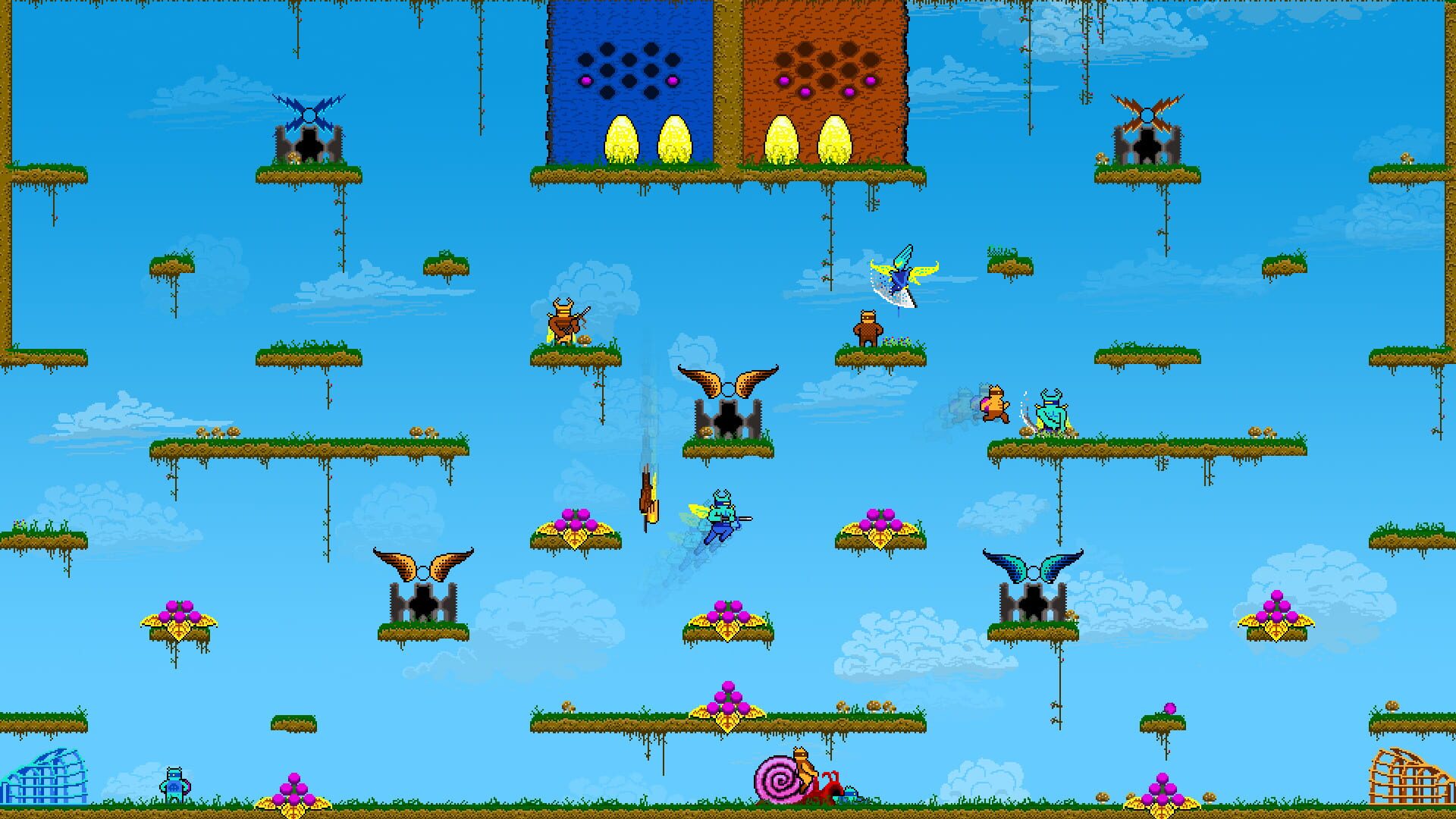
Killer Queen is played by two teams of up to five players each, across two linked cabinets (a blue cabinet for Blue team, and a gold cabinet for Gold team). The game is a 2D platformer, with a shared arena which fits entirely on each cabinet's screen. There are a variety of different arenas, but all arenas have berries, gates, a snail, and a base and basket for each team. Four players on each team initially play as Workers, while one player is the Queen. Both Workers and the Queen will respawn shortly after dying.
Teams can win by fulfilling one of three victory conditions:
Military Victory: Kill the enemy Queen three times.
Economic Victory: Bring a specific number of berries to your team's base (the number varies per arena but is the same for both teams).
Snail Victory: Ride the snail to your team's basket.
Workers can pick up berries (carrying only one at a time) and ride the snail, but cannot kill other units. However, if a Worker takes a berry to a Warrior gate, they become a Warrior until they die. Warriors cannot pick up berries or ride the snail, but they can kill other units and can fly. Workers can also take berries to Speed gates, which causes them to both move faster and ride the snail faster. (This speed upgrade is also maintained if the Worker turns into a Warrior.)
The Queen, like a Warrior, cannot pick up berries or ride the snail, but can always fly and kill other units. The Queen also has a special "dive" attack, and can touch gates to convert them to her team's side, preventing the enemy team from using them. However, as mentioned, if the Queen dies three times, the enemy team wins via Military Victory.
If a team fulfills any one of the victory conditions, they immediately win the match.
Development
Killer Queen went through several iterations on its journey to the arcade, starting off as a college rec league-like outdoor field game inspired by the scent trails of ants. ” After the success of the field game, the game grew into more of a passion project. Mikros and DeBonis - under the independent game studios Sortasoft and Smashworx - started developing the digital game alongside the field game in 2011. Iterations came and went, with one idea being a projected screen and 10 players holding retro NES controllers.
It was when the two made a bet with NYU professor Charles J. Pratt, who thought the field game could not be transformed into a successful multiplayer arcade game, that the structure of Killer Queen today started to take form. By 2013, DeBonis and Mikros had an early version of the arcade cabinet ready. With a commission from the NYU Game Center, the team dove into building the game's cabinet and preparing the game for debut at the college's fourth annual No Quarter exhibition.
The duo wanted to maintain the social aspects of the field game, and pared down the player count to 10 total. With five on each side, jammed close together jostling for space on the arcade machine's control panel, the repeating theme of “Meet Thy Neighbor” flashing across the screen is fitting. After the debut, Mikros and DeBonis took the game on a tour of arcade and video game shows, including Indiecade, GDC, the Amusement Expo and more. As players praised the raucous, community-oriented gameplay, investors and locations operators took interest.
The game soon found itself intersecting with the growth of bar arcades, with Logan Arcade in Chicago becoming the first commercial home for an arcade version of Killer Queen. The game was a hit there, becoming popular enough to warrant an entire night dedicated to playing it each week, and popularizing a trend that would have many bar arcades hosting league nights for it, filling locations on otherwise less popular nights. Community became integral to the game, with leagues similar to the competitive pinball scene growing to include an eager new fan base. As multiple bar arcades reported success and revenues the team behind Killer Queen took it to the next level.
They entered into the traditional arcade industry, looking to provide a unique experience in a traditional arcade cabinet. In 2016, Mikros and DeBonis contracted with Raw Thrills to build cabinets on a larger scale. The traditional arcade giant, headed by legendary designer Eugene Jarvis, made some changes to the cabinets and tweaks to the gameplay. The manufacturer upped the monitor size slightly, added retro style side art, included a tutorial for new players and added an AI system to fill in spots for groups less than 10 playing.
Development continues on the game, with new maps, gameplay tweaks and more released through patches and updates to owners of the now 200+ cabinets in locations nationwide.
Reception
The arcade game was received well, finding success in bar arcades especially. It received multiple awards, including the Developer's Choice Award at 2013's Indiecade and was a finalist at the Independent Games Festival in 2015.


