The articlegameplay, story, development, reception
Story
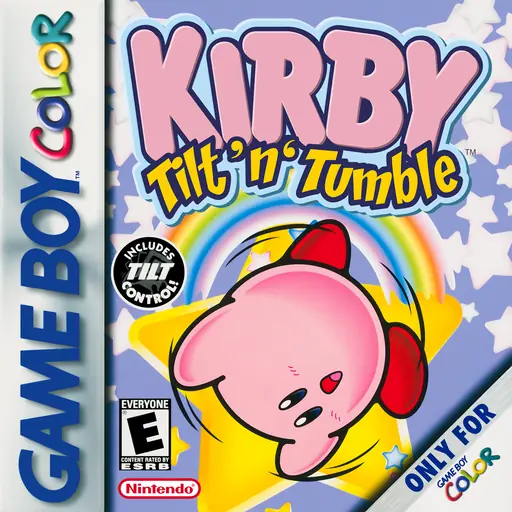
The game begins with Kirby napping on a cloud, when he is awakened as a Waddle Dee walks by, carrying a round pinball-like bumper. He then sees King Dedede, carrying a long bumper. Suspicious of the King's intentions, Kirby hops on a warp star and follows him, determined to find out what he is up to. Soon, Kirby discovers that Dream Land has lost its stars and sets off to get them back.
Development
Kirby Tilt 'n' Tumble started development in April 1999. It was originally titled Koro Monkey (Monkey Tilt 'N Tumble) and starred a monkey. After discussing with Shigeru Miyamoto, the developers then switched the character to Kirby. The game was released in Japan on August 23, 2000.
It was then released in North America on April 9, 2001. It was not released outside Japan and North America.
Reception
Kirby Tilt 'n' Tumble received "favorable" reviews according to the review aggregation website GameRankings. It debuted at number four by the American market research company NPD TRSTS for the month of April 2001.
Game Informer wrote that while the game's concept "sounds simple enough, it actually results in one of the most dramatic, high-tension game scenarios seen on any system." In Japan, four critics from Famitsu gave the game a total score of 30 out of 40.
It was listed as one of the best games for the Game Boy by Game Informer in 2014. Ranking the Kirby games for its 25th anniversary, the USGamer staff ranked it as the worst spin-off game in the series. Staff writer Caty McCarthy opined it as "kinda awful", adding that this wasn't one of the enjoyable games in the series released for the Game Boy and Game Boy Advance.
It was the sixth best selling Game Boy Color game in Japan, with 563,914 copies sold.
Legacy
A planned sequel to the original game, titled Kirby Tilt 'n' Tumble 2, was shown at Nintendo Space World 2001, which was being developed for the GameCube and was planned to require Game Boy Advance connectivity. Video game designer Shigeru Miyamoto demonstrated the gameplay, showing Kirby falling off a ledge on the television screen to the Game Boy Advance screen. He also mentioned that the player could write "programs", such as minigames, into the game cartridge. Originally planned for release in May 2002, the game was retitled as Roll-O-Rama, replacing Kirby with a marble ball. While shown at E3 2002, the title was never released.