Ludography
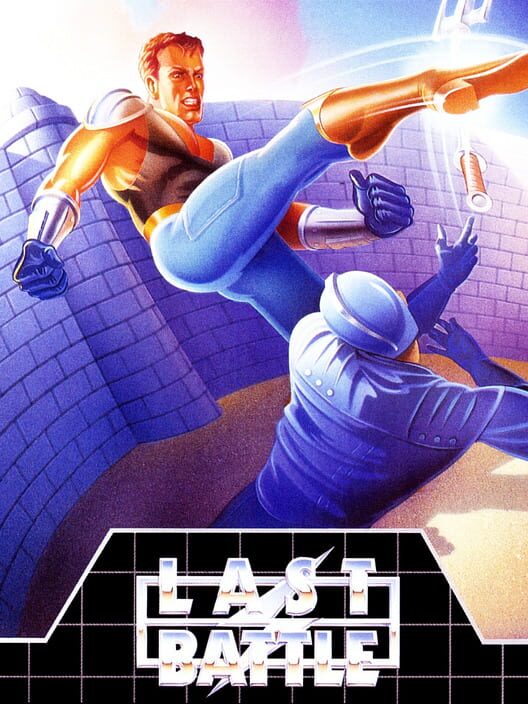
Last Battle cover

1989 · Port · Beat 'em up · Fighting

Last Battle

Port

Last Battle: Legend of the Final Hero is a side-scrolling action game similarly to its predecessor Black Belt. The player takes control of Aarzak (Kenshiro in the Japanese original), who fights against his enemies using his punches and kicks. Aarzak can attack while standing, jumping, and crouching, for a total of six basic attacks. In addition to his life gauge, Aarzak has a power-up meter that will gradually fill as he defeats enemies.

When the meter reaches a certain point (depending on the stage), Aarzak will transform into a super-powered state, allowing him to perform rapid punches and kicks for the rest of the stage. The game's levels (with the exception of boss battles and maze stages) feature a time limit at the lower-right corner of the screen; but unlike other time limits, instead of killing the character immediately when it reaches, it will instead gradually drain the player's life gauge until the player completes the level.

The game is divided into four stages or chapters, each featuring several levels. After completing a level the player will be shown a map which displays the player's current location and the paths they can take. Most of the levels are linear side-scrolling segments where the player must simply walk from one to side to the other while fighting every enemy who gets in the way. Other levels are dungeon mazes in which the player must figure out the correct path to the goal while avoiding traps.

The player will encounter various allies throughout the game that will increase Aarzak's offensive or defensive strength, or replenish their health. The game features several one-on-one encounters with bosses as well. The player must sometime complete levels in a certain order in order to finish a chapter.

'Last Battle' is also notorious amongst gamers for its harsh difficulty throughout.

The original Japanese version is based on the Fist of the North Star mangas/animes. During the translation process all references to Fist of the North Star were removed - similar to its predecessor Black Belt.

Also known as
Hokuto no Ken : Shin Seikimatsu Kyuuseishu Densetsu
Released
1 July 1989
Platforms
Sega GenesisArcadeAmigaCommodore C64/128/MAXCommodore 64Wii
Genres
Beat 'em upFightingPost-apocalyptic
Developers
—
Publishers
—
Modes
Single-player
Perspective
Side view
Themes
ActionScience fiction
Country
Japan
Languages
English

About

Last Battle: Legend of the Final Hero is a side-scrolling martial arts beat 'em up released for the Mega Drive/Genesis in 1989 by Sega. S. The Japanese version, titled Hokuto no Ken: Shinseikimatsu Kyūseishu Densetsu (北斗の拳 新世紀末救世主伝説; lit. "Fist of the North Star: The New Legend of the Post-Apocalyptic Messiah"), is based on the manga and anime series Fist of the North Star (Hokuto no Ken in Japanese).

Since the international version did not retain the Hokuto no Ken license, the graphics and characters' names were altered. It was the second Hokuto no Ken game released by Sega, following the Mark III original, released internationally as Black Belt. Versions for the Commodore 64 and Amiga based upon Last Battle were developed and released by Elite in Europe in 1991.

Keywords

  • post-apocalyptic
  • regional port

Media

Last Battle screenshot 1

The articlegameplay, story, development, reception

Gameplay

Last Battle is a side-scrolling action game similarly to its predecessor Black Belt. The player takes control of Aarzak (Kenshiro in the Japanese original), who fights against his enemies using his punches and kicks. Aarzak can attack while standing, jumping, and crouching, for a total of six basic attacks. In addition to his life gauge, Aarzak has a power-up meter that will gradually fill as he defeats enemies.

When the meter reaches a certain point (depending on the stage), Aarzak will transform into a super-powered state, allowing him to perform rapid punches and kicks for the rest of the stage. The game's levels (with the exception of boss battles and maze stages) feature a time limit at the lower-right corner of the screen; but unlike other time limits, instead of killing the character immediately when it reaches zero, it will instead gradually drain the player's life gauge until the player completes the level.

The game is divided into four stages or chapters, each featuring several levels. After completing a level the player will be shown a map which displays the player's current location and the paths they can take. Most of the levels are linear side-scrolling segments where the player must simply walk from one to side to the other while fighting every enemy who gets in the way. Other levels are dungeon mazes in which the player must figure out the correct path to the goal while avoiding traps.

The player will encounter various allies throughout the game that will increase Aarzak's offensive or defensive strength, or replenish his health. The game features several one-on-one encounters with bosses as well. The player must sometimes complete levels in a certain order in order to finish a chapter.

Reception

Last Battle received mixed reviews from critics. Upon release in 1989, Computer Entertainer gave a mildly positive review, praising the visuals for exhibiting "several of the Genesis graphic capabilities that seem to be possible only with a 16-bit system" but said there "is nothing especially original about the game" though it "will suffice as the requisite game of the type because it does offer the gamer plenty of fighting action."

Later reviews were more critical in the early 1990s, with criticism towards the graphics, simplistic gameplay, repetitive level design and awkward controls. In 1992, MegaTech magazine said it was "a failure on two counts: it neither shows off any of the Mega Drive's capabilities, nor is an enjoyable game in its own right". Mega placed the game at #2 in their list of the 10 Worst Mega Drive Games of All Time.
Releases by platformdates and regions as published

Releases by platform
PlatformReleasedRegions
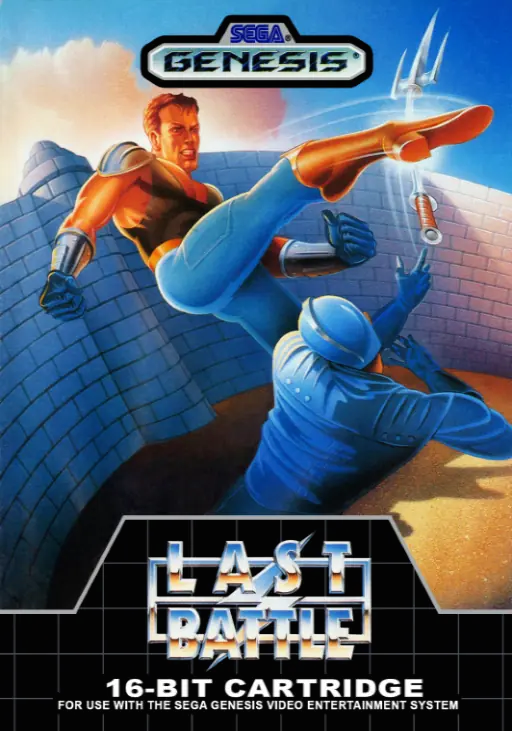
Sega Genesis14 August 1989North America · Europe 1 September 1990 · Brazil 31 January 1991
Arcade31 December 1989Europe
Commodore C64/128/MAX31 December 1991North America
Amiga31 December 1991Europe

Box artone per regional release we hold art for

Editions and related releases

Included in
Mega Drive 4Mega Drive 3Mega Drive 3: 81 Super JogosSuper Mega Drive 3: 43 Super JogosSuper Mega Drive 3: 71 Super JogosSuper Mega Drive 3: 30 Super JogosSuper Mega Drive 3: 60 Super JogosMega Drive
Part of
Hokuto no Ken: Shin Seikimatsu Kyuuseishu Densetsu
Port of
Hokuto no Ken: Shin Seikimatsu Kyuuseishu Densetsu

Games like this

Collections3 collections

Platform libraries

Publishers

Description adapted from its source, CC BY-SA 4.0.