
The articlegameplay, story, development, reception
Gameplay
Mad Stalker: Full Metal Forth is a side-scrolling beat 'em up game reminiscent of Kung-Fu Master and The Ninja Warriors, where players assume the role of a policeman taking control of a SlaveGear mecha suit known as Hound Dog through six stages of varying themes set in Artemis City in an effort to defeat a rogue SlaveGear model called Rising Dog, stop a rogue artificial intelligence named Omega, who has become rogue against humankind and destroy its army of robot enemies as the main objective. Prior to starting a playthrough, players have the choice of accessing the options menu at the title screen, where various settings can be adjusted such as controls and any of the three difficulty levels.
The game is played in a single plane field and all of the levels featured are linear in nature, where the player can go either left or right by controlling Hound Dog with an eight-directional joystick and two attack buttons, of which they differ in terms of strength and speed. Players use the joystick to jump, double jump, crouch and move their player character towards or away from enemies. Similar to Street Fighter II and other fighting games of the era, players can perform a variety of basic moves in any position, including grabbing/throwing attacks, while special moves are performed by inputting a combination of directional and button-based commands. Players can also execute a dash attack that can be cancelled by guarding enemy hits.
After defeating minor enemies and reaching the end of the stage, a boss must be fought in order to progress further through. If the Hound Dog sustaints too much consecutive damage, players will be rendered dizzy and left vulnerable for more incoming enemy attacks and if the health bar of the Hound Dog becomes empty, it will explode and the game is over as a result, though players has a chance of continuing where he or she left off by selecting the continue option at the title screen. In addition to the single-player campaign, the game also includes a versus mode where two human opponents face against each other with the mecha of their choice in one-on-one matches until the fighter who manages to deplete the health bar of the opponent before the timer runs out wins the bout and becomes the winner of the match, while a single human player can also fight against a computer-controlled opponent as well.
Story
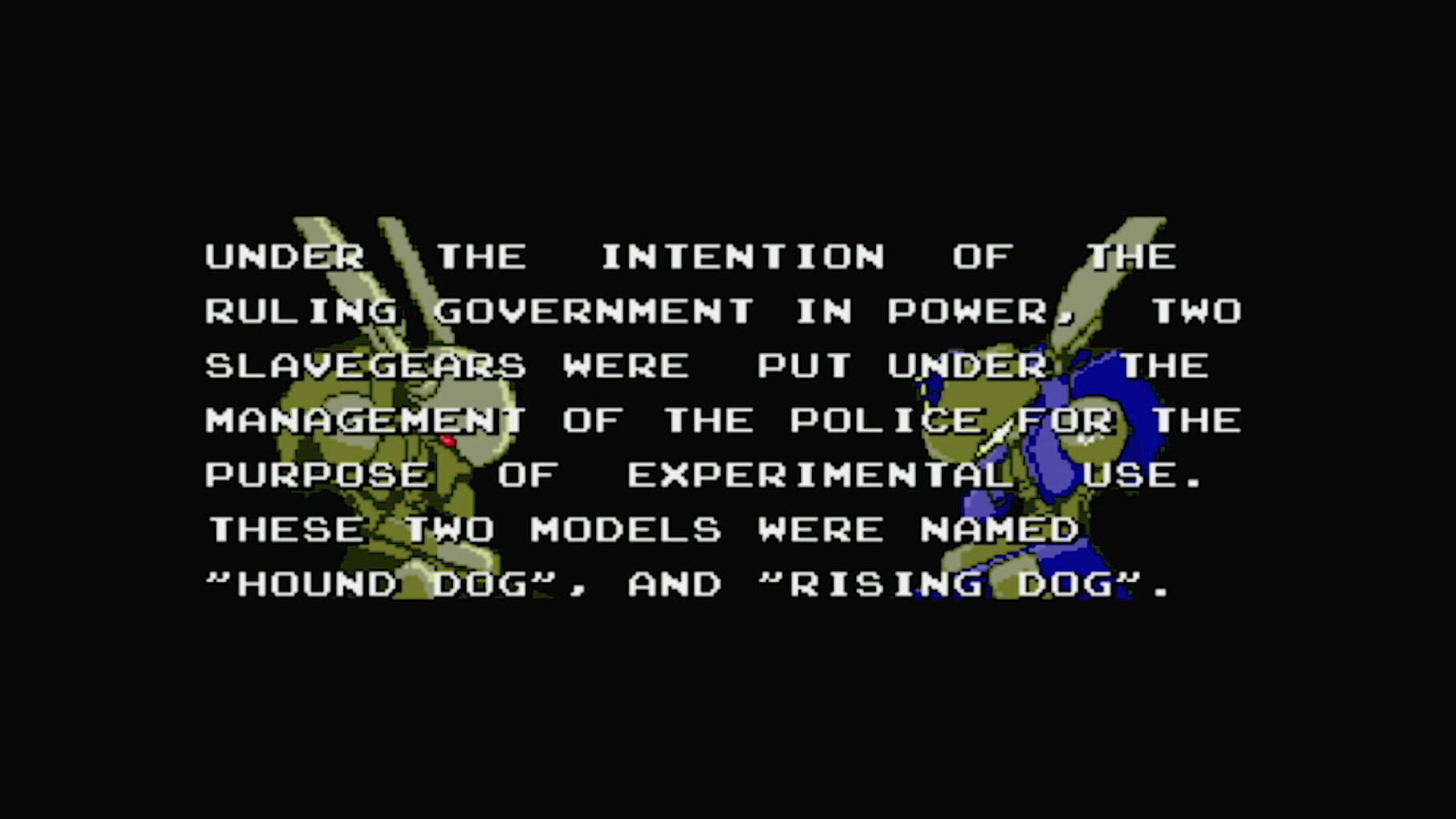
The plot summary of Mad Stalker: Full Metal Forth varies between each version. The game takes place in a post-war setting in the year 2142, where a warship built during the last moments of the war was discovered by the military, which contained several hundred mecha robots known as SlaveGears. These units were put under control of the current ruling government for power purposes, two of which are placed under police management for experimental use and given the names of "Hound Dog" and "Rising Dog" respectively. However the on-board computer at the unearthed warship, "Omega", suddenly becomes operational and accesses the military networks, freezing Artemis City and commanding Rising Dog on exterminating his enemies. The research facility is obliterated and Rising Dog manages to escape into the city, leading the police to recognize the emergency and ultimately deploy a SOS signal to Hound Dog in order to protect the city by destroying all enemy robots.
Development
Mad Stalker: Full Metal Forth served as the fourth title to be developed by Fill-in-Cafe for the Sharp X68000 after PitaPat and its creation was helmed by a small team at the company with producer Sōichirō Miyakawa, while Masaya Konya served as its director. Both Masaki Ukyo and Masatoshi Imaizumi shared multiple development duties during the project such as not only being artists and designers, but also programmers alongside Takumi Amano. Umihara Kawase illustrator Toshinobu Kondo was also involved in the production of the project as an advisor. Kondo stated that the team desired to develop a title featuring robots of their own, as members within the company were fans of the mecha genre with anime series such as Gundam and Zoom's 1989 Genocide proved to be a source of inspiration for them.
The music for Mad Stalker: Full Metal Forth was composed by Keishi Yonao. In a 2015 interview with website Video Game Music Online, Yonao recalled the process to compose the game's soundtrack, stating that the American band Earth, Wind & Fire and Sega's 1988 Galaxy Force were his main sources of inspirations for the funk-styled compositions.
Reception
Mad Stalker: Full Metal Forth received positive reception from reviewers and players alike since its initial release on the X68000. Taki Yasushi of Oh!X praised several aspects such as the graphics, sound design and gameplay. It became a relatively popular title from Fill-in-Cafe among users of the X68000 that would eventually lead it in being nominated for a "Game of the Year" award by Oh!X before ultimately losing against other titles on the system like Garō Densetsu Special and Super Street Fighter II: The New Challengers. Animerica gave the PC Engine Arcade CD-ROM² version a positive outlook.
In a retrospective review of the PC Engine version, Laurent Kermel of Video Game Den gave positive comments in regards to the graphics, large sprites and mecha designs, however he criticized the controls for being uncomfortable and repetitive setpieces but ultimately deemed the title to be better than Genocide on the system.
Legacy
According to former Treasure designer Tetsuhiko Kikuchi in a November 2012 issue of Nintendo Power, Mad Stalker: Full Metal Forth and Alien vs. Predator by Capcom were the main inspirations for the design of Guardian Heroes on Sega Saturn. In recent years, animation cels of the PlayStation cutscenes were sold on Mandarake between 2015 and 2017. In May 2019, Masatoshi Imaizumi revealed to Yosuke Okunari of Sega on Twitter that a sequel to Mad Stalker: Full Metal Forth was started but cancelled. Retronauts also noted the game to be an influence for Phantom Breaker.


