
The articlegameplay, story, development, reception
Gameplay
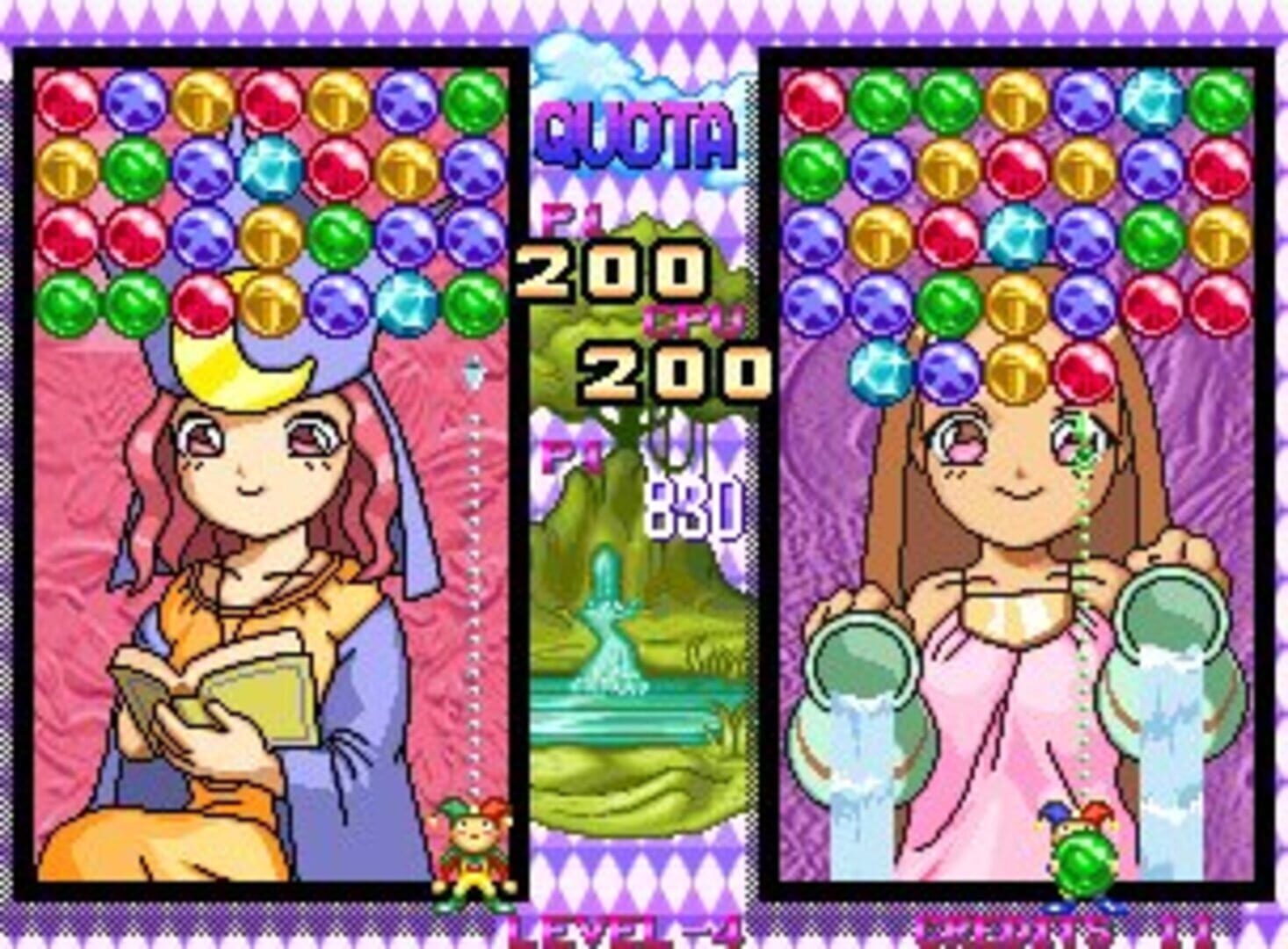
Like its predecessor, Magical Drop II is a puzzle game where the player takes control of one of several characters named after a tarot card, battling against computer-controlled opponents before facing the villainous Empress in a final encounter. Gameplay is similar to the first entry albeit with improvements; the objective is to clear the screen from a stack of constantly advancing colored 'drops' that descend from the top of the playfield. Drops can be picked up and dropped by the player's character, which is placed at the bottom of the screen, and they disappear when three or more of the same color are put together on a single column. Chains are formed either when a single drop caused a chain reaction or when more than one group of drops are cleared in quick succession. Forming chains cause the opponent's stack to descend faster.
One notable gameplay change is that normal drops and "special" drops can now be matched together, unlike the first game where they were considered completely separate. The single-player mode, now known as "Puzzle" mode, was also changed to add more rows to the player's playfield. New to the series are rainbow pieces, which can become special drops when they are incorporated into the playfield. The Japanese version contains a third mode named "Hirameki" that offers preset puzzles for the player to solve.
Development
Magical Drop II was developed by Data East, which had previously created a number of Neo Geo titles such as Spinmaster, Windjammers, Street Slam, and Karnov's Revenge, with Iwao Horita and Naomi Susa acting as co-supervisors. Shungo Katagiri and a staffer under the pseudonym "Tac.H" served as the game's sole planner and programmer respectively. Asami "Asamin" Kaneko, Hiroshi Hachiya, Mayu Sato, Rie Sakurai, and Shōji Takeuchi were responsible for the artwork. The soundtrack was scored by Gamadelic members Hiroaki "Maro" Yoshida, Masaaki "Koremasa" Iwasaki, and Shogo Sakai.
Magical Drop II was first released for the Neo Geo arcade system (MVS) in Japan by Data East on March 21, 1996, and later in North America by SNK in May. There are differences between the original Japanese release and English localization, such as the removal of "Flash" game mode and "Expert" difficulty in single-player mode, as well as voice acting. The game was then published in Japan for the Neo Geo home system (AES) on April 19, and later for Neo Geo CD on May 24. On June 21, an album containing music from the game was co-published in Japan by Scitron and Pony Canyon.
Reception
In Japan, Game Machine magazine listed Magical Drop II as the fifth most popular arcade game for the last two weeks of April 1996. Japanese publication Micom BASIC Magazine ranked the Neo Geo version seventh in popularity in its July 1996 issue. Readers of the Japanese Sega Saturn Magazine voted to give the game a 8.1735 out of 10 score, ranking among Sega Saturn games at the number 339 spot in a 2000 public poll. Both the original arcade release and the console conversions garnered average reception from critics, some of which reviewed it as an import title.
Reviewing the Neo Geo AES version, MAN!AC's Andreas Knauf wrote that it was an ordinary puzzle game in the vein of Columns, finding its concept simple but mature. Next Generation also reviewed the Neo Geo AES version, saying that it becomes monotonous after a while but is overall solid and reasonably addictive. They found the game's most distinctive quality was its accelerated pace, remarking that "you don't have to be as precise as [in] some puzzle games, but there is no time to think, just time to do". Saturn Fan's two critics reviewed the Saturn version, finding it to be more of an action title than a puzzle one, citing its fast-pacing and difficult but addictive approach. AllGame's Kyle Knight reviewed the Neo Geo AES release as well, giving positive remarks to the cheerful visuals, audio, and frantic but strategic gameplay.


