The articlegameplay, story, development, reception
Gameplay
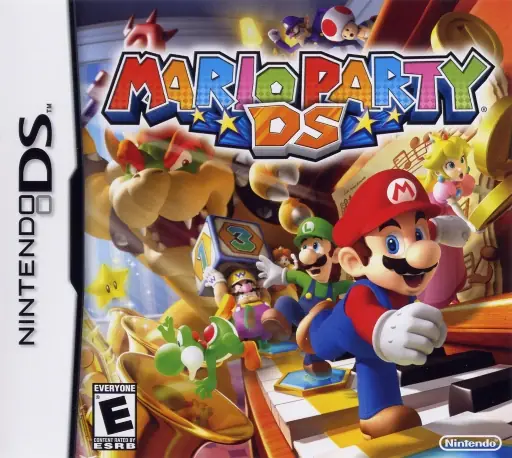
Much like other titles in the Mario Party series, Mario Party DS is a party video game that allows up to four players to compete in an interactive board game, rolling dice to move between one and ten spaces at a time. There are eight playable characters (Mario, Luigi, Princess Peach, Yoshi, Princess Daisy, Toad, Wario, and Waluigi) and five game boards. Characters can be controlled by human players as well as artificial intelligence (AI). There are four difficulty levels for computer-controlled characters: easy, medium, hard, and expert, with the lattermost difficulty being unlockable.
The players' objective is to collect more Stars than their opponents, though the method of obtaining them varies depending on the board. However, most Stars require coins to be purchased, which can be obtained by landing on certain spaces, as well as by winning minigames. Coins can also be spent on items to help players win. Once there are five turns remaining, an event known as the "Final 5 Frenzy" occurs in which Bowser aids the player in last place by giving them coins or a Star, depending on the outcome of a roulette.
Story
One night in the Mushroom Kingdom, five crystals known as Sky Crystals fall to the ground. One of the crystals is found by Mario, who shows it to all of his friends the following day. Suddenly, Kamek flies overhead, dropping party invitations from Bowser, inviting everyone to a feast in his castle to apologize for his villainy. Although the gang is initially suspicious, they travel to Bowser's castle anyway, only to be trapped by Bowser, who steals Mario's Sky Crystal.
Bowser also uses a device known as the Minimizer to shrink Mario and his friends down to minuscule size. Bowser, planning to find the four other Sky Crystals on his own, orders Kamek to throw the pint-sized heroes out to a distant location.
Development
Like almost all games in the Mario Party series prior to Mario Party 9 (2012), Mario Party DS was developed by Hudson Soft and published by Nintendo. The game was not showcased at Nintendo's E3 2007 press conference, though a short trailer revealed that up to four people could play wirelessly with only one game cartridge.
Mario Party DS was released in 2007 as the second handheld game in the Mario Party series; the first handheld title, Mario Party Advance, was released for the Game Boy Advance in 2005. Mario Party DS is the only game in the series to be released for the Nintendo DS, though several Mario Party games were later released for the Nintendo 3DS. It is also the last game in the series to be developed by Hudson Soft, as all subsequent titles have been developed by Nintendo Cube.
Reception
Mario Party DS received "mixed or average" reviews from critics, according to the review aggregation website Metacritic. In Japan, four critics from Famitsu gave the game a total score of 33 out of 40. The minigame variety was generally praised, while criticism was largely directed at the lack of Wi-Fi connection, which heavily restricted the multiplayer aspect. Several reviews alluded to Mario Party DS being superior to its predecessor, Mario Party 8 (2007). IGN's Patrick Kolan and Craig Harris summarized the game as "a worthwhile party outing for gamers who are new to the series" and "a solid multiplayer mini-game experience with a lot of the flaws of the previous versions", respectively.
The variety in Mario Party DS's minigame control schemes was consistently praised by critics. Some reviewers expressed concern toward certain minigames requiring usage of the console's built-in microphone, though several critics also complimented the ability to exclude such minigames from normal play if desired. Critical reception toward the design and pacing of the minigames was more mixed; GameSpot's Frank Provo stated that a majority of the minigames were engaging, Game Informer's Bryan Vore wrote that they were "suitably amusing", and Eurogamer's Ellie Gibson described them as "too simplistic, over too quickly or simply too dull to be enjoyable", as well as "badly designed and boring".
Legacy
In October 2020, Mario Party DS became the subject of a viral fabricated anti-piracy screen uploaded by YouTuber Joey Perleoni, who subsequently uploaded multiple other videos showing various instances in which the message could supposedly be triggered, such as when an item shop is entered or the "Final 5 Frenzy" event is initiated. In actuality, Mario Party DS does not contain any special anti-piracy messages. The original video inspired several internet memes as well as an online trend of users creating and uploading their own fake anti-piracy messages.