
The articlegameplay, story, development, reception
Gameplay
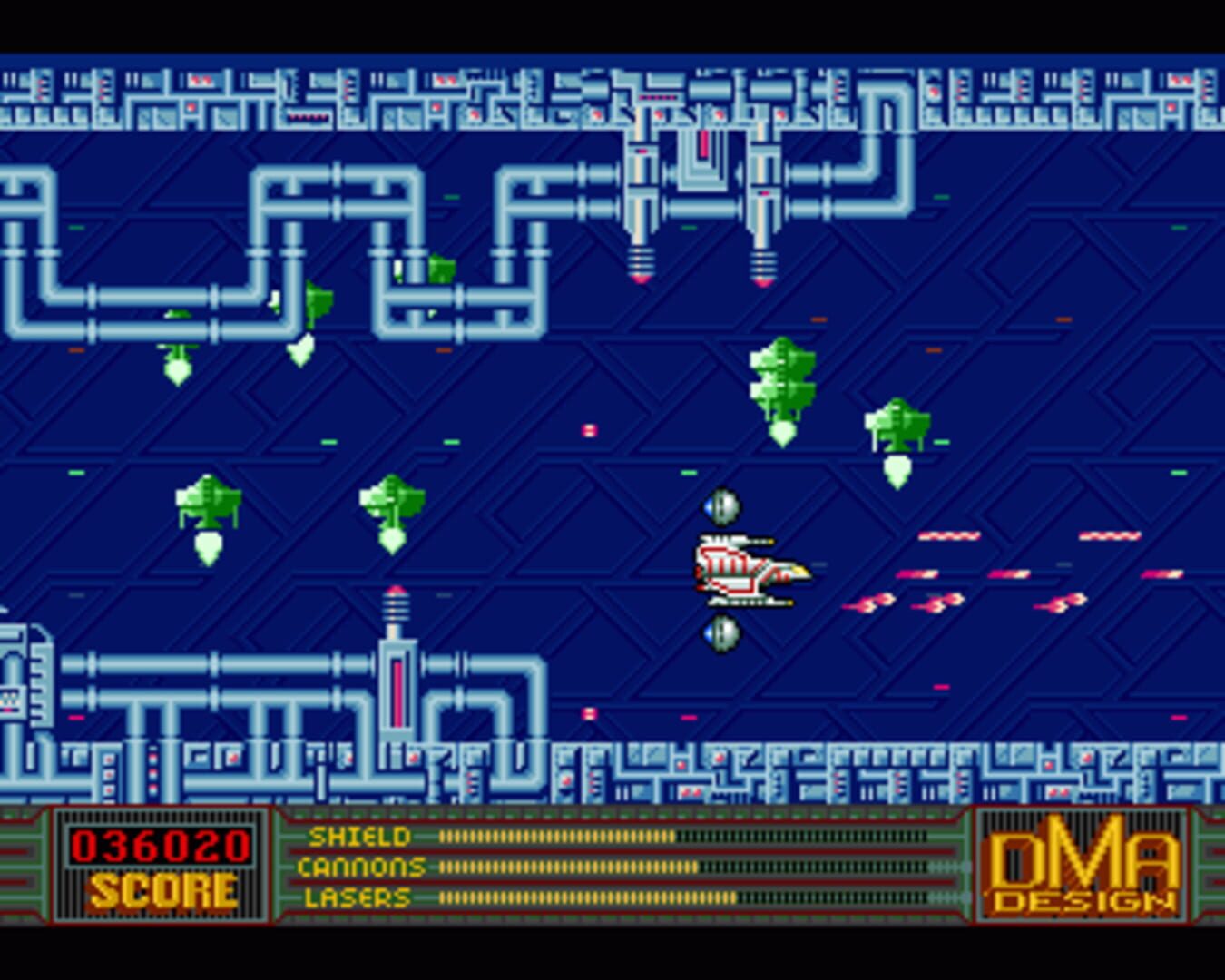
The player controls an alien space fighter, moving through six stages on the planet of Draconia to advance through the game. Players use the ship's weaponry—lasers and cannons—to attack all advancing enemies, and defeat the level's boss: a guardian of Draconia. The six bosses act as Draconia's living defence mechanisms—the planet was created to habituate gruesome and harmful creatures, of which there are over sixty, participating in unlawful tasks. In the game's levels, players discover space debris, which can be converted into upgrades for the ship.
The debris appears as tokens, and grants players additional weapons and upgrades, such as lasers, cannons, and improved ship and weapon power. The ship also has a shield, which provides temporary protection from enemies; contact with enemies and walls depletes the shields, increasing players' vulnerability to death.
Development
Game development studio Acme Software was founded in 1987 by David Jones in Dundee, Scotland. Jones began developing Menace under the working title CopperCon1 in his bedroom at his parents' house while attending the Dundee Institute of Technology at the time. Jones approached Hewson Consultants to publish the game in 1988; after playing, Andrew Braybrook recommended it to Hewson. When Jones was informed Hewson wanted the game to be the "Amiga version of Zynaps ", he realised sales would be limited and refused to sign the contract.
Hewson had already promoted the game in Popular Computing Weekly before the deal was dropped. After signing a publishing deal with Psygnosis, Acme Software was renamed DMA Design.
Reception
The game received mostly positive reviews from critics upon release, particularly for its gameplay, graphical design, and sound. Criticism was also directed at the game's ports, and the limitations met with the inferior hardware. Jason Holborn of ST/Amiga Format wrote that the game "provides some of the best arcade action" in an Amiga game. The game generated a considerable amount of money for DMA Design, allowing the company to develop more games. The game sold 20,000 copies, reportedly generating around £20,000.
Holborn of ST/Amiga Format called the gameplay "exceptional" and "addictive", stating that players will be "hooked for hours on end". Ciaran Brennan of Computer and Video Games praised its replayability, writing that it has "enough depth built in to make it last". Conversely, Zzap!64's Kati Hamza wrote that the gameplay is "rather poor", disliking the pace and level design, and Maff Evans in the same review called it "dull and unrewarding", pointing out the lack of excitement and reward. The Games Machine condemned the "jerky scrolling" of the PC version, while Rod Lawton of ACE called the gameplay of the Amiga version "stubbornly 8-bit".