The articlegameplay, story, development, reception
Gameplay
Compared to most console racing games of its time, F-1 Hero was much more difficult. The circuits were accurately depicted as having both sharp and wide turns, thus requiring players to slow down to certain speeds for corners, instead of most arcade-style games, which allowed players to unrealistically take turns flat-out. Gear shifting was also required for three of the cars (and notably for 8 of the 9 levels of the game), and some courses required dozens of gear changes per lap. Tire wear increased as the races went on, and players would be required to pit for tires at least once during each race to remain competitive.
When multiple cars were on the track, the game featured no direct interaction between vehicles. All of the competitors' machines behaved in a ghost-like manner, and could be driven through and occupy the same space as others. Cars were unable to spin others out, and could not directly impede their progress.
Nearly every screen in the entire game featured a short-looped, repeating soundtrack. Unlike most racing games, however, there was no music played while actually driving.
F-1 Hero featured a 16-race Formula One schedule resembling that of 1988. Each circuit featured a pit area represented by a pylon. On most circuits, the pits were located just prior to the start/finish line. In France, England, Spain, and Australia, the pits were located just after the start/finish line.
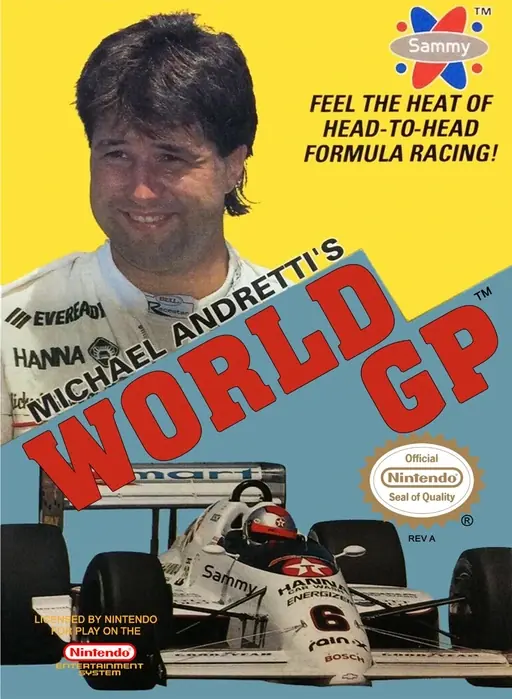
Four different machines were featured in the game. Each had a unique pitch, and slightly varying top speeds. The Chevy was the dominant machine in the game, despite not being a Formula One car. In reality, it was used in the CART series. Andretti, in fact, drove one in the CART series from 1989–1991, and the cover art on the game box accurately displays Andretti's 1989 Lola Chevrolet.