The articlegameplay, story, development, reception
Story
Astro Boy is a science fiction series set in a futuristic world where robots co-exist with humans. Its focus is on the adventures of the titular Astro Boy, sometimes called simply Astro, a powerful android created by the head of the Ministry of Science, Doctor Tenma, known as Dr. Astor Boynton II in the 1960s English dub, Dr. Boynton in the 1980s English dub.
Dr. Tenma created Astro to replace his son Tobio (named 'Astor' in the 1960s English dub, and 'Toby' in both the 1980s English dub and the 2009 film), who was killed in a car accident. In the 2003 anime, Tobio is shown as having run away from home before the accident. In the 2009 film, Toby's death was caused by an incident with the Peacekeeper, a weaponized robot.
Dr. Tenma built and adopted Astro in Tobio's memory and treated Astro as lovingly as if he was the real Tobio.
Dr. Tenma soon realized that the little android could not fill the void of his lost son, especially given that Astro could not grow older or express human aesthetics. In one set of panels in the manga, Astro is shown preferring the mechanical shapes of cubes over the organic shapes of flowers. In the original 1960 edition, Tenma rejected Astro and sold him to a cruel circus owner, Hamegg, the Great Cacciatore in the 1960s English dub. In the 1980 edition, Hamegg kidnapped Astro while Tenma was trying to find him.
In the 2009 film, Tenma rejected Astro simply because he could not stop thinking about Toby, but later during the film (and unlike in either the manga or the three anime series), Tenma realized that Astro made credit to replace Tobio. As a result, Tenma decided that he would readopt Astro. None of these events about Astro being rejected (completely or temporarily) or kidnapped in both the 1960 and 1980 anime and in the 2009 film occurred in the 2003, as Astro's birth was given by Professor Ochanomizu (Dr. Elefun in the 1960 and 1980 anime, and in the 2009 film; Dr. O'Shay in the 2003 anime).
After some time, Professor Ochanomizu, the new head of the Ministry of Science, co-head of the Ministry of Science in the 2009 film, notices Astro Boy performing in the circus and convinces Hamegg to turn Astro over to him. (In a retcon, the story becomes far more violent and complex). He then takes Astro in as his own and treats him gently and warmly, becoming his legal guardian. He soon realizes that Astro has superior powers and skills, as well as the ability to experience human emotions.
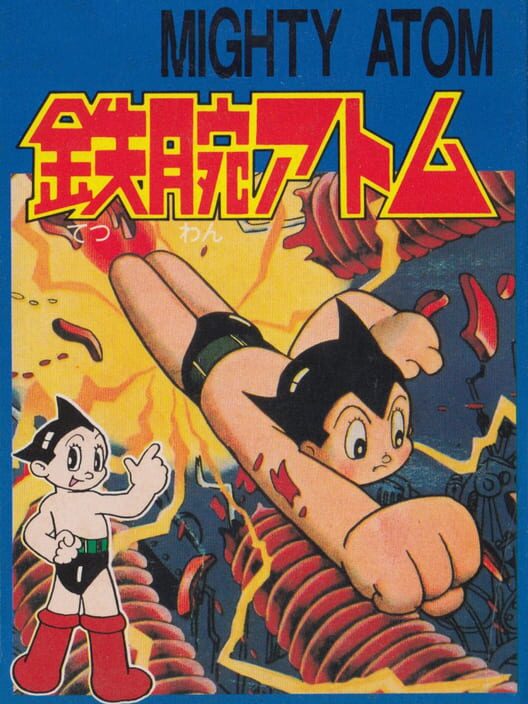
Astro then is shown fighting crime, evil, and injustice using his seven powers: 100K horsepower strength, jet flight, high intensity lights in his eyes, adjustable hearing, instant language translation, a retractable machine gun in his hips, and a high IQ capable of determining if a person is good or evil. Most of his enemies are robot-hating humans, robots gone berserk, or alien invaders. Almost every story includes a battle involving Astro and other robots. In one manga episode, Astro takes on the US Air Force, and stops it from bombing innocent Vietnamese villagers. This was a time-travel episode, in which Astro went back from the 21st century to 1969.
Development
The Astro Boy series consists of several storylines. In April 1951, Atom, known as Astro Boy or just Astro in English, originally appeared as a supporting character in the Tezuka comic Atom Taishi (Ambassador Atom, sometimes referred to as Captain Atom), which appeared in Shonen, a monthly magazine for boys. Tezuka then created a comic series in which Astro was the main character. According to Schodt, Tezuka created Astro to be a "21st-century reverse-Pinocchio, a nearly perfect robot who strove to become more human and emotive and to serve as an interface between man and machine."
As Tezuka's art style advanced, Astro Boy "became more modern and cute" to appeal to his audience of boys in elementary school. Schodt added that the page layouts used in Astro Boy episodes "became more creative." When designing supporting characters, Tezuka sometimes created characters that were homages to Walt Disney, the creator of Mickey Mouse and Disney Princesses, Max Fleischer, the producer of animated shorts featuring characters such as Koko the Clown, Betty Boop, and Superman, and other American animators. In several of the Astro Boy stories, the first few pages were in color.
Tezuka had a "Star System" of characters, in which characters from his other works played roles in Astro Boy. Similarly, several characters in Astro Boy appear in his other works. Tezuka developed "a type of dialog with his readers", since he developed so many stories during his lifetime. Tezuka also had a habit of introducing nonsensical characters at random moments in order to lighten a scene which was becoming too serious; he sometimes felt trapped by the need to satisfy his young male audience's desire to see battling robots.
Astro Boy was described by Schodt as an "analog", a world where humans and advanced technology coexist. As a result, the plots of the Astro Boy stories often involve issues that stem from this idea. At the time of Astro Boy's creation, Japan did not have the reputation for science and technology that it gained by the late 20th century. This made the "analog" nature of Astro Boy unique.
The manga was originally published by Akita Shoten in tankōbon format; 23 volumes of paperbacks were printed. The stories do not appear in order by publication date, but in the order that Tezuka and the collection editors considered most appropriate. The collection begins with The Birth of Astro Boy, an episode that Tezuka wrote in 1975 to make the collection of stories easier to understand. The first Astro Boy story ever written, first published in April 1951, is in volume 15.
Tezuka often re-drew chapters that he had created earlier. Schodt explains that this is the reason some may appear "more modern" than others. For many of his older stories, Tezuka added introductory pages where he himself was portrayed as the narrator. The color pages were reprinted in black and white for the inexpensive paperback versions.
The Dark Horse English-language version of Astro Boy is an adaptation of the Akita Shoten published works by Osamu Tezuka. The artwork was flipped from the original Japanese version so the books could be read from left to right. Frederik L. Schodt translated the English-language version of Astro Boy and for most of the characters, he used the original Japanese names.
Schodt believed that it was necessary to retain the Japanese names wherever possible, as the story was set in Japan. Schodt translated the nickname "Higeoyaji" to "Mr. Mustachio", and decided to use Astro Boy's English name. He explained that "Astro" is close to the Japanese name "Atom", an English word.
Schodt believed that using "Atom" in an American edition of the story would be "going too much against the history".
Occasionally, names of Japanese characters had double meanings that were impossible to convey in the Dark Horse English-language translation. Schodt decided that keeping the sound of the names was important, especially when the names were famous. In those cases, Schodt tried to use the double meaning elsewhere in the translation. When dealing with minor foreign characters with humorous-sounding names, Schodt used equivalent English puns wherever it was possible.
The editors of the Dark Horse English-language Astro Boy book did not remove content that could be perceived to be racially insensitive. They explained that in some cases, people may be portrayed differently from how they actually were in 2002, the year of publication of the English version. The editors said that some readers may feel that the portrayals contribute to racial discrimination and, while that was not Tezuka's intent, the issue needed to be explained as some readers may feel offended or insulted by the depictions. They felt that it would be inappropriate to revise the works, because Tezuka had died and there was no way to reverse what he created, and revising his works would violate his right as a creator. They also expressed the belief that editing or stopping publication of the work would "do little" to end racial and ethnic discrimination throughout the world.
Reception
Astro Boy has sold approximately 100 million copies. The series is widely considered one of the greatest manga and anime series of all time. In a 2006 "experts" ranking for the "Greatest Manga of All Time" held by the Japan Media Arts Festival for their 10th anniversary, Astro Boy ranked 6th, the 3rd highest Tezuka manga on the list after Phoenix and Black Jack. In addition, the 1963 anime adaptation ranked 2nd in the "Greatest Anime of All Time" list. In a 2009 poll held by Asahi Shimbun for the "Greatest Shōwa Manga", Astro Boy ranked 5th, the highest ranked Tezuka manga on the list.
Those who have cited Astro Boy as an influence include manga artists Katsuhiro Otomo, Go Nagai, Naoki Urasawa, Akira Toriyama and animation directors Hayao Miyazaki and Yoshiyuki Tomino.
Astro Boy became Tezuka's most famous work. Frederik L. Schodt, the translator of the English-language version of the manga, said it had "extraordinary longevity and appeal across cultures." Schodt said that many of the stories are "sometimes" of "uneven quality."
Schodt said that as the time becomes closer to "a true age of robots," Astro Boy assumes more meaning. Jeff Yang of the San Francisco Chronicle, in discussing Schodt's The Astro Boy Essays, said "while kids came for Astro's atomic action – just about every installment included Astro harrowing a fellow robot who'd fallen from digital grace with his fission-powered fists – they stayed for the textured, surprisingly complex stories."
Astro ranked 43rd on Empire magazine's list of "The 50 Greatest Comic Book Characters". The 1960s anime was named the 86th best animated series by IGN, with the publication naming it the first popular anime television series. In TV Asahi's poll of the "Top 100 Anime", Astro Boy came in 23rd.
The 1980s anime was extremely popular in Australia, Canada, and many parts of Asia, with two different English dubs. The dub shown in Australia (and to a lesser extent in the United States) was coordinated by Tezuka Productions and NTV and produced in the U.S. Another dub was produced in Canada solely for broadcast there.
While the 2003 anime did poorly in North America, having received poor distribution and having been heavily edited, including the removal of its orchestrated soundtrack and much of Astro's childlike innocence, it was better received in the UK on the BBC, where it ran for almost three years, as well as other parts of the world such as on the Dubai-based MBC 3.
On April 7, 2003, one day after the premiere of the 2003 anime in Japan, the city of Niiza, Saitama registered the Astro Boy character as a resident to coincide with his birthdate in the manga. That same day, the JR Yamanote Line platform at JR Takadanobaba Station started using the theme music from the TV series to signal the departure of a train. Many lamp posts in the area carry pictures from the TV series, and two large murals depicting Tezuka's works are across the street of JR Takadanobaba station. Later in 2004, the theme music from the TV series was used to signal the departure of a train at JR Niiza Station on the JR Musashino Line.
At Google, the first Android version was internally codenamed Astro Boy.