Ludography
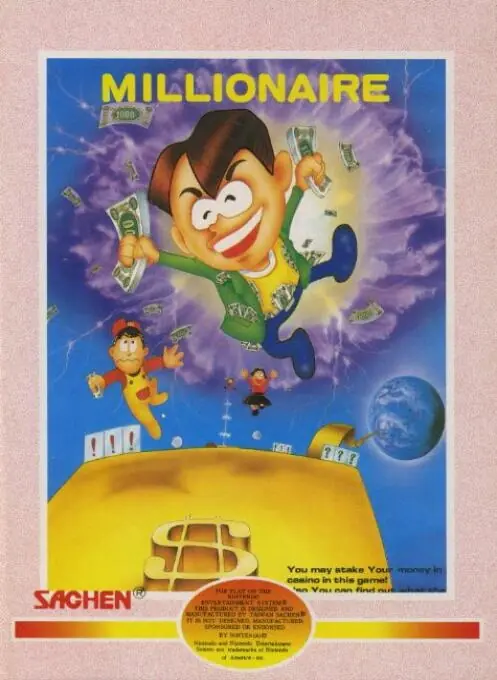
Millionaire cover

1991 · Board game · Business simulation

Millionaire

Nintendo console exclusive

Millionaire is a version of the popular board game Monopoly. The rules are pretty similar to the original, but the places in the board are the most noticeable difference. Instead of pieces of land with street names, the board features country names, such as Spain, Turkey or Switzerland. After buying such places, players can build houses or hotels.

Up to four players can take turns in this game. Each one starts with 7.500 dollars, and leaves the board when there's no money left to pay the bills. The last player standing wins.

Released
31 December 1991
Platforms
NESAcorn ElectronZX Spectrum
Genres
Board gameBusiness simulation
Developers
—
Publishers
Incentive Software
Modes
Single-player
Perspective
Bird view / Isometric
Themes
Business
Country
United Kingdom

About

Millionaire is a business simulation game originally written for the ZX Spectrum by John Hunt and ported to the Acorn Electron and BBC Micro. The objective is to become a software millionaire and avoid bankruptcy.

Media

Millionaire screenshot 1

The articlegameplay, story, development, reception

Gameplay

Millionaire is a text-based management game in which the player takes the role of a home-based games programmer who has written a program and must market it to the retailers. Starting with an investment of £500, the player uses this money to pay advertisers and cover tape duplication costs. Meanwhile, new games must be written and promoted while keeping costs down. The style of game that could be programmed included arcade, adventure, and strategy.

The player then has to allocate 20 management points to spread amongst programming, presentation, original ideas, and maintaining player interest.

A character called Honest Harry who can offer deals such as cheap cassettes, which will lessen distribution costs, or programs. Sometimes, these deals are not so good as the programs could be bugged or stolen, having negative effect.

Progress in the game is monitored by observing the sales figures at the end of each month. If the player makes enough money the a screenshot of a bigger and better house/office is displayed. Chance plays a role; certain events will affect sales positively or negatively.

Reception

A review in Crash praised the games graphics. In Your Spectrum's "Joystick Jury" feature, two of the three reviews thought the game would be a Hit.

Releases by platformdates and regions as published

Releases by platform
PlatformReleasedRegions
NES31 December 1991Asia

Box artone per regional release we hold art for

Games like this

Collections3 collections

Platform libraries

Description adapted from its source, CC BY-SA 4.0.