
The articlegameplay, story, development, reception
Gameplay
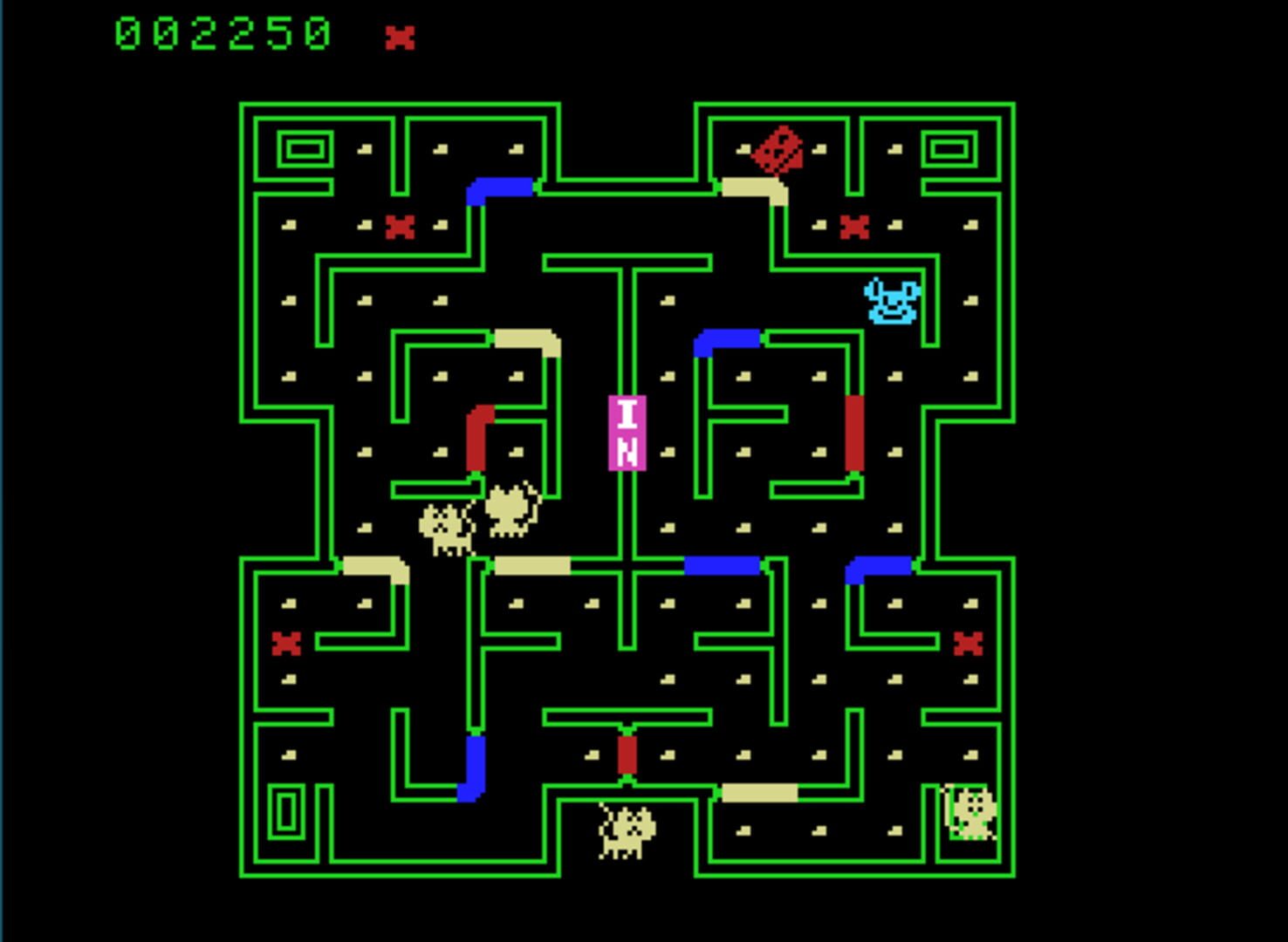
The player uses a four-position joystick to maneuver a mouse throughout a maze and eat pieces of cheese scattered along the paths. Six cats patrol the maze and chase the player, with two present at the outset and four more being released one at a time. The maze has three sets of color-coded doors, which the player can open or close by pressing the corresponding buttons in order to block the cats' approach. The player can also escape the cats by entering the "IN" box at the center of the screen, which will teleport the mouse to one of the four corners at random. Contact between the mouse and a cat costs the player one life.
The player can pick up bones from the corners of the maze, then use them later by pressing a fourth button. Doing so turns the mouse into a dog for a short time, during which it can eat the cats for bonus points and temporarily remove them from the maze, but the cats will move at a faster speed when they re-spawn into the maze. Unused bones carry over from one level to the next and from one life to the next.
At times, a hawk will fly through the maze, trying to catch the player. The hawk can eat both the mouse and the dog, costing the player one life, and it can fly over the walls. It can only be foiled by using the "IN" box, which causes it to fly randomly and then leave the maze.
At any given time, a bonus object is present in the maze and can be eaten for points, causing a more valuable object to appear elsewhere. The bonus sequence restarts when the player either loses a life or eats the most valuable object in the sequence. When all of the cheese has been eaten, the player earns a bonus and moves to the next level.
Reception
In his 1982 book How to Beat the Video Games, Michael Blanchet said that Mousetrap's gameplay "closely resembles that of Pac-Man with a couple of very interesting twists".
According to Electronic Games in 1983, Mouse Trap was unsuccessful because arcade owners viewed it as another "basic" maze game.
Games #44


