
The articlegameplay, story, development, reception
Gameplay
Ogre Battle is a real-time strategy role-playing game. Magnus, the protagonist, commands a battalion of up to 50 troops. Members of the battalion are sectioned off into units, by the player. Each unit must contain a leader.
Any character can be dubbed leader, minus most non-human entities, soldiers and basic classes like the Fighter or Amazon. Gorgons and Saturos are the main exceptions to this rule. Each unit, including the leader, has a maximum of five members. Units are used to battle enemy units, which follow the same structural formation.
Story
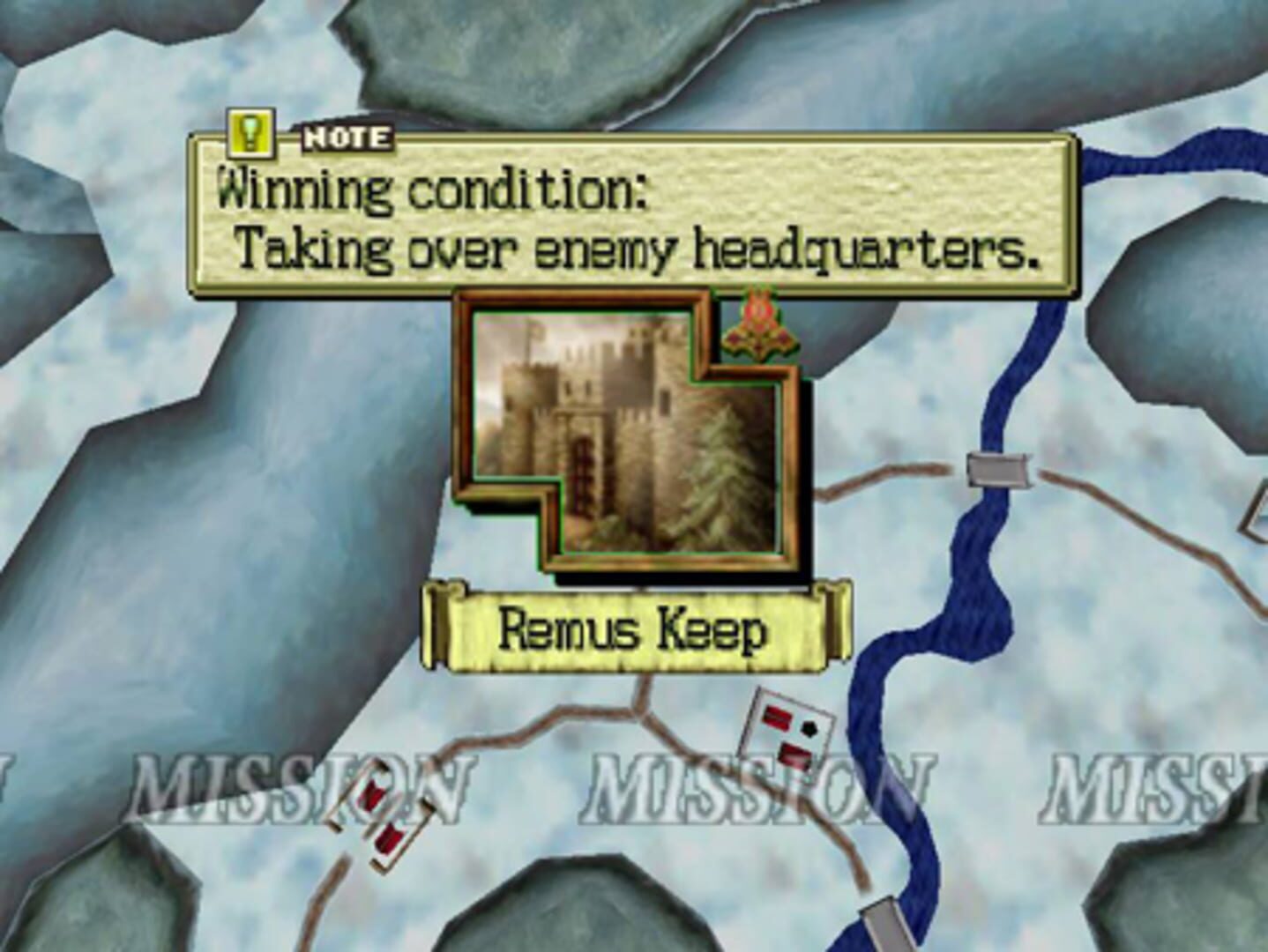
The story follows Magnus Gallant, a recent graduate of the Ischka Military Academy, and fledgling captain in Palatinus' Southern region, Alba. As civil war erupts in the country, Magnus eventually decides to join the revolution with its leader, Frederick Raskin, first liberating the southern region with the Zenobians' aid, then Nirdam and uniting with them, then returning the Eastern Region of Capitrium to the Orthodox church, and finally marching on the capital of Latium. However, along the way, Magnus' battalion, the Blue Knights, finds its enemies escalating, from the puppet kingdom of Palatinus, to the might of the Holy Lodis Empire, to the Dark Hordes of the Netherworld.
There are three possible Endings determined by the player's Chaos Frame, and within those endings are slight scene variations depending on the characters who joined the player's army. All three possible endings have one thing in common: Frederick dies an untimely death. The Chaotic ending is an ending where Magnus gets expelled from the revolutionary army, because they consider him a "monster" who settles everything by force; realizing that his actions were for naught, he disappears and the people forget about the great general who once saved them, therefore ensuring Palatinus' destruction due to Barbarians. In "Neutral" ending, he is named "General Magnus Gallant, the guardian of Palatinus". The last one is Lawful, after Frederick dies an untimely death, the war against the tribes Of the East of Gallea and Zeteginia, who wanted to invade Palatinus right after Lodis weakened it, attack; Magnus is named: "Magnus Gallant, The Paladian King"; his rule becomes forever to be remembered and his son Aeneas Gallant takes the Throne, following his father's footsteps.
Development
Following the release of Tactics Ogre in 1995, series creator Yasumi Matsuno began planning for a third Ogre game which would balance the "soft" concepts of Tactics Ogre with the "niche" style of Ogre Battle: The March of the Black Queen. He also wanted to steer series developer Quest Corporation into developing a more mainstream role-playing game. In the event, Matsuno left Quest for Square, going on to develop Final Fantasy Tactics as a spiritual successor to Tactics Ogre. Ogre Battle 64 was the first Ogre title developed by Quest after Matsuno and other staff left for Square.
Production began sometime prior to 1997 for Nintendo 64 (N64), at which point it was known only as Ogre Battle Saga. During this stage, the developers were debating whether to release it as a standard cartridge, as a title for the disc-based 64DD, or both. While apparently planned for the 64DD, it later settled into being a standard cartridge-based game. It was credited as having the second-largest N64 cartridge at 320 megabits.
Reception
The game received "favorable" reviews according to the review aggregation website Metacritic. In Japan, Famitsu gave it a score of 33 out of 40. Nintendo Power gave it a favorable review while the game was still in development. Vicious Sid of GamePro said, "Beneath Ogre Battle 64's intimidating interface and plodding pace lies a wealth of strategy: If you choose to enlist, be sure to pack plenty of patience."
The game won the award for "Best Strategy Game" at GameSpot's Best and Worst of 2000 Awards, and was nominated for the "Best Game No One Played" award, which went to Samba de Amigo. The staff noted that the game's sales had "fallen prey to [its] console of origin, the N64." The game was also nominated for the "Best Console Strategy Game" and "Gamers' Choice: N64" awards at The Electric Playground's Blister Awards 2000, both of which went to Front Mission 3 and Perfect Dark, respectively.


