Ludography
Paladin's Quest cover

1992 · Quiz · Role-playing

Paladin's Quest

Nintendo exclusive

Paladin's Quest is the first game in the Lennus series. It is an Fantasy JRPG for the Super Nintendo / Super Famicom.

Also known as
Lennus: Kodai Kikai no Kioku · Lennus: Memories of an Ancient Machine
Released
13 November 1992
Platforms
SNES
Genres
QuizRole-playingTurn-based Japanese role-playing
Developers
—
Publishers
Enix
Modes
Single-player
Perspective
Bird view / Isometric
Themes
Fantasy
Country
Japan
Composers
Kōhei Tanaka

About

Paladin's Quest, originally released as Lennus: Kodai Kikai no Kioku (レナス 古代機械の記憶; "Lennus: Memories of an Ancient Machine") in Japan, is a utopian/dystopian science fantasy role-playing video game developed by Copya System and published in Japan by Asmik Corporation on November 13, 1992, for the Super Nintendo Entertainment System. It was published in North America by Enix in October 1993. It was different from other role-playing games at the time, because when the player casts magic, it takes away HP (health points) instead of MP (magic points/power).

Its sequel, Lennus II, was only released in Japan.

›Story

The game centers around a boy named Chezni who, on a dare, activates an ancient machine called Dal Gren and in doing so releases a being of immense power and evil. As a result the magic school is destroyed and the headmaster of the school orders Chezni to destroy Dal Gren at whatever cost before it destroys the world. During his travels he meets a girl named Midia, very much like himself, who wishes to help him on his quest, and numerous other mercenaries that come to aid Chezni. The main antagonist is a young dictator named Zaygos, who wants to use the Dal Gren for his own nefarious purposes.

Keywords

  • dinosaurs
  • magic
  • turn-based
  • robots
  • boss fight
  • nintendo power
  • leveling up
  • shopping
  • party system
  • recruitable characters
  • unbeatable enemies
  • spellcaster

Media

The articlegameplay, story, development, reception

Gameplay

The player character travels through dungeons, towns, and an overworld map, battling in random encounters. In case of a battle, the game switches to first-person, similar to the Dragon Warrior games. The battles are turn-based. Increasing a character's speed increases the chances of acting earlier within a turn, but does not change how frequently that character's turns come about.

From each battle, characters accrue experience points, which eventually lead to higher levels and better attributes. During battle, use of healing items usually, but not always, takes priority and occurs before the enemy can strike.

Story

The game centers on a boy named Chezni who, on a dare, activates an ancient machine called Dal Gren and in doing so releases a being of immense power and evil. As a result, the magic school is destroyed and the headmaster of the school orders Chezni to destroy Dal Gren at whatever cost before it destroys the world. During his travels, he meets a girl named Midia, very much like himself, who wishes to help him on his quest, and numerous other mercenaries that come to aid Chezni. The main antagonist is a young dictator named Zaygos, who wants to use the Dal Gren for his own nefarious purposes.

Reception

Paladin's Quest received mixed to negative reviews. GamePro commented that the game "feels rather stale. Its dialogue, story, transitions, settings, and even its gameplay seem to have been done before." They criticized the system wherein magic usage draws from the character's pool of hit points, and found the characters in general underpowered against the game's enemies, requiring tedious backtracking to inns and reloading of saves.

Mike Weigand of Electronic Gaming Monthly commented, "For fans of Soul Blazer, this borrows the perspective, but it isn't as interactive, plus combat isn't as direct. Fans of these kinds of RPG games will probably be more than satisfied." Zy Nicholson reviewed the game as an import in British magazine Super Play. He commented that Paladin's Quest is short and falls within the graphical limitations of the last-generation NES, both things which he found particularly hard to accept given the cart's above-average size and accordingly above-average price.
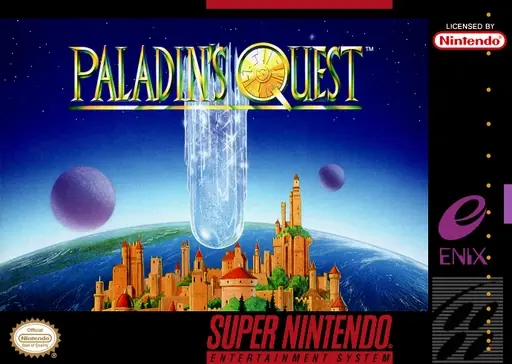
Releases by platformdates and regions as published

Releases by platform
PlatformReleasedRegions
SNES13 November 1992Japan · North America 1 November 1993

Title IDsone per regional release, with its latest update

Title ids and disc serials by release
PlatformTitle IDRegionLatest update
SNESSHVC-LNJapan—
SNS-LNNorth America—

Box artone per regional release we hold art for

Games like this

Collections1 collection

Platform libraries

Description adapted from its source, CC BY-SA 4.0.