
The articlegameplay, story, development, reception
Gameplay
Pandora's Tower is an action role-playing game where players take the role of Aeron as he explores a fortress called the Thirteen Towers, suspended above a ravine known as the Scar, on a quest to cure his lover Elena of a curse. Aeron can be controlled through both the Wii Remote and Nunchuk or the Classic Controller. The base from which Aeron explores the Thirteen Towers is the Observatory, a building on the edge of the Scar. In the Observatory, Aeron can save his progress, and interact with Elena and the merchant Mavda.
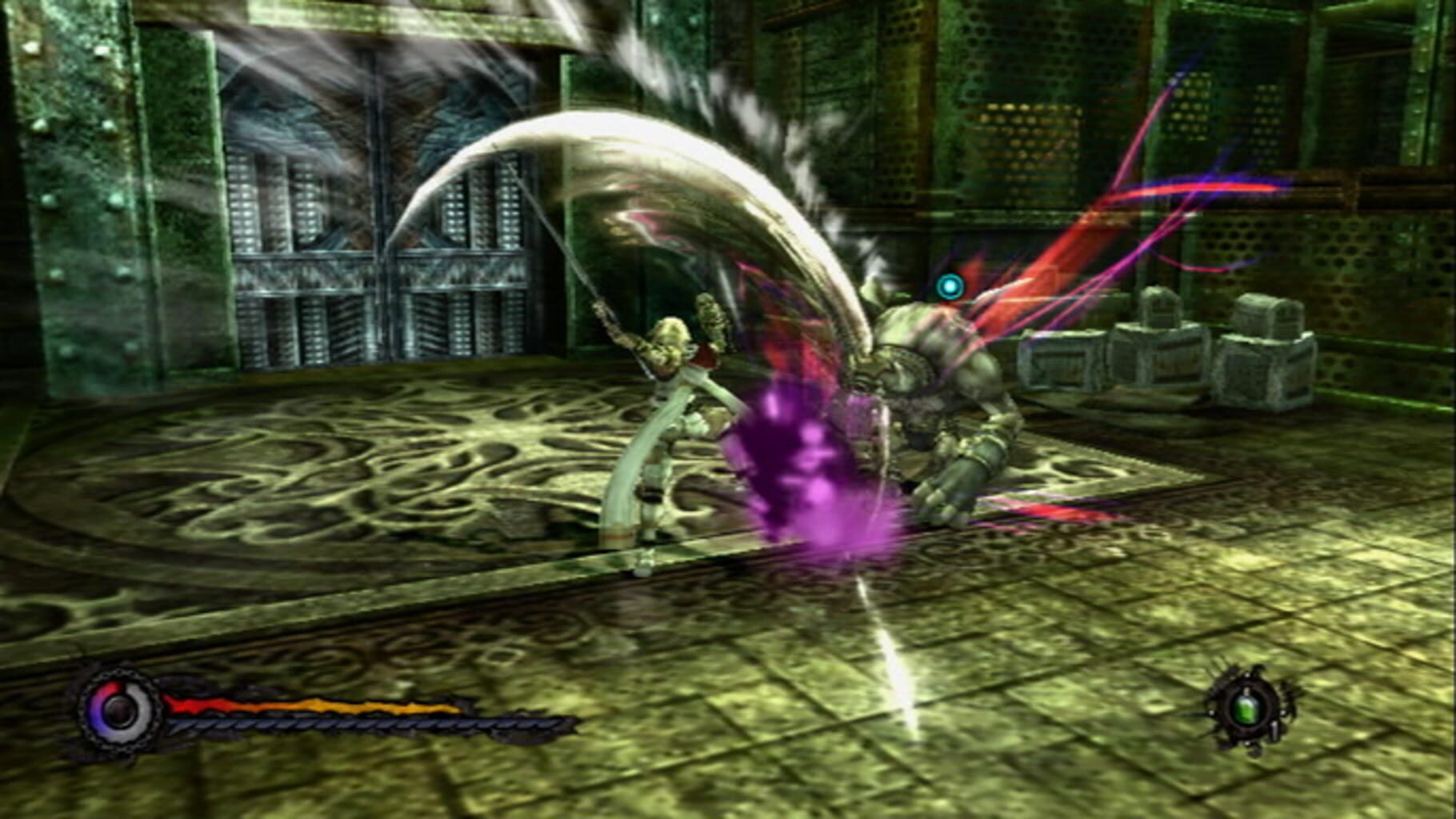
The main objective when inside the Thirteen Towers is the reach the Masters, powerful monsters housed at the top of each tower in a locked room which act as the game's bosses. These rooms must be accessed by solving puzzles throughout each Tower to unlock the door. On his way through the Towers, Aeron must fight numerous smaller enemies: he can perform a basic melee attack, and a charged attack which deals higher damage and will trigger additional attacks if the player times a button press with the appearance of a targeting ring around Aeron.
Story
Pandora's Tower is set on the fictional continent of Imperia: once divided into ten kingdoms, the now-nomadic Vestra tribe were stripped of their kingdom. The dominant religion of Imperia is Aios, a polytheistic system worshiping nature as personified by twelve deities. Though once united through the ancient War of Unification which began the Unified Era, Imperia has seen recent conflicts as three kingdoms sought to break free from the powerful kingdom of Elyria.
During the game's present, the war has ended but tensions are still high on both sides. The game's primary setting is the Okanos region at the Thirteen Towers, a giant fortress suspended above a giant chasm called the Scar, held in place by thirteen giant chains said to keep the Scar from growing. Initially built five centuries before, a disastrous magical experiment caused the Towers to be infested by monsters. Fifty years prior to the start of the game, a new experiment involving the monsters triggers the Scar's creation.
Development
The first stages of development began in late 2006 after the completion of Jump Ultimate Stars. Up to that point, developer Ganbarion had only ever worked on licensed titles, and the team wanted to do something original. When Nintendo asked whether they wished to work on an original intellectual property due to being impressed by their work, Ganbarion accepted and pitched them the idea. The initial concept was how something pure had been corrupted and needed to be purified once again, with the main theme being love.
The concept of the heroine needing to eat meat did not come until much later, when producer Chikako Yamakura was talking with another staff member about the then-prevalent fashion for ekiben, boxed lunches served on trains, and the idea came to her "out of the blue". Only the basic elements of the story had been decided by then, and despite reservations by Nintendo's then-CEO Satoru Iwata, the project was greenlit as Iwata felt that they deserved the chance to work on a fresh project. The long development cycle was the result of continuous problems faced by the team which ran from the use of the Wii Remote to mixed responses from testers on the mechanics surrounding Elena which necessitated some aspects surrounding the character to be scrapped and redone from scratch. This latter measure needed to be undertaken just a year before the game's release.
Reception
On aggregate site Metacritic, Pandora's Tower received a score of 73/100 based on 48 critic reviews, denoting "mixed or average" reception. Destructoid's Tony Ponce praised the game's premise and how fleshed out Elena was despite her role as a damsel in distress, but felt that there was too much background lore, and that Aeron's lack of personality hurt the relationship aspect. Andrew Fitch, writing for Electronic Gaming Monthly, praised the world design, but faulted the lack of character development given to Aeron and Elena. Eurogamer's Matt Edwards referred to the game's plot as "a soppy and yet surprisingly sinister love story", saying that moments between the couple raised a genuine smile.
IGN's Chris Schilling said that while the story was "slight", it was bolstered by a good localization and voice acting, in addition to darker elements in the plot and during cutscenes. GameSpot's Ashton Raze praised Aeron and Elena's romance as "a grounded, human [story] in a world of monsters". Heidi Kemps, writing for Joystiq, noted genuine emotion in the relationship mechanics of Aeron and Elema, while Steve Hogarty of Official Nintendo Magazine referred to the scenario as "a boy-meets-girl love story with a Clive Barker twist" in addition to praising its dark tone. The game's time limit mechanic and its impact on Elena's condition divided opinion: some praised its implementation, but some critics noted that it might put too much pressure on the player.


