The articlegameplay, story, development, reception
Gameplay
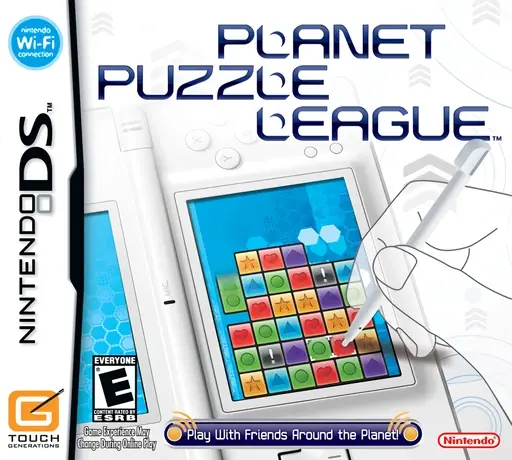
In Planet Puzzle League, identically-sized square blocks (panels) of various colors are stacked in a two-dimensional well 6 spaces wide, of which the active on-screen playfield is 12 spaces tall. The blocks in the stack align according to an invisible grid, such that the blocks occupy distinct rows and columns.
Planet Puzzle League, by default, is played with the Nintendo DS unit in a sideways "book-style" orientation, which allows the vertically oriented playfield and its blocks to be displayed larger, making it better-suited for touch-screen gameplay. The game can also be played in the standard Nintendo DS orientation, for button positioning that is suited for traditional button-based gameplay. Either control method can be used, regardless of orientation. The game can be configured for either left-handed or right-handed play.
When using touchscreen control, blocks can be dragged horizontally with the stylus. In this control scheme, a move occurs as a block is dragged from one grid space into an adjacent grid space, during which a two-space horizontal cursor is repositioned, framing both grid spaces. As a block is dragged into a space occupied by another block; the other block is swapped into the space vacated by the dragged block. For computer-controlled players and when using traditional button-based control, the cursor is navigated along the playfield to select spaces to swap, in which a move occurs when blocks are repositioned in a swap. Players move the cursor using the D-pad and perform swaps using the A or B action button.
When blocks of the same color are aligned adjacent to one another in vertical or horizontal lines of three or more while supported from underneath, the blocks are cleared, "exploding" (disappearing) from the playing field one by one, from left to right, top to bottom. When more than three blocks are cleared at the same moment, the event is known as a combo. Combos are measured by the number of blocks cleared, with a clear of six blocks referred to as a "+6" combo. Once all the blocks in a clear or combo have disappeared, the blocks that were resting atop the cleared blocks drop down.
When blocks that drop down as a result of a clear result in another clear upon landing, the clears are linked together in a chain. Chains are measured by the number of clears in the chain, with a chain of three clears referred to as an "x3" or "triple" chain. When the blocks for a chain are actively moved into position while the blocks in a cleared line are exploding, the resultant chain is referred to as an active chain. In some modes, hints for performing active chains are occasionally provided in the form of an arrow indicating a particular move to perform.
In all gameplay modes except Puzzle modes, the stack of blocks lifts (rises) up from the bottom of the screen. As the match progresses, the stack rises at an accelerating rate. In these modes, players have the ability to manually lift the stack by using a Lift button. For touch control, the Lift button is a touch-screen area located to the side of the playfield.
For button control, a shoulder button is used for the Lift button. If a player's stack is in a state of rising while at or beyond the top edge of their playing field, the player loses the match.
The lift of the stack stops while blocks are exploding. If a combo or chain is performed, a stop occurs, in which the rising of the stack will remain stopped for a short time after the clear. The duration of the stop depends on level of combo or chain that was performed, as well as the height of the stack, decreasing as the match progresses. Lifting the stack manually during a stop overrides it and resumes natural lifting speed.
In several modes of play, rectangular garbage of various widths and heights can drop from above the playing field to add to the stack. When a block is cleared while touching a piece of garbage, the garbage piece and all same-colored garbage pieces contiguous with it are transformed as a group, space by space from right to left, row by row from bottom to top. In the transformation, the bottommost layer of each piece of garbage is turned into blocks. The rising of the stack is stopped during the transformation of garbage.
Until the entire transformation event is completed for the entire group, the newly formed blocks still behave as part of the garbage, and cannot be moved or used in a clear. Once the transformation event is completed the newly formed blocks move, fall and clear as normal.
In Vs. modes, garbage can be sent to the opponent(s) by clearing surprise blocks (chrome blocks with exclamation marks) or performing combos or chains. The garbage pieces are produced according to the table:
For a chain, the garbage piece produced spans the whole width of the playfield, with a height of one less than the chain level.
A new addition to the Puzzle League series, item blocks are special blocks that are optionally available in Garbage Battle matches, which cause certain effects when cleared. While the item is in effect, the item block is displayed to the right of the playfield of the affected player, scrolling up from the bottom of the screen, with the effect wearing off when the item scrolls past the top of the screen.
Fever blocks, indicated by a flame symbol, cause all the player's clears during a fixed period of time to be chained together.
Tri-Color blocks, indicated by a symbol of three squares, cause the variety of colored blocks in a player's playfield to be reduced to three colors for a fixed amount of time: red, blue, and green.
Reflect blocks, indicated by a symbol of an upward-pointing arrow with a bar on top, cause a player's garbage to be sent to the opponent.
Twitch blocks, indicated by a symbol of circular arrows, cause the opponent's playing field to shake, changing the blocks' colors constantly.
Paralyze blocks, indicated by jagged line symbol, cause a row of blocks in an opponent's playfield to become inaccessible for moves for a
Reception
5 out of 10 praising its mind-bending puzzles, curious combo mechanics and great online options. It also stated that "Even though the game itself is far from puzzle-perfect, Planet Puzzle League is a fun title with enough worthy challenges to warrant playing. Its weird, paradoxical combo scheme keeps it from approaching the greatness of games like Lumines, Tetris, or Super Puzzle Fighter, but if you're looking for a new way to flex your brain and test your reflexes, this piece is a solid fit." Craig Harris of IGN gave a game a 9 out of 10 score saying that "The last time I played the fun and addictive Puzzle League design was in the extremely watered down Dr.
Mario/Puzzle League cartridge released on the Game Boy Advance a couple years back. Intelligent Systems really went to town in this Nintendo DS version -- it's an excellent retooling of a very addictive puzzle game."