The articlegameplay, story, development, reception
Development
Pop'n Music was developed by Konami in 1998, a year after the success of Beatmania. Its name was coined by Beatmania's former producer, Reo Nagumo, who was inspired by the name of a radio program. Nagumo was originally part of Konami's merchandiser and medal game department; after he was brought on by the department's sound manager to work on Beatmania, the development team created Pop'n Music in parallel with sequels for Beatmania. Compared to Beatmania, which focused on club music, Pop'n Music was developed with a broader target audience in mind.
As a result, the game employed musical genres such as enka, kayōkyoku, and jazz. An official mook published in 1999 stated that Pop'n Music cabinets were installed near photo booths and that high-school girls were the primary audience for the series.
Konami applied a similar business model for Beatmania to Pop'n Music by selling dedicated arcade cabinets for the series and providing upgrades in the form of software and circuit board hardware. The former editor-in-chief of Gamest attributed the longevity of Pop'n Music to the system of regular content updates that Konami had pursued from the 1990s. After submitting a patent application in 1999, Konami received a patent for the Ojama system in 2000. Merchandise for Pop'n Music appeared early in the series' history, such as a 2001 book on character designs titled Pop'n Music Character Visual Guide. This came after the establishment of Konami's Creative Products division in 1996, which was cited by Nikkei Business as marking a shift within Konami to market character-focused goods.
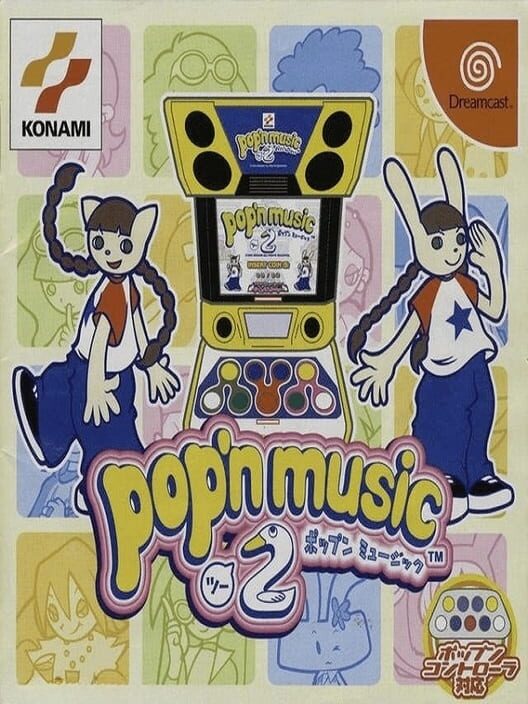
The designer for the first Pop'n Music game was Shintaro Mukai, who received coloring assistance from Shio. Shio was in charge of design from Pop'n Music 2 onward and remained on the development team during Pop'n Music 20 Fantasia. In an interview for the Pop'n Music Character Visual Guide, Shio stated that she strove to keep designs simple while also making characters stand out from a distance in arcades. The series' visuals have influenced other Konami productions: designers for Pop'n Music contributed to the titular characters for the game Elebits, and former Konami producer Koji Igarashi included Mimi and Nyami as characters in the Japanese localization of Scribblenauts. In 2011, the series accepted fan-made designs for new characters through a campaign for Pop'n Music 20 Fantasia.
A major redesign was introduced with Pop'n Music Lapistoria; staff stated that the redesign was an attempt to modernize character designs and broaden the range of facial expressions to support the story. Designs that predated Lapistoria remained in the game as inhabitants of Pop'n World, while characters with the new design belonged to a new setting named Lapistoria. The series underwent a second redesign with Pop'n Music Peace, moving away from the bishōjo-like style of Lapistoria by adopting visuals that aligned closer to the original game.
Songs written for Pop'n Music span a large variety of genres. Each song name is accompanied by a genre tag, which are rarely shared between songs. While many songs are categorized into existing musical genres, the series also employs idiosyncratic fictional genres in its naming system. Genre names were removed in 2014 with Pop'n Music Lapistoria and returned in 2025 with Pop'n Music High☆Cheers!!.
The series is heavily influenced by the Shibuya-kei microgenre; notable musicians associated with the genre who have composed for Pop'n Music include Perfume's producer Yasutaka Nakata and members of Cymbals, Plus-Tech Squeeze Box and Round Table. From its first arcade title in 1998, Pop'n Music has also included songs from Beatmania. The development team, aiming for Pop'n Music to have delineated concept and target audience, was initially hesitant to reuse Beatmania songs. Ultimately, they included one song from Beatmania in the first Pop'n Music game as a hidden feature.
Additional songs from spin-off games such as Pop'n Stage were also reused in later installments of Pop'n Music.
The series employs sound directors who compose new songs and lead the musical development of each game. Directors include Hiroshi Takeyasu, Kiyoshi Murai, Tomosuke Funaki, Wac, Des-Row, and Pon. The sound director for the first three installments, Takeyasu, noted a stronger J-pop influence in Pop'n Music 3 after Konami's record label began being involved in production. Guest directors have also composed for the series, such as Yoko Shimomura in Pop'n Music 13 Carnival and Yasunori Mitsuda in Pop'n Music 20 Fantasia.
Each game's theme is also decided by sound directors; the fantasy theme of Fantasia was decided by Pon and Wac. The sound directors for Pop'n Music Lapistoria composed songs that matched a particular character's personality and background to fit the game's story-centered theme. In other Pop'n Music games, characters were created to fit a given song. Arcade circuit boards were upgraded in Pop'n Music 4, 9, and 15, which necessitated new technical specifications for songs from previous games.
The development team considered the workload of Pop'n Music 9 to be particularly high, as it included all songs from previous installments and a change in audio coding formats.
Reception
Pop'n Music has been positively received in Japan. The series reached number 8 in a public poll by Famitsu for the best music games of all time. Early in the series' history, Pop'n Music was number 6 in the magazine Game Machine's list of most popular arcade games in Japan. Several of the series' Dreamcast ports have also garnered a favorable response; the first port was the 78th best selling game of its console, and Pop'n Music 4 placed number 8 in a summary of reader polls held by Dreamcast Magazine for the best Dreamcast game.
Some reviewers have praised Pop'n Music for its gameplay; Shacknews and Impress Watch described it and "addictive" and "a game that anyone can causally play". The series has been evaluated on its difficulty levels; reviews for the Dreamcast and PlayStation 2 ports felt that the games were accessible with "simple rules" but challenging upper stages. Total Control considered the control scheme to be a "stripped down version" of Beatmania but added that players would be "worked up into a frenzy" on harder stages, while NGamer asserted that the series was a "'hardcore' favorite" and owed part of its appeal to its difficulty.
The series' nine-button controller is sold as a peripheral for consoles such as the PlayStation 2 and Dreamcast. Many critics have welcomed the peripheral's addition: Total Control's review of Pop'n Music for the Dreamcast and Dreamcast Magazine both argued that the game was more enjoyable with the controller. The Wii release was criticized for lacking the nine-button controller; NGamer claimed that the use of the Wii Remote lowered the game's difficulty, while Shacknews argued that the game was "impossibly crippled" by not having a peripheral device.
Several music commentators and game critics have commended the series' soundtrack: the music writer Kei Ichimura complimented the "originality" of each composer's style combining "seamlessly" with various genres. Impress Watch echoed the sentiment, arguing that the music was compelling and had an "energy" unique to the series. GameSpot felt that the Wii version contained a "catchier set of songs" compared to Dance Dance Revolution, and Total Control described the first Dreamcast port's soundtrack as having "something for everyone". Pop'n Music has also played a role in the early careers of several musical artists; Iori Saeki performed for the series under the alias NU-KO in her first singing role, and the Vocaloid producer cosMo@bousou-P listed Pop'n Music as an inspiration in his music.