The articlegameplay, story, development, reception
Gameplay
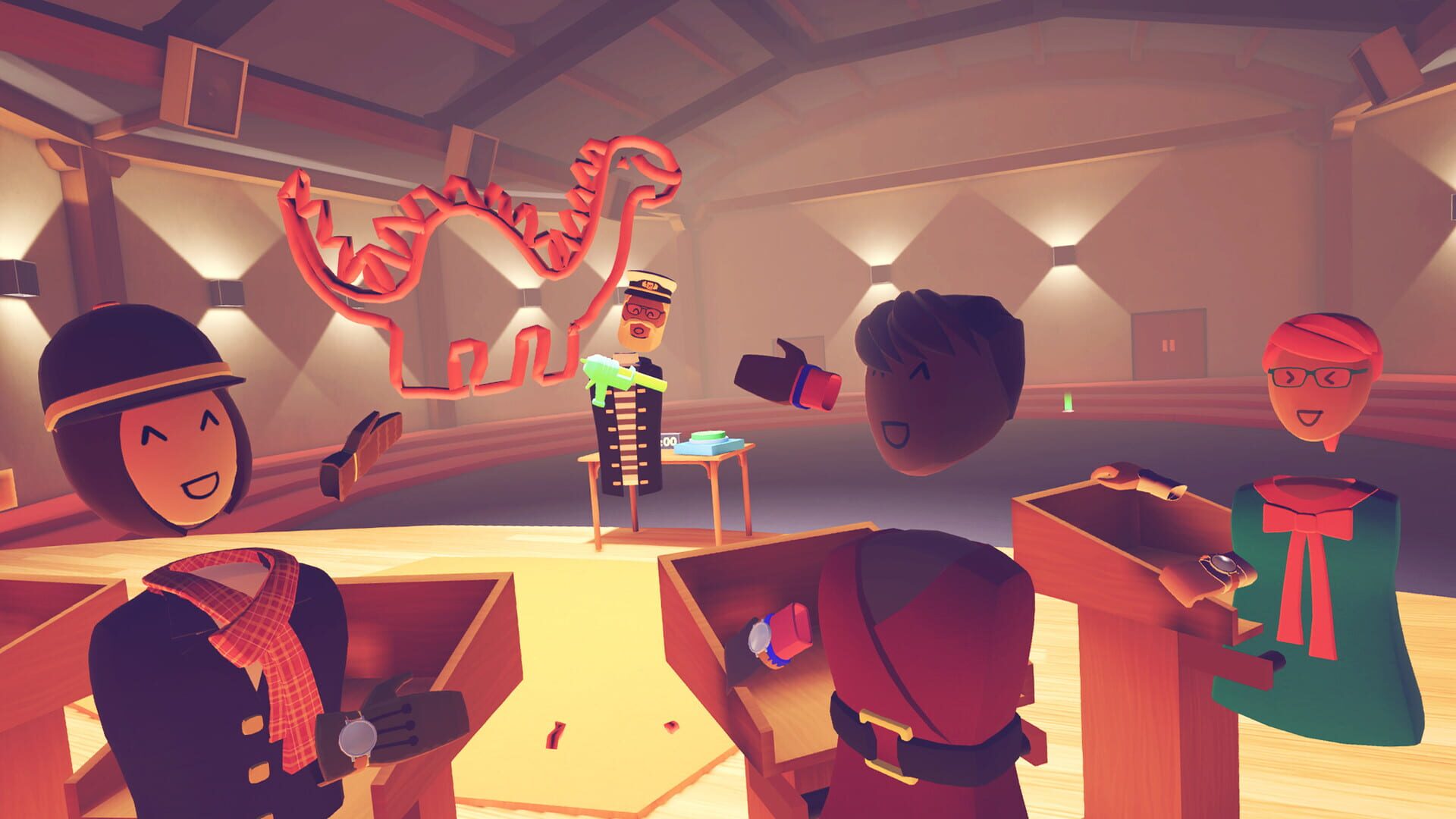
Rec Room supported optional virtual reality (VR) gameplay across compatible devices, including headsets from Meta, Pico 4, and Steam VR platforms. In virtual reality mode, players interacted with the environment using motion controllers, enabling object manipulation and spatial movement. A non-VR mode known as "screen mode" was also available, allowing access to the game without needing a headset through a PC or PS4, and was later expanded to iOS, PS5, Xbox, Nintendo Switch, and Android.
In VR mode, players could explore the in-game space within the confines of their physical floor space, while roaming further in-game by using the controllers. Players could "teleport" a short distance, and likely experience no virtual reality sickness, or could "walk" smoothly with the thumbstick, although this posed a higher risk of motion sickness.
When loading into the game for the first time, new players would start in Orientation, a place where they would be introduced to the game's basic mechanics and given their virtual watch. After going through orientation, players would start in their Dorm Room any time they loaded into the game.The Dorm Room was a small private room with a flexible dummy that players could punch, a whiteboard that players could draw on, and a mirror. Players could change their outfit and appearance via buttons on the side of the mirror, which could also be used to access the in-game shop to buy more outfit items.
Players could leave their Dorm Room by either interacting with a door, which would load them into the Rec Center, or could choose a room to go to from their watch menu. The watch menu had a list of rooms sorted by their genres and types. Players could also use a search bar to search up a specific room to play.
In the Rec Center, players could interact with other players, join Rec Room Original rooms through doors, or play minigames like darts, or throwing basketballs into hoops. The Rec Center would occasionally be updated during events with decorations and sometimes usable or responsive components.
All rooms joined by a player were public by default, but players could also create a private instance of any room, or join other private rooms (if invited).
In all rooms, players could interact with other players in real time through voice and text chat, (though players under the age of 13 on "Junior" accounts could not use either) and interact using their hands and movement of their body.
Rec Room had many social features, all accessible through the watch menu, but often had accompanying gestures. For example, players could choose to friend another player with a handshake. Players could also invite, mute, or report other players, as well as block with a 'talk to the hand' gesture, "cheer" them for various reasons with a thumbs up, or form a party with other players to travel between rooms together with a fist bump.
By playing, players could earn experience, and eventually level up, receiving a gift box and an increase to the indicator next to their username showing their level. Levels were originally capped at 50, but were later increased to 87.
Development
Seattle-based development studio Rec Room Inc. (formerly Against Gravity Corp.) was co-founded in April 2016 by Nicholas Fajt, Cameron Brown, Dan Kroymann, Bilal Orhan, Josh Wehrly, and John Bevis. Prior to the company's founding, CEO Fajt worked as a program manager on the HoloLens team at Microsoft.
Kroymann worked on the same team after working on the Xbox team. CCO Brown worked as the creative director of HoloLens.
In 2016 and early 2017, the company raised $5 million in funding for the development of Rec Room and its community. It remained free to download throughout its lifespan.
In June 2019, Rec Room Inc. announced that the company raised an additional $24 million over two rounds of funding. In December 2020, Rec Room Inc. announced an additional $20 million in funding.
In March 2021, Rec Room Inc. announced another funding round of $100 million with a valuation of $1.25 billion leading to its unicorn status. In December 2021, Rec Room Inc. announced that they raised $145 million during another funding round, bringing the studio's value up to $3.5 billion.
In March 2025, Rec Room laid off 16% of its staff, citing a "more challenging fundraising environment" and a slowdown in gaming market growth. This did not prevent a more severe layoff in August 2025, where 50% of the remaining staff were laid off.
Most of the music heard in Rec Room Originals was composed by creative director Cameron Brown, going by "gribbly" in-game, using Reason, with Korg Gadget also being used for music used in Laser Tag and Jumbotron.
Reception
Dan Ackerman, writing for CNET, described Rec Room as VR's "killer app". In January 2017, Ars Technica reported that trolling and harassment were major issues for Rec Room. In June 2017, MIT Technology Review contributor Rachel Metz described it as a great example of VR's potential for social interaction while criticizing its underdeveloped anti-abuse features. Filmmaker Joyce Wong described Rec Room as her choice of "most interesting piece of art in 2017".