The articlegameplay, story, development, reception
Gameplay
In Resident Evil, the player chooses to play as either Chris Redfield or Jill Valentine as they explore the Spencer Mansion to find their missing compatriots and secure an escape route. The environment is presented from a third-person perspective, using fixed camera angles and pre-rendered backgrounds, while the player uses tank controls to move. Certain parts of the environment can be examined, items can be collected, heavy objects can be pushed around, and the player can navigate from room to room using doors, stairs, or elevators. Both characters have different perks: Chris has more health and handles heavy weapons more effectively, while Jill has an increased inventory capacity and starts with a lockpick that opens several locked doors which Chris must find keys for.
Chris and Jill begin with only a survival knife and a Beretta M92FS, and zombies and various other monsters scattered around the Mansion will attack them on sight. While the player can procure other firearms to defend themselves, including a Remington Model 870 and a Colt Python, there is limited ammunition throughout the area, preventing the player from killing everything they come across. Taking damage depletes the player's health, shown on an electrocardiogram in the inventory screen – it can be restored using herbs and first aid sprays, but if the player takes too much damage, they will die and must restart from their last save.
The player has a limited inventory capacity of 6 slots as Chris, or 8 as Jill – spare items can be deposited in item boxes found inside various safe rooms, alongside typewriters that let the player use ink ribbons to save their progress. In the inventory screen, items can be examined, equipped, discarded, or combined with each other to produce various effects – e.g. combining two herbs to increase their potency, or making an item needed to progress. Certain items are needed to solve puzzles and either provide the player with more supplies or open new areas.
Each character has a supporting partner that joins them during the story – field medic Rebecca Chambers for Chris, weapons specialist Barry Burton for Jill. Depending on the player's actions, their partner can either die or accompany them throughout the entire game – different endings exist depending on whether the player is able to save their partner and/or the other playable character and escape with them.
Story
S.) is sent out into the surrounding Arklay forest to investigate a recent string of cannibalistic murders. When contact with them is lost, Alpha Team is sent out to investigate – consisting of Chris Redfield, Jill Valentine, Barry Burton, Joseph Frost, Brad Vickers, and captain Albert Wesker. They discover Bravo Team's helicopter crashed in the forest, with pilot Kevin Dooley dead at the scene.
Alpha Team continue to explore the surrounding forest, but are suddenly attacked by a pack of ravenous Dobermanns. Joseph is mauled to death, while Brad flees in their helicopter – the survivors flee from their pursuers, eventually taking shelter in a mysterious mansion.
One member of Alpha Team (Barry in Chris' story, Chris in Jill's story) is separated and does not make it inside – the player character splits off from the others to investigate noises coming from the west wing, but discover Bravo Team member Kenneth J. Sullivan being eaten by a zombie. When Wesker mysteriously vanishes (alongside Jill in Chris' story), the player is left to explore the mansion alone and attempt to find their allies. As they explore, they find that Bravo Team has been massacred – Forest Speyer was pecked to death by infected crows, while Richard Aiken dies from venom poisoning after being bitten by Yawn, a giant mutated snake, and captain Enrico Marini is shot dead in the torso by an unseen person just after revealing that there is a mole in S.T.A.R.S.. The only Bravo Team survivor, field medic Rebecca Chambers, is rescued by Chris.
The player eventually comes to discover that the mansion was a research facility of Umbrella, a pharmaceutical corporation that was secretly producing Bio Organic Weapons (B.O.W.s) for unknown purposes. The cannibalistic murders were caused by an outbreak of the "Tyrant Virus" (t-Virus for short), a virulent agent capable of turning any species it infects into flesh-eating zombies. At an underground laboratory beneath the mansion, the player discovers that Wesker is the mole, being an employee of Umbrella placed in S.T.A.R.S. to keep an eye on their operations; He also blackmailed Barry into helping him under the threat of Umbrella killing his family, but if Barry survives, he turns on Wesker upon learning that he was bluffing as he betrayed Umbrella for his personal interests.
W. super soldier which he calls the ultimate bio-weapon, in order to demonstrate its potential after the survivors mock it as a failure, but his plan backfires as it kills him first before focusing on the player, who defeats it. Optionally, the player can save the other playable character from a holding cell if they collected a set of MO disks scattered around the mansion, and, if their partner survived (Barry for Jill and Rebecca for Chris), the self-destruct sequence for the mansion will be activated. The player and anyone they saved escape to a helipad where they fire a flare to signal Brad, who is still flying his helicopter looking for them.
The survivors are ambushed by the Tyrant, and battle it until Brad drops a rocket launcher for the player to finally destroy it. All remaining survivors of the incident then fly out of the mansion. The ending varies depending on whether the partner survived and/or the supporting character was freed. If the partner did not survive, the self-destruct sequence is not activated and the mansion does not explode, while the Tyrant is now loose in the wilderness.
If the supporting character was left in their cell, they are presumed dead. Canonically, all four protagonists (Chris, Jill, Barry, and Rebecca) survive and the mansion is destroyed.
Development
Resident Evil was created by a team of staff members who would later become part of Capcom Production Studio 4. The inspiration for Resident Evil was the earlier Capcom horror game Sweet Home (1989), itself a video game adaption of the Japanese horror film of the same name. Shinji Mikami was commissioned to make a game set in a haunted mansion like Sweet Home. The project was proposed by Sweet Home creator Tokuro Fujiwara, who was Mikami's mentor and served as the game's producer.
Fujiwara said the "basic premise was that I'd be able to do the things that I wasn't able to include" in Sweet Home, "mainly on the graphics front", and that he was "confident that horror games could become a genre in themselves." He entrusted Mikami, who was initially reluctant because he hated "being scared", with the project, because he "understood what's frightening."
Resident Evil adopted many gameplay systems from Sweet Home, including the limited item inventory management, the mansion setting, the puzzles, the emphasis on survival, the door loading screen, the use of scattered notes and diary entries as storytelling mechanics, multiple endings depending on how many characters survive, backtracking to previous locations in order to solve puzzles later on, the use of death animations, individual character items such as a lockpick or lighter, restoring health through items scattered across the mansion, the intricate layout of the mansion, and the brutally horrific imagery.
Part of the inspiration for limited ammunition came from the MSX port of the game Alcazar: The Forgotten Fortress, according to scenario writer Kenichi Iwao. The idea of having limited ammunition was inspired by the limited amount of supplies in the game's randomized dungeons. Iwao wanted to take more elements from the game, such as adding more ways to attack zombies with items such as mines and traps, but was unable to due to schedule constraints.
Production began in 1993, and the game took three years to develop. During the first six months of development, Mikami worked on the game alone, creating concept sketches, designing characters, and writing over 40 pages of script. The project was originally planned for the Super NES, before moving development to the PlayStation in 1994. Koji Oda was working on the Super NES version, after having worked on Super Ghouls 'n Ghosts (1991). Oda revealed that the setting was originally more of a hellish place, before being changed to a more realistic setting.
Several of the Resident Evil mansion's pre-rendered backdrops were inspired by The Overlook Hotel, the setting for the 1980 horror film, The Shining. Mikami also cited the 1978 film Dawn of the Dead as a negative inspiration for the game. The game was initially conceived as fully 3D and first-person with action and shooting mechanics. A first-person prototype was produced, and initially featured a supernatural, psychological Japanese horror style similar to Sweet Home, before opting for an American zombie horror style influenced by George A.
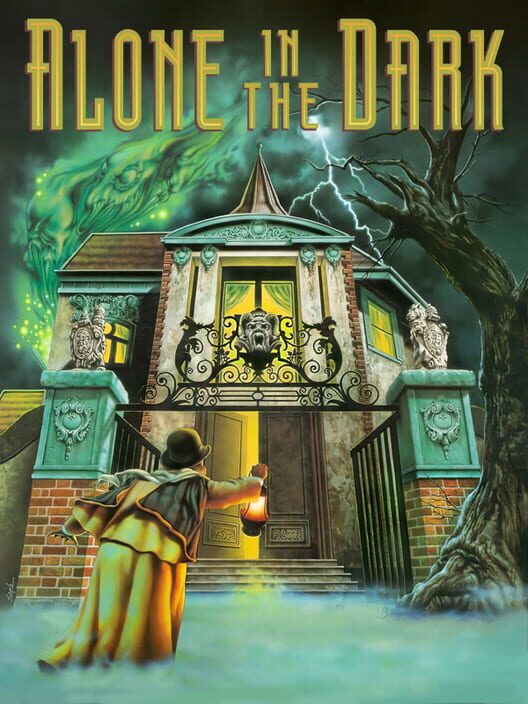
Romero films. During production, Mikami discovered Alone in the Dark (1992), which influenced him to adopt a cinematic fixed-view camera system. Mikami said that, if it was not for Alone in the Dark, Resident Evil would have had a first-person view instead. Mikami was initially reluctant to adopt Alone in the Dark's fixed-view camera system, saying it "had an effect on immersion, making the player feel a bit more detached", but eventually adopted it because the use of pre-rendered backdrops allowed a higher level of detail than his fully 3D first-person view prototype, which "didn't get along so well with the original PlayStation's specs."
A concept art claimed to be of the original first-person prototype has been available since the 1990s, showing more similarity to Doom rather than Alone in the Dark. A first-person perspective was not used again for the mainline Resident Evil series until Resident Evil 7: Biohazard (2017).
wasn't good enough." Early footage of this co-op prototype was revealed in 1995. At this stage of development, a local co-op mode was present, along with different outfits. A later demo made for the 1995 V Jump Festival presentation in Japan featured real-time weapon changes, with the co-op mode removed and rudimentary character models and textures.
An early 1996 preview in Maximum Console magazine featured a graveyard and a slightly different version of the final boss. The graveyard, which was removed from the final game, eventually made it into the 2002 remake. Also featured in the game until late in development were guest houses and a tower, which were replaced by the guard house and the lab respectively. Another feature that was removed from the final game was the real-time weapon changing, from the earlier 1995 V-Jump demo.
The co-op mode and real-time weapon changes were not used again for the mainline series until Resident Evil 5 (2009).
Capcom did not use any motion capture in the game, despite having their own motion capture studio; instead, the animators referred to books and videos to study how people, spiders, and other animals encountered in the game move.
In pre-production, other characters were conceived. Dewey, an African-American man, was intended to perform a comic relief role, while Gelzer, a big cyborg, was a typical "strongman" character. Both were later replaced, by Rebecca and Barry, respectively.
Almost all development was done on Silicon Graphics hardware using the software program Softimage. The PlayStation was chosen as the lead platform because the development team felt it was the most appropriate for the game in terms of things such as the amount of polygons. The development team had upwards of 80 people towards the end of the game's development. According to Akio Sakai, head of Capcom's consumer software division, Capcom were hesitant t
Reception
The original PlayStation version of Resident Evil was critically acclaimed, receiving an aggregated rating of 91 out of 100 at Metacritic based on eight reviews. Among those who praised the game was GameSpot, describing it as "one of those rare games that's almost as entertaining to watch as it is to play". Famitsu gave it ratings of 9, 10, 10 and 9 out of 10, adding up to 38 out of 40. This made it one of their three highest-rated games of 1996, along with Super Mario 64 (which scored 39/40) and Tekken 2 (which scored 38/40).
Resident Evil was also one of only ten games to have received a Famitsu score of 38/40 or above up until 1996. GamePro described the storyline and cinematics as "mostly laughable", but felt the gameplay's "gripping pace" and the heavy challenge of both the combat and the puzzles make the game effectively terrifying. They reassured readers that the unusual control system becomes intuitive with practice and applauded the realism instilled by the graphics and sound effects. The four reviewers of Electronic Gaming Monthly also commented on the realistic graphics and sounds, and additionally praised the selection of two playable characters.
Sushi-X remarked that it, "at first glance, may appear to be a clone of Alone in the Dark, but in reality, it is a totally new experience". Mark Lefebvre remarked, "The element that really grabs a player here is fear. After trading blows with the first zombie, you'll quickly become hesitant to turn down any uncharted corridors in the mansion."
A reviewer for Next Generation said it "manages to be as genuinely scary as a good horror film - no small achievement. There are a lot of things that work around games being this frightening ... In this case, however, the fine character work, creepy and well-executed sound effects, and just the right music in just the right places all have a subtle, cumulative effect ..." While criticizing the "laughable" dialogue and voice acting, he felt they were overridden by the game's positive aspects.
He pointed out that the lack of genuinely confounding puzzles allows the game to move at a good pace, and the use of prerendered backgrounds allowed the PlayStation to handle much more detailed characters. Yasuhiro Hunter of Maximum stated that "The game has the greatest atmosphere of any other game in existence [sic] - naming a game that makes you jump as much as when encountering your first pair of Cereberos in this title would be very difficult." He also praised the heavy difficulty of the puzzles, the great care required in combat, the 3D graphics, and the exceptionally high replay value.
Computer Gaming World gave a more mixed review for the Windows version, explaining that they "tried to hate it with its graphic violence, rampant sexism, poor voice acting and use of every horror cliché, however...it's actually fun."
The Saturn version was also very well-received. While most remarked that Capcom had taken too long to bring Resident Evil to the console (the game had been out on the PlayStation for well over a year, and hype had built up for Resident Evil 2, which would be released in just a few months), critics agreed that the game was still as stunning as it had been on its initial release and had been accurately recreated for the Saturn. Computer and Video Games, for example, commented that "With all the talk about the Saturn being inferior in this department, the [graphics] quality cannot be surpassed. All of the rooms, the enemies and the animation are almost identical."
0 for graphics, sound, and funfactor), summarized that "It would have been nice to have it on the Saturn sooner, but this is as close to a sure thing as you could ask for." Sega Saturn Magazine said that "the intense feeling of terror heightened by the chilling music and eerie silences ... sets Resident Evil apart from any other adventure game you may care to mention." Critics also widely praised the Saturn-exclusive Battle Mode.
The Director's Cut was positively received as well, with most critics regarding the advanced mode and the bundled Resident Evil 2 demo as the highlights. However, all four reviewers for Electronic Gaming Monthly decried it, arguing that a handful of changes and a demo disc were not enough to justify the price.
Resident Evil was a best-seller in Japan, North America, and Europe, including the United Kingdom. Shortly after release, it became the best-selling PlayStation game ever at the time. 016 million units in 1996 which made if the 4th best-selling game of the year, only trailing Pocket Monsters, Tekken 2 and Super Mario RPG. Overseas, it topped the US charts and entered at number-two on the UK charts.
In the United States, the game sold over 1 million copies by early September 1996, becoming a system-seller for the PlayStation and increasing its install base at the time. In Europe, the game shipped 230,000 units on its first day of release, with 21,500 sold on its first weekend in the United Kingdom where it was one of the fastest-selling CD releases up until then. The game went on to sell at least more than 300,000 units in Europe by December 1996.
By December 1997, the game had sold about 4 million units worldwide and grossed more than $200,000,000 (equivalent to $411,000,000 in 2025). According to Capcom's investor relations website, the original version of Resident Evil has sold over 2.75 million copies, while the Director's Cut version (including the Dual Shock edition) sold an additional 2.33 million copies. All PlayStation versions of the game have sold a combined 5.08 million units worldwide.
Resident Evil was the first game to be dubbed a "survival horror", a term that it coined for the genre. It was ranked as the 91st top game of all time by Next Generation in 1996, stating that it "successfully redefine[d] the genre which started with Infogrames' Alone i
Legacy
Resident Evil's success resulted in a media franchise that has since branched out into comic books, novels and novelizations, sound dramas, a non-canonical series of live-action films and animated sequels to the games, and a variety of associated merchandise, such as action figures. The series has become Capcom's biggest franchise. The events of the game were retold in Resident Evil: The Umbrella Chronicles, originally released for the Wii in 2007.
GameSpot listed Resident Evil as one of the 15 most influential video games of all time. It is credited with defining and popularizing the survival horror genre of games. It is also credited with taking video games in a cinematic direction with its B-movie style cutscenes. Its live-action opening, however, was controversial; it became one of the first action games to receive the "Mature 17+" (M) rating from the Entertainment Software Rating Board (ESRB), despite the opening cutscene being censored in North America. Chicago Tribune said it "revolutionized" gaming in 1997.
Resident Evil is credited with sparking a revival of the zombie genre in popular culture since the late 1990s, leading to a renewed interest in zombie films during the 2000s. Resident Evil also played an important role in the zombie genre's shift from supernatural themes to scientific themes, using science to explain the origins of zombies. In 2013, George A. Romero said it was the video games Resident Evil and The House of the Dead "more than anything else" that popularised zombies in early 21st-century popular culture.
A documentary based on his adaptation was released on digital on January 7, 2025. In a 2015 interview with Huffington Post, screenwriter-director Alex Garland credited the original Resident Evil video game as a primary influence on his script for the horror film 28 Days Later (2002), and credited the first Resident Evil game for revitalizing the zombie genre. Shaun of the Dead (2004) star and co-writer Simon Pegg also credits the original Resident Evil game with starting the zombie revival in popular culture. The Walking Dead comic book creator Robert Kirkman named Resident Evil as his favorite zombie game, while The Walking Dead television series director Greg Nicotero credited Resident Evil and The House of the Dead with introducing the zombie genre "to a whole generation of younger people who didn't grow up watching Night of the Living Dead and Dawn of the Dead."
After the original Resident Evil video game sparked a renewed interest in the zombie genre, it was followed by zombie films such as 28 Days Later, Dawn of the Dead (2004), Shaun of the Dead, 28 Weeks Later (2007), Zombieland (2009), Cockneys vs Zombies (2012), and World War Z (2013), as well as zombie-themed graphic novels and television shows such as The Walking Dead and The Returned, and books such as World War Z (2006), Pride and Prejudice and Zombies (2009) and Warm Bodies (2010). The Resident Evil film adaptations also went on to become the highest-grossing film series based on video games, after they grossed more than $1 billion worldwide.
In 2002, Resident Evil was remade for the GameCube as part of an exclusivity agreement between Capcom and Nintendo that spanned three new games. The remake includes a variety of new gameplay elements, environments, and story details, as well as improved visuals and sound. The game was also later ported for the Wii in 2008. A remastered version of the remake, featuring high definition graphics, was released as a download for the PlayStation 3, PlayStation 4, Windows, Xbox 360, Xbox One in 2015 then later for Nintendo Switch in 2019, with a limited edition PlayStation 3 version released at retail in Japan.
Resident Evil: The Umbrella Conspiracy is a novelization of the game that was written by S. D. Perry in 1998 as the first book in her series of Resident Evil novels. The novel combines Jill's and Chris scenarios into one narrative and features all five of the main characters (including Barry, Rebecca and Wesker).
The book also takes liberty with some of the original source materials; the most notable difference being the inclusion of an original character named Trent, an insider from the Umbrella Corporation who provides Jill with information about the Spencer Mansion prior to the events of the mansion incident. Since the book was written a few years before the Nintendo GameCube remake, the novelization lacks the presence of Lisa Trevor in the mansion. However, the book does allude to the original version of George Trevor's journal from The True Story Behind Bio Hazard, as well as the short story it contained, "Bio Hazard: The Beginning", which involved the disappearance of Chris Redfield's friend, Billy Rabbitson. Another notable difference in the novels is moving the location of Raccoon City from the Midwest to Pennsylvania, apparently about an hour's drive from New York. Overall, despite having been written before the retcon introduced in the Resident Evil remake and Resident Evil Zero, the book still maintains overall similarity to what the story warped into in the early 2000s.