The articlegameplay, story, development, reception
Gameplay
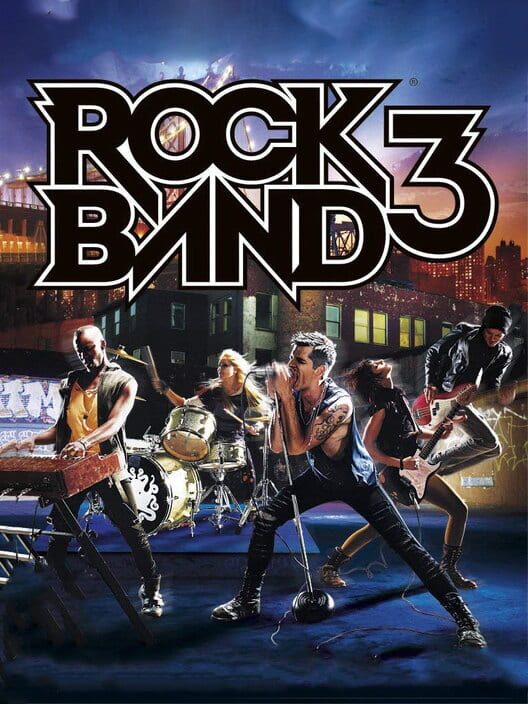
Rock Band 3 allows for 1–7 players, either locally or through online game services, to use various instrument controllers to accurately simulate the playing of music. In addition to supporting the four Basic instrument controllers from previous Rock Band games (lead guitar, bass guitar, drums and vocals), Rock Band 3 adds support for two additional microphones for singers to provide backup vocal harmonies (previously found in The Beatles: Rock Band and Green Day: Rock Band), an electric keyboard as a new instrument (or any MIDI-compatible keyboard), plus support for a specially made 102-button MIDI bass, and an actual Squier guitar by Fender. Support for MIDI compatible electronic drum kits as well.
Prior to a song, each band member selects from one of four difficulty levels, Easy, Medium, Hard, and Expert, which influence the number and rate that notes appear on the note track; they also can select the Pro mode for real guitar, bass, keyboards, and drums. As the band performs, they score points. Each player can build up a multiplier by hitting consecutive notes correctly, which increases how many points each note is worth, but the multiplier is set back to 1× if a note is missed. After successfully completing a song, the performance of each player and the band as a whole is rated on a 5-star scale. The best performance by a player for each song in the player's library is tracked separately based on instrument, Basic or Pro mode, and difficulty, then is used to provide and compare leaderboard statistics at the end of the song.
The overall goal of the band is to successfully complete a song and earn as many points as possible by using their selected controllers to play the notes shown on the screen at the proper time; or, in the case of the vocalists, to sing in relative pitch to the original artist. Players can also gain additional points by using "Overdrive". Once a player has enough energy, which is collected by perfectly playing marked sections of the song, he or she can activate Overdrive to double the number of points the whole band earns while it is deployed. Each instrument deploys overdrive differently, and some instruments have multiple methods of activating it.
In point competitive mode (without the "no-fail" option on — not recommended for Pro mode), players who are doing poorly might be forced to drop out of the band, which silences their part temporarily while the rest of the players continue to play. A dropped player can be saved up to two times by another player activating Overdrive; if the player is not saved soon enough, the whole band may fail the song and need to restart or exit to the song library. In some game modes, an option is also available to continue the song right from where the band failed at the cost of not being able to record a score for the rest of the song's playthrough.
Although Rock Band 3's gameplay in Basic mode is very similar to that of previous games in the series, it does introduce a new gameplay mechanic designed to make fast sections such as trills, tremolo picking, and drum rolls easier to play. In such sections, players are rewarded for being exactly on cue, but they are not penalized for small differences.
Players have better tools to sort through songs to help manage a song library that was expected to be larger than 2,000 songs after the game's release by the end of 2010. Necessary sorting options include filters based on Pro mode support, keyboard or vocal harmony support, variable difficulty settings, music genre, decade, numbers of times played, leaderboard positions, and when the player acquired the song; any numbers of these filters can be applied to fine-tune the sort, such as selecting all "moderate-difficulty metal songs from the '80s that support keys and harmony vocals". Players are able to rate songs from 1 to 5 "lighters" and use this as a sorting metric. The rating system also allows Harmonix to suggest new songs to players in the Rock Band store.
Players are also able to create, save, name, and design art for custom set lists which they can share through the game's online services or through the Rock Band website. The "Battle of the Bands" mode featured in Rock Band 2, in which Harmonix created daily and weekly themed challenges based on the library of songs, extends into Rock Band 3, but allows players to create the challenges themselves from within the game or the website, including the type of challenges, what instrument(s) it is aimed for, and how long to allow the battle to run, then advertise them through social media services like Twitter and Facebook. Harmonix also creates custom setlists and battles. The official Rock Band website was updated to reflect these new features, as well as allowing players to track their own bands or friends' bands.
The game features a more in-depth career mode; players are able to design more detailed characters, which appear nearly at all points alongside the narrative, making the game "one story of your band", according to Harmonix senior designer Dan Teasdale. The career mode includes over 700 career goals, similar to Xbox 360 Achievements or PlayStation 3 Trophies, which helps to drive players to progress in the game. "Road challenges" combine features of the Tour mode of Rock Band and Rock Band 2 with Mario Party concepts, according to Teasdale, and is based on feedback from Rock Band players. For example, the band may be challenged to re-invigorate the virtual crowd using copious amounts of Overdrive after they were disappointed by an opening act, or in another challenge, the band will be required to play as accurately as possible for a crowd of critics.
Numerous versions of these challenges are available, that vary in the amount of time to complete (from 30 minutes to 3 hours) and difficulty. Some of these challenges feature multiple gigs; after playing through one gig, the band is presented with three choices for songs to play at the next gig, either from pre-made set lists, cust
Development
Despite previous success of rhythm games, the genre as a whole saw nearly a 50% drop in revenues in 2009; sales of top-tier titles The Beatles: Rock Band and Guitar Hero 5 were significantly off from initial projections. Part of this has been attributed to the late-2000s recession limiting new purchases, but other analysis have speculated that consumers had grown tired of purchasing new iterations of instrument controllers for the same gameplay. While designing Rock Band 3, Harmonix sought to capture the playing experience that "really started this whole phenomenon in the first place", according to project director Daniel Sussman. Harmonix's CEO, Alex Rigopulos, stated that "Our ambition for Rock Band 3 was really to re-energize and reinvigorate the (music game) category and advance it and move it forward."
In introducing the game to journalists at a closed media event about a month prior to the 2010 Electronic Entertainment Expo, Harmonix called Rock Band 3 a "disruptive title" for the music game industry. Another aspect that Harmonix considered was "a ground-up rebuild of the Rock Band platform" and how players could interact better with the game and music library, according to Sussman.
Harmonix included the keyboard controller to help address these goals. The keyboard functionality was "designed basically to answer that staleness factor" that has been seen in music games, as said by Sussman. The gameplay for Basic keys was designed so that it was party-accessible, simple, and easy for existing Rock Band players to learn. Pro keys, on the other hand, was designed so that it would be fun playing the accurate actual notes of the song.
The team also included Pro mode to help invigorate existing players to give them new challenges, aimed at those that "had any aspirations of connecting with the music in a deeper way", according to senior designer Sylvain Dubrofsky. Sussman commented that the combination of existing and new gameplay modes provides "an experience that is both accessible to players who are just getting into this thing, and builds something for the hard-core player who is maybe a little bored with where music games are". Sussman noted that there still remains a large gap between mastering the Pro modes and playing real instruments: "We see Pro as a different experience from the five-button simulation, but not necessarily a track to expertise." Sussman further commented that inclusion of Pro mode, particularly at higher difficulty levels, was "because it shows the potential ceiling of where this can take you".
However, Harmonix was still dedicated to helping to "open doors" for players interested in learning real musical instruments, such as by including appropriate music fundamentals that can be used outside of the game. Harmonix created the Pro Guitar charts for songs through careful audio interpretation of master tracks and through watching live performances of the songs to ensure they were using the correct chords.
Rock Band 3 was distributed by Electronic Arts after the two companies reached a continued agreement for distribution of the series, which was initially set to expire in March 2010, with the final EA-distributed title to have been Green Day: Rock Band.
A pre-E3 event occurred on May 20, 2010, to provide exclusive coverage of the game to selected gaming journalists, who would remain under news embargo until June 11, 2010, just prior to E3. The first evidence that Rock Band 3 would include keyboards came from a teaser image for the game in the Green Day: Rock Band demo, released in late May 2010; the image showed 5 icons, 4 representing the existing instruments in the game and the fifth showing a keyboard layout. Ars Technica claimed via a mole, that the unit would be a "keytar", and that the game would include Pro mode. Ars Technica later claimed that Harmonix requested to have the article removed due to the embargo, and insisted that the unit should not be referred to as a "keytar". Ars Technica further commented that while other gaming sites had to wait until June 11 when the embargo was lifted, USA Today was able to reveal their stories the day before, scooping the other sites who had originally remained quiet on Ars Technica's story for fear of breaking the embargo.
The 2010 E3 Game Critics Awards awarded Rock Band 3 for the "Best Social/Casual Game", and included both the new keyboard and the Pro guitar peripherals as "Best Hardware" nominees. The game was also awarded the title of "Best Music Game" as well as being nominated for "Most Innovative" by GameTrailers.
Several offers were made available to players who pre-ordered the game, depending on vendor. In North America, those that pre-ordered through GameStop received early access to three downloadable tracks for the game; "Burning Down the House" by Talking Heads, "My Own Summer" by Deftones, and "Blue Monday" by New Order. Players preordering the game through Amazon.com or Best Buy received immediate access to a unique in-game guitar for their avatars.
After the dissolution of MTV Games, MadCatz took over the publication and distribution rights for the game. They re-released the game in several promotional instrument bundles in November 2011, including one featuring the Fender Mustang Pro-Guitar controller. All of the bundles included access to five downloadable tracks with Pro mode.
Harmonix continued to support Rock Band 3, not only through additional downloadable content, but by continually updating the core software for PlayStation 3 and Xbox 360 owners, addressing critical issues and incorporating new features. This included adding support for the Rock Band Network Audition mode for Rock Band Network 2.0 (supporting the unique Rock Band 3 feature set), and, due to high demand from the game's fans, unofficial support for the light-and-fog stage kit device previously developed for Rock Band 2 on the Xbox 360. Official support for Rock Band 3 ended with the release of six downloadable songs in 2015.
Reception
Rock Band 3 received universal acclaim from gaming journalists who considered the game to be a major jump from Rock Band 2 and a pinnacle of the rhythm game genre. Matt Miller of Game Informer called the title "a culmination of Harmonix's efforts to bring music to the masses". Ben Kuchera of Ars Technica commented that for Rock Band 3, "This is the new state of the art for rhythm games, and it's hard to find fault with what's being offered." Joystiq's Griffin McElroy asserted that Rock Band 3 "is the greatest rhythm game ever made, and quite possibly the only rhythm game you need to own".
Reviews praised the incorporation of realistic instruments and the education of how to play them into the video game setting, seeing the title as a means of preparing players to pick up real instruments. Chad Sapieha of The Globe and Mail said that with the release of Rock Band 3 "we are just a hair's breadth away from moving beyond make believe" while the New York Times's Seth Schiesel stated that "Harmonix has brilliantly torn down the wall between music games and real music".
Reviews praised the introduction of keyboard and the new controller. Miller described the keyboard peripheral as "small and light" with a number of options for how one can play it, with Johnny Minkley of Eurogamer adding that the keytar approach makes the keyboard peripheral "gaming's next must-have shame-maker". Many reviews noted that while there are some enjoyable and difficult non-Pro versions of the keyboard charts, playing in this mode was not much different from the established "five button" guitar method, and that the real enjoyment from the peripheral was through Pro mode. IGN's Hilary Goldstein noted that the keyboard addition allows Harmonix to expand the types of songs that one would previously have never expected to appear in a Rock Band game, such as Warren Zevon's "Werewolves of London" or any Elton John song. Sam Machkovech for The Atlantic expressed similar sentiments, adding that with the ability to include more keyboard or synthesizer-heavy songs into the game, "the songs are just plain better".
The new Pro mode was critically acclaimed as the primary feature that distinguished Rock Band 3 from other music games in the field. Minkley stated that the inclusions of Pro features "at once dramatically expand the potential of the game and fundamentally change the approach required to play and enjoy it". Reviewers appreciated the training modes, including their integration into the overall game's career progression and the breadth of material that is covered. Nina Shen Rastogi of Slate commented that Rock Band 3's training modes helps to overcome the discouraging early period of trying to learn guitar as "the gaming elements will mask the rote, homeworklike nature of the guitar training process".
Kuchera noted that the modes were aimed at those who have some understanding of music theory already; "If this is your first introduction to music theory, though, you may need a little more explanation", he concluded. This lament was similarly stated by Machkovech, who felt the lessons had "text that was written by a musical savant" that would be too confusing to those without musical backgrounds and too simple for those trained in music arts. Chris Kohler of Wired described the experience he and a friend had where after playing through Devo's "Whip It" on Pro guitar and keyboard, they were able to retain enough muscle memory to play their respective parts on real instruments, albeit not perfectly; Kohler summarized his experience that "Just playing Rock Band 3 taught us a little bit of actual music".
A primary consideration for the game was the cost of entry to enjoy the new features of the game particularly in Pro mode; both the cost of the new keyboard and Pro guitars (ranging from $80 to 280) and the time investment to learn these aspects was considered high and may only cater to niche players. The Metro noted that if one does not purchase any of the additional hardware controllers, "it's not much different to Rock Band 2". Goldstein commented that the amount of investment into the game will affect one's perception of the game's value: "either something completely new and challenging or just more tracks to rock out to". Goldstein further noted that with the cost and time spent on the Pro guitar models, "why not spend a little more and buy the real thing".
Several reviewers commented that the buttoned Mustang Pro guitar is not as sturdy as other instruments and does not have the same tactile feel as a real guitar. Specifically, the reviewers noted that the width of the button impressions do not vary in width as real guitar strings would, and there is no tactile feedback as one would have with a fretboard. These reviewers suggested that players, if dedicated to the Pro guitar mode, to wait for the stringed Fender Squier which had more favorable reviews.
The game's soundtrack was considered to be "the most unusual and varied in the franchise" by Miller, and "an eclectic collection that's a little more pop than metal" by Goldstein. Kuchera considered the set list to be one of the best in any music game, "spanning decades and genres and bringing a wide variety of songs to suit any taste".
During the 14th Annual Interactive Achievement Awards, the Academy of Interactive Arts & Sciences awarded Rock Band 3 for "Outstanding Achievement in Soundtrack", along with a nomination for "Family Game of the Year".
Initial sales figures from the United Kingdom showed that, for the two days that the game was available, only about 7,400 units were sold across all platforms, placing Rock Band 3 as the 26th-best-selling title during the week ending October 30, 2010. The title was the 15th best selling game in North America for October of that year based on sales data from the NPD Group. In an interview with Edge after the holiday season in February 2011, Alex Rigopulos stated that Rock Band 3 hadn't "yet sold to the level we hoped it would