The articlegameplay, story, development, reception
Gameplay
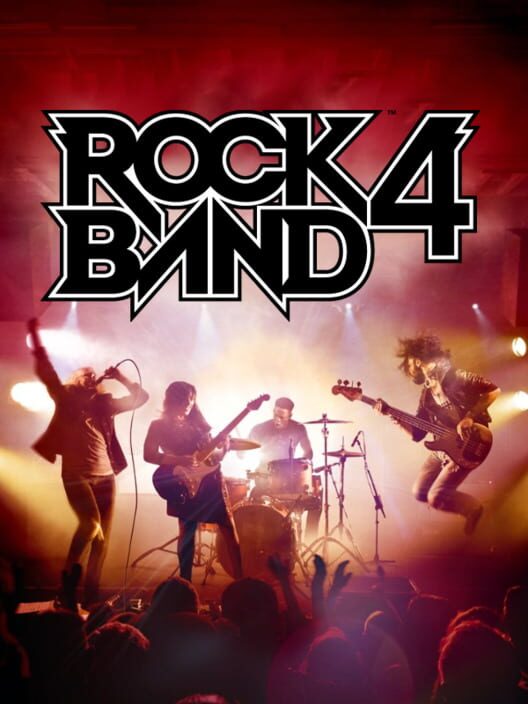
The gameplay of Rock Band 4 follows that from previous games in the series: the player or group of players use special instrument-based controllers or microphones, often based on real instruments such as a Fender Stratocaster or a Jaguar, to mimic playing the instruments by following scrolling cues on screen and attempt to play through a song and score points. Players score points for successfully hitting notes, earning a scoring multiplier for hitting a continuous series of notes without mistakes, while failure to hit the right notes can penalize the players' performance and could end the song prematurely. During the song, certain phrases are marked with specially colored notes, which if played correctly, fills the player's Overdrive meter. Once sufficiently filled, the player is able to trigger "Overdrive" through various means depending on instrument, which doubles their scoring multiplier as well as boosting the band's overall performance meter. Players are rated using a five-star system based on their score, and possibly earning a gold star rating if playing on Expert difficulty with a high score.
When Rock Band 4 launched, the game supported three main modes. Quickplay allows the players to select any song to play that is on disc or in the downloadable content library of songs. Players can also engage in "Shows" which are a series of songs broken up into a number of sets. Some songs in these Shows are predetermined, but others are left to be voted on during a short period between songs by the band members; individual members also have the opportunity to select a song from a limited list during periods of the current song when their musical part is inactive.
The available options are based on what songs the collective band members have in their library and the band's chosen theme, and voting options may include specific songs (including one selected mid-song), or broad classifications such as by genre type, release year, or song length. To aid in the cooperative nature of the game, any scoring multipliers and remaining Overdrive are carried over between songs in Gig lists as well as between sets in the Career mode.
The main mode for Rock Band 4 is a Band Tour career mode which IGN described as a role-playing game. Within the narrative of the Band Tour, the players' band starts off as a small town group with a handful of fans. En route to becoming more popular and successful, the players are tasked with the option of what types of gigs they want their band to play, with various risks and rewards that influence: how many fans the group attains per geographic region; what future gigs they will have available; and how much in-game money they earn (which can be spent customizing their band's clothes and instruments). While there are a number of possible sets that the band can select from with more unlocked as the players progresses in the game, the primary means of advancing the band's narrative is through multi-part Tours which consist of 3 to 6 different shows to be played in order.
At the start of each of these Tours, the players will have two options that will affect what type of song sets they will see on the tour and the benefits of completing each set and the overall Tour. For example, players are able to have their band take a corporate-sponsored gig, which will earn the band a large amount of in-game money, but may impact their band's reputation and limit future venues, while taking on smaller shows will not produce as much money, but increase the band's renown and open more possible gigs. Subsequent Tours may require the players to earn more stars from other, single Sets that are available, before that tour is available.
Sets during Band Tours may feature pre-determined song lists or song lists decided by the band similar to the main Sets mode, with available songs limited to certain criteria as overall band difficulty or genre type. Players may also be presented with the option to swap out a song for a crowd-requested one, or to also play an encore song in the same manner as with Sets. The band is not only rated on their general performance based on the five star rating, but as well as the players' stage presence impact the rewards from these gigs, which are based on how well the band performs in unison, such as hitting "Overdrive" together, drummers completing drum fills, and vocalists improvising. Taking crowd requests and completing encores also boosts this stage presence. These will increase the rewards in terms of fans and money at the end of a successful set.
Rock Band 4 now has the use of Freestyle Guitar Solos, an optional feature. If this feature is disabled, guitar solos in songs are presented as they were in previous Rock Band games with more of the same note-matching aspects in beat with the original song's solo; the player scores as they normally do as during regular song sections, with an added scoring bonus based on the percentage of the solo notes hit correctly. When this feature is enabled, instead of the predefined solo, the game shows suggestions for the solo style to emulate at that time, such as single notes or longer licks, chords, or tremolos, using different patterns to highlight the guitar player's on-screen track. The track markings also indicate which set of fret keys on the instrument control to use, which determine the pitch of the notes.
Players cannot fail these freestyle sections, but they are scored on how well they hit the suggested style during the segment, and they can retain their scoring multiplier by performing the proper playing style on each section of the solo. The game includes tutorials to help explain these mechanics to players. Further, the audio feedback from these solos has been refined as to make whatever the player performs stay consistent and in-tune with the other active and backing instruments.
Drums players for Rock Band 4 are able to count down to start the song as often done by real-life bands. Rock Band 4 will change ho
Development
Rhythm games like Rock Band and Guitar Hero had been widely popular during 2005 to 2008, but due to oversaturation of the market and the onset of the 2009 recession, the rhythm genre suffered major setbacks, and the genre's popularity had quickly waned. Harmonix had released Rock Band 3 in 2010, and while well received by critics and fans, had only an estimated one million retail sales, lagging behind its dancing game, Dance Central, released during the same period. Harmonix would continue to support Rock Band 3 through 2013 with additional content patches and over 280 consecutive weeks of new songs provided as downloadable content (DLC), as well as producing Rock Band Blitz, an arcade-like rhythm game that did not require instrument controllers, but used existing music libraries. In April 2013, Harmonix released its last regular DLC, stating that they were focusing on other projects. The company noted that they would look to reintroduce Rock Band in the future, when they felt the time was right to bring back the game.
Development of Rock Band 4 began in the last quarter of 2014. This followed from several factors. Harmonix's former CEO and current creative director Alex Rigopulos explained that the studio had awaited both a "critical mass" of adoption for the next-generation consoles, and a "clear and compelling creative vision" for the game before beginning work on a successor—prompting the franchise's hiatus. Rigopulos said that internally if they were going to bring back Rock Band, they wanted to "really make the best game that we had ever made; that we had a vision for what Rock Band 4 was going to be, that made it worth making, really".
A clear vision of the goals for the game came about more than a year prior to the game's release. Harmonix's Greg LoPiccolo added that they did not want to try to introduce Rock Band 4 during the new consoles' first year where they would have to compete with major franchises. Funding for development was aided by $15 million in investments from Spark Capital and Foundry Group, not only to support Rock Band 4 but the remake of Harmonix' Amplitude and future projects involving virtual reality.
Following the aggressive focus on musical instruction within Rock Band 3, Rock Band 4 instead puts a larger focus on the franchise's core gameplay, multiplayer, and the overall feeling of the experience; Rigopulos felt that the franchise had become too "sprawling" in functionality, and that "there is an existing gameplay core that is very powerful and very fun, and we don't want to tamper with that core. At the same time, we need to bring something new to the experience." Owing to this renewed focus, the Pro Guitar and piano keyboard modes were dropped from the game. Rigopulos stated that Ubisoft's competing Rocksmith series "is serving the audience that wants actual guitar instrumental instruction very well."
The new Freestyle Guitar Solo feature was something that Harmonix had built a prototype for in early 2014; at the time they did not have a clear concept of its use but found the mechanic to have potential and built up parts of Rock Band 4 around it. Rigopulos also noted that they were not trying to develop Rock Band 4 with competition from Guitar Hero Live in mind; that competition had caused the original over-saturation of the rhythm game market in 2009. With Rock Band 4, Harmonix' goal is a smaller but known fraction of the market of both old Rock Band players and new ones, such that meeting those numbers would make the game financially viable even if it does not outsell Guitar Hero Live. This goal also helps to manage the costs of the game as they do not have to manufacture as many instrument sets as they had done previously.
Harmonix developed a new game engine called Forge, also used for their remake of Amplitude, to take advantage of the upgraded hardware of the PlayStation 4 and Xbox One, allowing the game to run at 1080p at 60 frames per second; product manager Eric Pope stated that the engine included better lighting, character models, and animation. The game was not released for the Wii U or the personal computer market, with product manager Daniel Sussman stating that two issues that would limit a personal computer version is existing music availability, and the lack of security for the specific music tracks which the PlayStation and Xbox consoles already possess. Sussman stated that either platform could be possible in the future if there is market demand, but their present focus was the safest route to bringing Rock Band to mass market through the major console platforms.
On January 13, 2015, Harmonix announced three new DLC songs, the first in nearly 21 months. The sudden release, along with a survey posted by Harmonix a few days later, indicated the possibility that the studio was planning to develop a new Rock Band game for eighth generation consoles. On March 5, 2015, Harmonix officially announced Rock Band 4.
Rock Band 4 is expected to be the only retail release of the franchise for the current generation of consoles; Rigopulos called the multiple-release cycle "taxing" on both the studio and consumers, and instead sees the game as a platform which they can continuously improve over the life of the title without excessive work. In August 2015, Harmonix stated that they already have plans for post-release patches, both free and paid, to add new gameplay functionality to expand the Rock Band 4 title, with plans to release a free patch in December 2015 to include an option for "Variable Breakneck Speed", which affects the rate at which notes scroll on the screen, among other features.
In March 2016, Harmonix launched a crowd funding campaign through the Fig platform to produce Rock Band 4 for personal computers, to have been released in the last quarter of 2016. Harmonix estimated the game would cost $2 million to make, of which they would contribute $500,000 towards if they can raise the remaining $1.5 million. The port would have been prima
Reception
Rock Band 4 received positive reviews from critics, who judged that the game does not significantly deviate from its past, otherwise strong, iterations, but considered the soundtrack to be weaker than previous games. Aggregating review websites GameRankings and Metacritic gave the Xbox One version 79.64% based on 22 reviews and 79/100 based on 27 reviews and the PlayStation 4 version 78.47% based on 31 reviews and 78/100 based on 51 reviews.
IGN praised Rock Band 4 for remaining "every bit the magical cooperative gaming experience the series has always been", with a particular focus on its continuity in gameplay with previous installments, and its "party-friendly" improvements to managing multiplayer play. The Freestyle Solos feature was also praised for allowing players more creative freedom in their performance. The game's on-disc soundtrack was considered "weaker" than previous installments, describing it as primarily featuring "B-list" musicians, lesser-known songs by notable acts (such as Rush) that had not yet been featured in Rock Band, and lacking a number of major acts that had historically made appearances in the franchise. However, it was acknowledged that the game's backward compatibility with songs purchased for previous versions provided a "massive incentive" for players with pre-existing libraries. The Tour mode was praised for its unpredictability and humor, although noting that it was more fun with a larger library of songs beyond those included with the game.
GameSpot noted that the Freestyle Solos "genuinely enhance[d] the core experience", explaining that players "can actually create some really cool sounding stuff. Like, surprisingly cool. And it's weirdly addictive. It's not the same adrenaline-fueled, fist-pumping thrill of nailing every note in a really technical section, but there is an unexpected sense of discovery and reward".
Although praising Rock Band 4 for maintaining the "spirit" of prior installments, it was panned for not distinguishing itself enough from them, such as describing the career mode as being an iteration of a structure already used in previous music games (including Rock Band 2). Regressions were also noted, such as a lack of practice modes beyond Freestyle Solo tutorials, the shallowness of character customization, and the removal of online multiplayer. The soundtrack was also described as "underwhelming", albeit acknowledging several "seriously inspired choices", such as the Protomen.
NPD Group reported that Rock Band 4 was the tenth best selling game for October 2015 based on units, while accounting for price, was the fourth best selling game. Analyst Michael Pachter estimated revenue from Rock Band 4 sales were about $100 million in early 2016. Mad Catz, prior to release, had anticipated high sales of Rock Band 4 in part to avoid defaulting to their current debtor; however, sales were lower than expected based on their 2016 Fiscal Year results. Though Rock Band 4 contributed significantly towards sales of controller hardware for Mad Catz, the company found the game's "sell-through was lower than originally forecast resulting in higher inventory balances as well as lower margins due to increased promotional activity with retailers".
Alongside reporting of these results, several senior executive members resigned from the company, and the company laid off 37% of its staff as part of a restructuring plan. In their financial earnings report given mid-2016, Mad Catz reported a total loss of more than $11 million, much of it attributed to unsold Rock Band 4 inventory. Harmonix subsequently announced in March 2016 that Mad Catz would be replaced by PDP as the game's publishing and hardware partner. In Mad Catz's 2016 annual financial report, the company said that its partnership with Harmonix for Rock Band 4 had been a "burden" on the company, as though they ultimately sold all stock of their instruments, the revenues were not as great as anticipated.
com. Harmonix stated that they amended their employee policy to require them to identify their employment at Harmonix as part of such reviews or to remove them, and stated the posted reviews were "inappropriate actions". Separately, PlayStation 4 users of Rock Band 4 in Europe were unable to download some of their previously purchased DLC from the PlayStation Store, at least four weeks after the game's launch. Mad Catz stated that the issue stemmed from technical and licensing difficulties between the various countries served by the European PlayStation Store.
Harmonix affirmed there were issues with more than 400 existing songs due to difficulties with licensing between them and Sony Computer Entertainment Europe but that they expect to have these available by early December 2015. Harmonix was finally able to confirm the licensing problems were resolved by December 2016, and anticipates the missing tracks will be available by May 2017.
During the 19th Annual D.I.C.E. Awards, the Academy of Interactive Arts & Sciences nominated Rock Band 4 for "Family Game of the Year". At the following year's awards ceremony, the Academy of Interactive Arts & Sciences also nominated the expansion Rock Band Rivals for "Family Game of the Year".