
The articlegameplay, story, development, reception
Gameplay
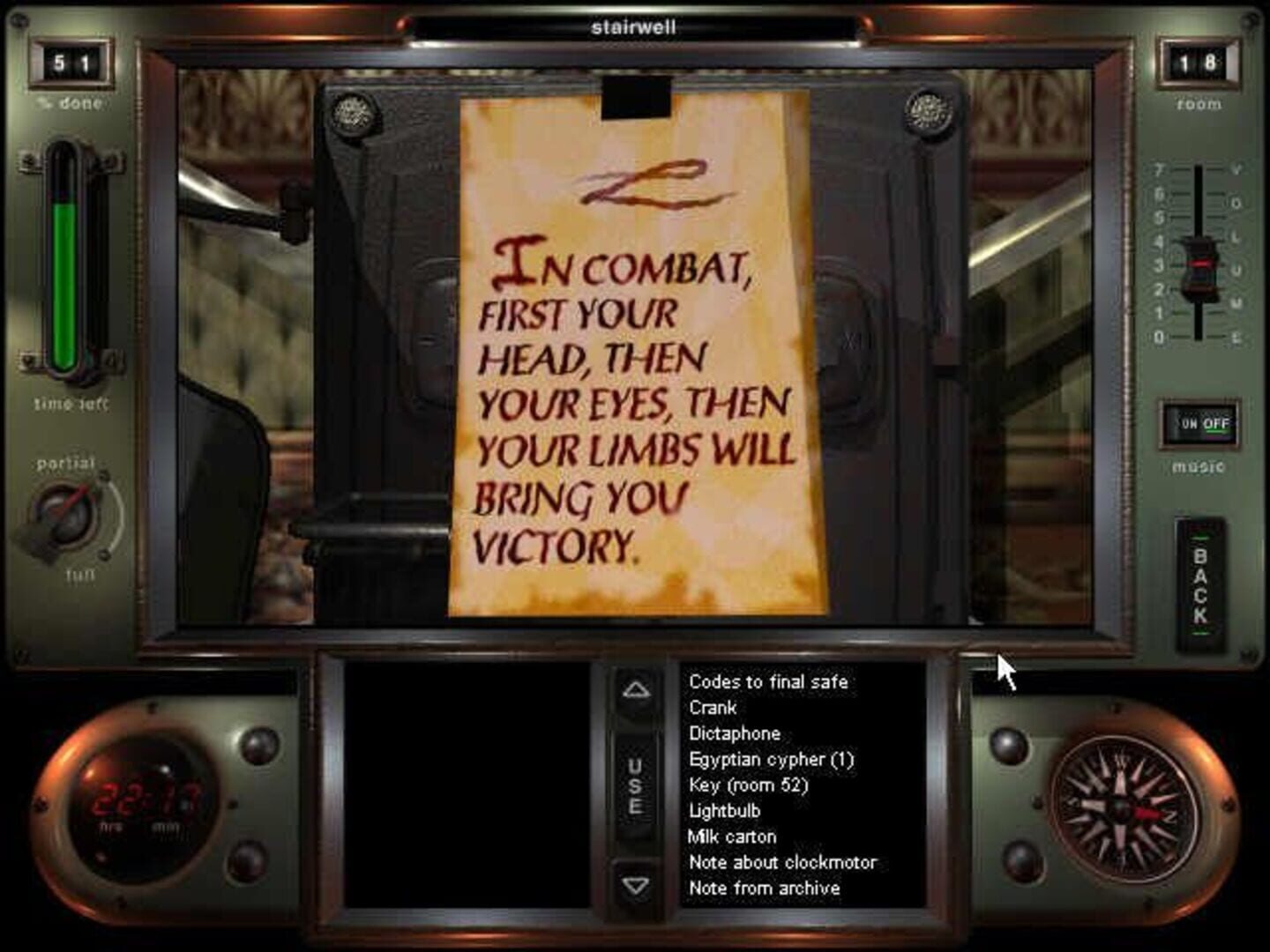
Safecracker is a puzzle adventure game that takes place from a first-person view in a pre-rendered visual environment. The player uses a point-and-click interface to traverse the game world and interact with objects. In a manner that has been compared to Zork Nemesis, the player's movement is restricted to jumps between panoramic static screens. The camera view can rotate 360° on each screen.
In Safecracker, the player assumes the role of a professional in the security systems business, who seeks a job with the fictional Crabb & Sons Company. The firm is a manufacturer of safes with unusual designs. As an audition, the player character is contracted by Crabb & Sons' owner to infiltrate his mansion headquarters and crack the safes within, with the ultimate goal of breaking into the new "F-9-12" design.
The game begins outside Crabb & Sons' building, after which the player sneaks in and begins to explore. Safecracker features nonlinear progression: the mansion's rooms can be navigated, and their safes tackled, in multiple orders. However, the game must be beaten under a 12-hour time limit. The mansion contains over 50 rooms and 35 safes, which are guarded by puzzles in a range of styles.
Among these are mathematics puzzles, anagram codes, conversions of temperature units, translations from braille, musical problems and sliding puzzles. Unlocking a safe provides the player with clues and keys, which open up new areas and allow other puzzles to be solved. At the same time, certain clues are hidden around the mansion in books and other objects that the player may investigate. Clue items are stored in the inventory on the heads-up display (HUD) interface, which also features a meter that tracks the number of puzzles solved.
Development
Safecracker was conceived in 1994 by acquaintances Jörgen Isaksson and Nigel Papworth of Umeå, Sweden. Papworth's interest in making games was first sparked when Isaksson showed him Myst: its simple HyperCard engine suggested to Papworth that game programming could be easy. Isaksson himself had previously experimented with the medium to entertain his younger sister, yielding a computer conversion of the board game Mastermind. Papworth seized on this idea and reworked Isaksson's Mastermind board into a safe puzzle.
After a short time, the pair had devised five more safes in this style, and the thought arose for an entire game about cracking safes in a single building. This concepting stage began in summer 1994. Isaksson and Papworth soon pitched the Safecracker idea to Erik Phersson and Jan Phersson-Broburg, the heads of a local computer services company, Sombrero, that Isaksson had co-founded. The more recent hire Leif Holm was present as well.
At a meeting in fall 1994, roughly one month after Isaksson had shown Myst to Papworth, the five men resolved to create Safecracker together. The Phersson brothers had already been anxious to expand into new fields. Phersson-Broburg immediately arranged an interview with Sanji Tandan, the head of Warner Music Sweden, based on the logic that the publisher had a worldwide foothold in the CD business. The first contact with Warner occurred in October 1994.
However, the Safecracker team initially lacked any materials to sell Tandan on the game. Papworth, a professional illustrator, wrote that he hurriedly "made 2 pretty crude visuals with colored felt tips on an A1 sketch pad that showed a start sequence and some examples of different safe puzzles". Phersson-Broburg composed a financial roadmap for the project, while Isaksson cooperated with Papworth to construct the game's plot. The team used StrataVision 3D to create a test of Safecracker's pre-rendered graphics.
Tandan enjoyed their presentation and the meeting was a success. Based on this event, the five team members founded Daydream Software in November 1994.
Nevertheless, Daydream's handshake deal with the publisher fell through. Tandan reported back that the rest of Warner Music Sweden was uninterested in pursuing computer games. Shortly thereafter, the Safecracker plan was revived during the 1994 Christmas party at Daydream's new office space. The team was called by the London-based Warner Interactive Entertainment, whose executive Laurence Scotford expressed interest in the game and soon flew to Umeå to learn more.
The team then traveled to the publisher's London headquarters and pitched Safecracker directly. A writer for the city of Umeå later remarked that it was "a tricky display with cumbersome computers", but the parties reached a tentative agreement to partner on the game. Afterward, the contract was carefully tweaked at Daydream's offices. The developer signed with Warner to develop Safecracker in March 1995, as part of a three-year, multi-title deal set to run until March 1998.
5 million kr; Daydream was set to earn 50 kr per unit sold, while Warner retained all revenues for the first 50,000 sales of the game. In retrospect, Papworth felt that Daydream was "lucky" to have joined the game industry when it did, as many of "the big record companies" were entering the computer game business with low standards as to the content they financed.
Daydream Software began development of Safecracker by creating thorough blueprints of the mansion and its rooms on paper. Objects inside the building were similarly drawn on paper ahead of the modeling stage. Nigel Papworth wrote that he "raided the local bookshops and bought up all the books [he] could find on antique furniture and Victoriana" for inspiration. The plan was to build the game's visual assets on Macintosh computers with Strata StudioPro after the concepting phase.
However, Daydream soon deduced that the agreed-upon budget and deadline for Safecracker were unworkable with the developer's existing personnel and technology, according to Papworth. Hoping to speed up production, Jörgen Isaksson suggested that the team develop Safecracker's graphics on expensive Silicon Graphics workstations instead. Daydream felt that these machines and their software "offered an unbeatable combination of speed, quality in modeling and rendering". The company persuaded Warner Interactive Entertainment to pay $50,000 for three workstations and a server, which made Daydream one of Sweden's top three buyers of Silicon Graphics computers.
As a result, the graphics-production setup for Safecracker consisted of SGI Indy machines, for modeling the visuals, and a single SGI Challenge server. All of them were used for rendering.
For Safecracker's design, the team adopted a nonlinear approach because they were "allergic" to linear gameplay, Papworth later said. While researching adventure games in preparation, Papworth catalogued his dislikes with the genre and shaped Safecracker accordingly. This resulted in a scheme to make the basement and first floor fully traversable from the start, and the second floor unlockable after a relatively short time. In this way, Papworth noted, "Only the end task would be dependent on most of the clues having been already solved", which prevented Safecracker from becoming a series of roadblocks.
Nonlinearity proved to be a challenge for both the designers and programmers. In an attempt to prevent the open structure from confusing players, the team included "exact instructions and advice" in the starting sequence, Papworth explained. Papworth used each room's theme to determine the design of its puzzles: for example, the music room contains a jukebox-inspired safe. He recalled creating roughly "80% of the safe designs in the first 3–4 weeks" of production; the rest were handled by other team members at later times.
Safecracker was developed primarily on Macintosh hardware wit
Reception
In October 1997, Safecracker won the "People's Choice" prize among entertainment products at the Macromedia International User Conference (UCON). This followed the game's wins, before its launch, at the Macromedia European User Awards.
Reviewing the game's PXL Computers edition, Joseph Novicki of PC Gamer US and Joel Strauch of PC Games offered conflicting opinions. Novicki praised the "clarity of purpose" in Safecracker's narrow focus on puzzle-solving, compared to Myst-inspired titles that combine puzzles with plot. By contrast, Strauch considered the game's limited story and premise to be major flaws. The lack of interaction beyond safecracking was likewise cited as a positive and a negative, respectively, by the two writers. While Novicki summarized Safecracker as "good puzzle game for gamers of all skill levels", despite problems with its inventory system, Strauch called the puzzles a mixed bag and ultimately panned the game.
The reviewer for PC PowerPlay, David Wildgoose, continued Strauch's complaints about the "stifling and pointless basic premise" in Safecracker. Charlie Brooker of PC Zone concurred: he dismissed the title as a dull, limited experience, and "the sort of thing that [only] impresses computer game virgins and Macintosh owners". He also echoed Strauch's criticism of the QuickTime VR implementation, which both writers found unimpressive as a computer game engine. Brooker's only praise went to the soundtrack, which he considered "alright".
Wildgoose joined Brooker in calling Safecracker's visuals technically impressive but nevertheless drab and boring, and took a harder line than Strauch against the "witless, haphazard" puzzles. Writing for IGN, Scott Steinberg was more positive on the puzzles, of which he noted that "a rather large quantity ... are nothing short of ingenious". He also offered light praise to the visuals, in contrast to Brooker and Wildgoose.
Despite these concessions, Steinberg ultimately declared Safecracker prohibitively difficult and confusing, and he sharply criticized its "techno crud" score.
The adventure game websites Just Adventure and Adventure Gamers were more approving of Safecracker. Ray Ivey of the latter publication called the puzzle design "simply a delight", and felt that the game was addictive. Just Adventure's Randy Sluganski similarly lauded the puzzles. Although he found them extremely difficult, he wrote that "you actually feel a sense of accomplishment and pride" after solving them.
Sluganski also enjoyed the "top-notch" visuals. While he and Ivey both declared Safecracker's plot an afterthought, neither writer felt that its simplicity detracted from the game. Both compared the proceedings to Jewels of the Oracle, which Sluganski believed would limit its appeal, but he nonetheless strongly recommended Safecracker to puzzle devotees. Ivey offered a more general recommendation: to him, Safecracker was a "breezy good time, not to be missed."
Legacy
With Safecracker as its first release, Daydream Software became an important force in Swedish games. A writer for the city of Umeå later remarked that Daydream "laid the foundation for the lucrative gaming industry in northern Sweden", which later included Coldwood Interactive and Nifflas Games in Umeå itself. The team followed Safecracker with Traitors Gate (1999) and the online game Clusterball (2000). However, Daydream was hounded by problems related to its public launch.
The Umeån writer noted that shareholders did not understand the game industry or "the time it takes to develop a large, extensive computer game", and that they demanded faster returns than the prospectus had promised. The Wall Street Journal reported that stocks had crashed at Daydream by early 1998. In retrospect, Nigel Papworth called the company's hit IPO "bad for us [in the end]. Here we were, blue-eyed, no proper management, no board."
Jan Phersson-Broberg likewise believed that the IPO was premature. After a series of financial and management problems related to its public status, the developer was shuttered in 2003.
In April 2006, plans for another Safecracker installment were revealed by publisher DreamCatcher Interactive. It was developed by Kheops Studio, previously known for Return to Mysterious Island. At the time of the announcement, Adventure Gamers reported that the game was to be a spiritual sequel rather than a direct follow-up, and that it would feature 35 safe puzzles. According to Kheops' Benoît Hozjan, DreamCatcher first contacted his team about developing a new Safecracker in early 2006, thanks to the original's status as a hit for the publisher.
Kheops responded with a pitch for the game and suggested a story based on locating a will. Hozjan noted that the team had difficulty with the title's "fully puzzle-oriented" design, as its earlier projects had emphasized plot. The resultant game, entitled Safecracker: The Ultimate Puzzle Adventure, follows a safecracking professional who seeks the lost will of Duncan W. Adams, a wealthy collector of safes with unusual designs.
After going gold in July 2006, the title reached store shelves in August. A port for the Wii was released in December 2008.