The articlegameplay, story, development, reception
Gameplay
Sam & Max Save the World is a 3D graphic adventure game in which the player controls the character of Sam. The player has Sam explore the environments of the game and solve a series of puzzles using a simple point-and-click interface. The game's puzzles have logical solutions, although a number of them have far-fetched solutions due to the game's cartoon setting. Depending on the type of in-game entity a player selects using the cursor, the player can have Sam walk around an area, look at and comment on objects, pick up certain items or otherwise try to use them.
Sam may also engage in conversation with non-player characters; when this occurs, the game presents a dialog tree with several subjects to pick from. Topics of conversation may directly involve the story or provide assistance with the game's puzzles, while others may be entirely unconnected. In some cases, the player may be able to choose dialog for Max to speak as well.
The game implements an inventory system to allow Sam to store any items that the player picks up during the course of the game. The player may select any of the items in the inventory and can then attempt to use them on objects in the game world or give them to other characters simply by clicking on the desired target. Unlike Save the World's predecessor, Sam & Max Hit the Road, inventory items are context specific, and cannot be used together or combined to create new items. Typically, Sam carries a gun that may be used to solve several puzzles.
The characters can travel between a variety of locations in the game using their black and white 1960 DeSoto Adventurer, which, when selected, will present the player with a list of available destinations. The DeSoto is also used for several driving sequences, usually involving pursuing or fleeing criminals in other vehicles. In these driving sequences, the player can use Sam's gun, the car's horn, or have Max attempt to communicate with other vehicles via a megaphone. In addition, special inventory items may be used to complete specific puzzles within these sequences.
Driving sequences are also used for several minigames, such as pulling innocent drivers over for fabricated felonies. In keeping with the developer's heritage from the LucasArts adventure games, Sam & Max Save the World is designed so that the player characters cannot die or reach a complete dead-end.
Story
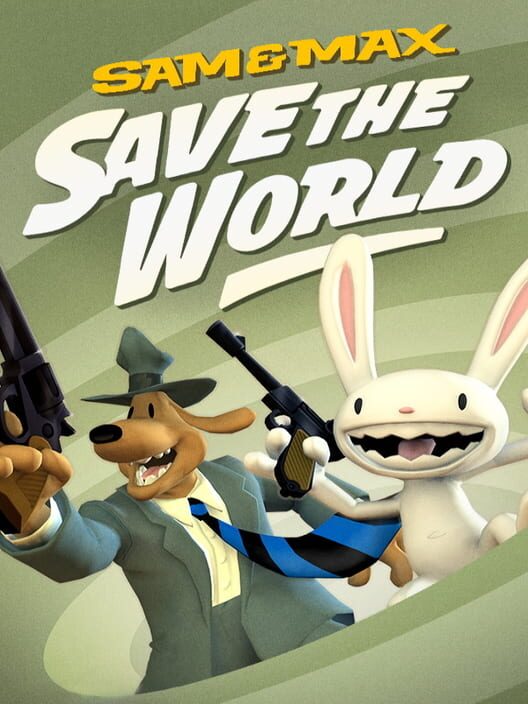
Sam & Max Save the World is set in a universe that parodies American popular culture, and it follows the title characters of Sam and Max, the Freelance Police, a pair of vigilantes and private investigators. Sam is a level-headed but enthusiastic anthropomorphic dog who wears a blue suit and fedora. He is inquisitive, knowledgeable in obscure areas and tends to prefer the logical solution to problems, but he is not above using force. Max is described as a "hyperkinetic rabbity thing"; cunning, uninhibited and reveling in violence and mischief.
His reactions to situations usually incorporate force but often with a seeming disregard for his own personal safety. Together, the Freelance Police operate out of a dilapidated office block in a dangerous New York City neighborhood, where they receive cases over the telephone from an unseen police commissioner.
There are several supporting characters that consistently appear throughout the episodes.
Roscoe Bosco is the proprietor of the nearby convenience store and supplies the Freelance Police with a number of items across the game. Driven paranoid by repeated shoplifting, Bosco is obsessed with conspiracies, believing that nearly every US government agency, as well as many criminal outfits, are after him. As such, his store is overwhelmed with security devices and contraptions created by Bosco himself. He regularly attempts to disguise himself as a variety of foreign nationals, but to little effect.
Further down the neighborhood is Sybil Pandemik, who owns a small office across from Sam and Max. Sybil is unable to keep a consistent job and regularly changes her career choices. Introduced as a psychotherapist and former tattoo artist, she later becomes a tabloid journalist, professional witness, professional matchmaker, software tester, and Queen of Canada over the course of Save the World.
In a hole in Sam and Max's own office resides Jimmy Two-Teeth, a rat who works as a petty criminal, confidence trickster and fence. He profusely dislikes Sam and Max, who he sees as always interfering with his work.
Other characters include the Soda Poppers, a group of three former child stars from the 1970s. The three, each with their own trademark catch-phrase, first appear as victims of hypnosis in the first episode, later acting as the judges on a Pop Idol parody in the second episode. By the fourth episode, they are elected the governors of the Dakotas and plunge the region into civil war over ownership of Mount Rushmore. Also making sporadic appearances is Hugh Bliss, an eccentric magician and leader of the Prismatology cult, a parody of Scientology.
He is often seen attempting to promote his self-help guides based on Prismatology. Sam finds Bliss irritating, while Max almost idolizes him. ".
The game opens with Sam and Max, the Freelance Police, lounging in their office, awaiting a new case after a long hiatus. Eventually, the commissioner sends them out to investigate a group of former child stars, the Soda Poppers, who have been causing trouble in the neighborhood. The Soda Poppers are attempting to promote a self-help video called Eye-Bo, which (when watched) hypnotizes the viewer. After seeking assistance from Sybil to reverse the hypnotism on the Soda Poppers by knocking them unconscious, the Freelance Police learn that the scheme has been devised by one Brady Culture, another former child star who owes his fall from popularity to the rise of the Soda Poppers.
Sam and Max and the Soda Poppers confront Culture, who hypnotizes the Soda Poppers again. However, Sam manages to fool Culture into ordering the Soda Poppers to attack himself, subduing the threat. The next case the Freelance Police get involves liberating a studio audience held hostage by a deranged TV talk show host, Myra Stump. At the TV station, Sam and Max deduce that Myra has been hypnotized and, after using other shows in the studio to become celebrities, they convince her to let them become guests on her show.
Once on the show, Sam notes a strange toy bear on the host's desk, the source of the hypnotism. Using the studio sound system, Sam electrocutes both Myra and the bear, allowing the audience to leave.
The commissioner then tasks Sam and Max with infiltrating the Toy Mafia, a criminal organisation operating from a casino. The commissioner's mole in the organisation has gone quiet; he wants the Freelance Police to find out what happened to the mole. Sam and Max quickly discover that the Toy Mafia are responsible for the toy bear that hypnotised Myra. As they gain the Mafia's trust, they ascertain that the mole has switched sides and is now leading the outfit.
After discovering that the casino is a front for a factory producing the hypnotizing bears for mass distribution, the Freelance Police sabotage the factory and destroy the operation. Soon after, the US President starts bringing in bizarre policies; Max is particularly concerned about the introduction of gun restrictions, while Sam believes the President has been hypnotized. At the White House, Max beheads the President, revealing him to be a mechanical puppet designed to hypnotize the nation through TV broadcasts. The President's bodyguard, none other than the now-fallen Toy Mafia's pit boss, activates a giant robot disguised as the statue at the Lincoln Memorial to run in an emergency election against Max.
Sam discredits Lincoln's campaign, resulting in Max winning the preside
Development
Sam & Max Save the World originates from Sam & Max: Freelance Police, a graphic adventure game that was developed by LucasArts from 2002 to 2004. Freelance Police was a sequel to the 1993 title Sam & Max Hit the Road. However, LucasArts ceased production on Freelance Police in March 2004. In the subsequent weeks, LucasArts underwent major restructuring; many of the developers who worked on past LucasArts adventure games were made redundant.
Some of the former Freelance Police development team consequently formed Telltale Games in June 2004 to continue developing the sort of adventure games that LucasArts no longer wished to produce. Sam & Max creator Steve Purcell, who described himself as disappointed and frustrated with LucasArts' decision, took the Sam & Max franchise to Telltale after the LucasArts license expired in mid-2005. Telltale Games announced the new series of Sam & Max games in September 2005. Brendan Q.
Ferguson, who worked on Freelance Police as a programmer, designer and writer; Dave Grossman, one of the project leaders on Maniac Mansion: Day of the Tentacle; and Purcell primarily led the development of the project.
Unlike Freelance Police, Save the World was developed in episodic form, with episodes being released in quick succession, to allow for reduced development time between titles and quicker delivery of content to consumers. Telltale launched a website for Sam & Max in November to accompany their new series. The following month, Purcell began publishing a Sam & Max webcomic entitled "The Big Sleep" on the site; the webcomic ran for twelve issues and concluded in April 2007. Purcell won an Eisner Award in 2007 for the webcomic. In March 2006, Telltale acquired US$825,000 in funding from a group of private investors, to help sustain growth until its next round of equity funding.
Telltale released the game's trailer for the Electronic Entertainment Expo in May 2006, showing the new voice actors for Sam and Max. Initially, David Nowlin was cast to voice both characters, however it was later decided that Nowlin would only voice Sam and a separate voice actor, Andrew Chaikin would voice Max. Chaikin would only be cast in the first episode, as he was unable to continue his role for health reasons. While at the convention, Telltale revealed that the first episode was forecast for release towards the end of 2006, via the distribution service GameTap.
Telltale announced a release date of October 17 over GameTap in early September, with the note that each episode would be made available from Telltale themselves within fifteen days of release. Development on the first episode was completed on September 25, and from October 10, GameTap began hosting the Sam & Max animated series as promotional material for release. The first episode, "Culture Shock", was released on-time on October 17. The next five episodes were released over short intervals until the series finale in April 2007.
The series debuted on Steam on June 15 the same year. Telltale began shipping a special collectors edition of the game in July, while the retail version of the game was published in August. January 2008 saw a significant update to the game, upgrading the game engine and ensuring compatibility with Windows Vista.
Three months later, Telltale announced a Wii version of the game. Telltale reported that an email campaign and Internet rumors of a port had stirred up interest within the company for producing a Wii version. They redesigned the game's point-and-click interface to accommodate the Wii Remote, the primary controller for the console. The game was initially forecast for release in North America on October 7, 2008, but was released a week later on October 14. The European version was published later in December.
In February 2009, Telltale Games renamed the game from its initial release title of Sam & Max: Season One to Sam & Max Save the World. Telltale's public relations spokeswoman, Emily Morganti, explained that while Season One was thought to communicate the game's episodic nature to potential consumers, the company felt that it was nondescript in relation to the game's story. The message accompanied the announcement of an Xbox Live Arcade version of the game, which had been subject to media speculation since February 2007. Both Windows and Wii versions of the game were republished using the new title.
According to Dave Grossman, the objective for Telltale Games with Sam & Max Save the World was to create a game with a "lot of story and character in it". Grossman explained that the Sam & Max franchise was therefore most ideally suited to the graphic adventure genre; while action was thought to be possible with the source material, it "would be kind of wrong". Still, designers decided to introduce action moments such as car chase scenes, wanting players to "feel like [they] are these crazy Freelance Police officers" and "just be involved in all this sort of mayhem" presented in the original comic strips. Like in previous Sam & Max games, Sam & Max Save the World used a point-and-click gameplay system, itself a variation of the control scheme used by Telltale in their preceding adventure game series, Bone; the action sequences implemented in the game still maintained the point-and-click interface.
Very little of the design from Freelance Police was carried over into Save the World; LucasArts still held onto the assets created for use in Freelance Police, and Telltale was wary of using similar design patterns. While Ferguson and Purcell had both been involved with the canceled LucasArts project, Grossman had not. The team decided to just start from fresh, and pursue a different treatment of the game's subject. Purcell himself wanted to ensure that the game conveyed the "gritty" feel of the original comics—something he felt was lacking from the LucasArts renditions of the franchise. Grossman stated that "we wanted to get a little bit more of that dirt on the streets, and the paper cups and peop
Reception
Sam & Max Save the World received positive critical reaction from reviewers. 0", as the critical favorite, while the third episode, "The Mole, the Mob, and the Meatball" received the lowest scores. The entire season holds a score of 88 percent on GameRankings. In addition to receiving several editor choice awards, the game has been recipient to publisher awards for the best adventure game of 2006.
As Telltale Games had managed to release a steady stream content with only small time gaps, journalists in the video game industry had considered Sam & Max Save the World to be the first successful application of episodic gaming. Previous unsuccessful implementations of the distribution model included attempts by Valve with the Half-Life series, Ritual Entertainment with Sin Episodes: Emergence and Telltale themselves with Bone.
The debut episode, "Culture Shock", was recipient to a mostly optimistic response from critics. The episode was thought to adequately follow 1993's Sam & Max Hit the Road, with the introduction of the new 3D engine and gameplay being positively received. Criticisms of "Culture Shock" focused on the story; while the humor in the writing was praised, the plot was seen as a "thin excuse for the jokes" and the episode's primary antagonist was described by IGN's Steve Butts as "a bit of a letdown". The humorous writing and characters had done enough to compel the Academy of Interactive Arts & Sciences to nominate Culture Shock for "Outstanding Achievement in Story and Character Development" at the 10th Annual Interactive Achievement Awards.
The second episode, "Situation: Comedy", was thought to produce a better antagonist than "Culture Shock", with the puzzles linking in well to the story. However, critics described the puzzles as too easy, and expressed disappointment at the reuse of lines from the first episode. The next episode, "The Mole, the Mob, and the Meatball", was the lowest rated episode amongst reviewers. Although the episode received compliments for its dialogue and humor, it was criticised for its easy puzzles and short length.
", was held by critics to be one of the series' best episodes. The episode's story of political satire was subject to praise, whilst the increased length was also appreciated. Puzzles were felt to be more difficult and satisfying to solve. Detractors of the episode, however, felt that the episode suffered from the need to constantly move between locations and from the reuse of old characters and locations.
0", the fifth episode, was the critical favorite of the series. ", with a fitting tribute to text adventure games towards the end. However, the script was thought to be inferior to the preceding episode. The season finale "Bright Side of the Moon" received a more reserved response than the two previous episodes, with criticisms directed at the length of the game and the depth of character interaction.
Nevertheless, reviewers felt that the episode had reasonable puzzle design and that it was a respectable end to the series.
Critics gave positive reviews towards the overall gameplay mechanics, although they often presented some reservations. Several reviews praised the simplicity of the game interface. GamingTrend reviewer Ron Burke praised Telltale's "intuitive" point-and-click system. Mark Smith of Game Chronicles, however, stated that the streamlined mechanics eliminated "a lot of the exploration and discovery we normally associate with these types of games".
Some reviews directed criticism towards puzzle design; according to Smith, the game is "certainly accessible to kids and younger teens", but the adult audience "will find these games way too easy". Reviewing for Adventure Gamers, Evan Dickens felt that the puzzles took "a bit of thought and consideration, but never to a point of consternation", believing that the low difficulty was intended by Telltale to allow players to "proceed through the story with minimum frustration". Hyper's Tim Henderson commends the game for being "highly accessible [and] almost as funny as the original", but criticises it for its episodic content being a "tease".
In relation to the story and writing, critics felt that the overall plot was ineffectual. Al Giovetti of JustAdventure felt the plot was lacking, while Burke considered the episodic nature to be detrimental to maintaining plot cohesion between the episodes, a point with which Dickens agreed. Despite this, several reviewers thought that the individual episode stories and the presentation and development of the characters were good. Reviewers considered the writing for each episode as one of the best features of the game; they also praised the level of humor in the game, although Dickens felt that it was not until the fourth episode that the writing properly established itself.
In addition, they directed some skepticism towards the reuse of scenes and characters, with critical opinion divided on the degree of success in this regard. A point of contention rose between British and American reviewers over the story and setting, exemplified in PC Gamer; whilst positive towards the first and fourth episodes, the British edition of the magazine felt this repetition was a severe failing of Save the World, and that the writing did not work well. In contrast, the American edition rated each episode highly, stating that the quality of the series was "excellent".
Critics commended Sam & Max Save the World's graphics and art direction; Dickens commented that "the cartoonish, absurdist nature of Steve Purcell's characters is captured perfectly" within an "enthusiastically colorful world that is at its best the stranger it gets", while GameZone reviewer Anise Hollingshead praised Telltale for successfully upgrading the characters' graphics "withou