The articlegameplay, story, development, reception
Gameplay
In Samurai Warriors, the player takes the role of a single officer in battle and must fend off hordes of enemy soldiers and defeat the enemy commander. The player has at their disposal a range of combo attacks and crowd-clearing special moves known as Musou attacks. The variety of attacks available increase as the player's character gains levels and new weapons.
Musou attacks can only be performed when the character's Musou gauge is full. The Musou gauge increases when the character inflicts and receives damage. Additionally, if the character is low on health or possesses a special skill, they can use their True Musou attack, a more powerful version of the regular Musou attack.
Each character can equip up to five items before each battle, which will affect their attributes or give them additional abilities. Players can find items which affect their attributes through normal battle by defeating enemy officers or breaking open crates. The items which give characters special abilities are obtained by meeting conditions in specific battles.
Like items, weapons can also be found in battle. Each character has four different types of weapons that they can find. In addition to their base attributes, weapons will randomly have additional attributes attached to them. The value of these bonuses depends on three things: the difficulty level, the stage the player is on and the ranks the character has in the 'Discern' skill.
In addition to the random weapon drops, each character has a unique fifth weapon. Unlike the other weapons, the fifth weapons have set bonuses and attributes. Fifth weapons are obtained by meeting conditions in specific battles on either the Hard or Chaos difficulty level.
Samurai Warriors contains a number of changes to Dynasty Warriors' combat system, most notably the ability to perform free-style combo attacks during Musou attack mode, during which the game enters bullet-time; common soldiers move slowly, but officers are unaffected. Other changes include the ability to perform a roll to dodge attacks, and deflect incoming arrows with their weapon. Additionally, the series has hyper attacks, or the ability to dash while attacking enemy soldiers.
The character development system has been overhauled. There is a new ranking system after battles which depends on five categories:
Time in which the battle is won.
Amount of experience earned.
Missions successfully completed in battle.
Number of enemies defeated while using a Musou attack.
Number of enemies killed in total.
Each of these categories is given a rank (from lowest to highest: E, D, C, B, A, S) depending on the player's performance, and then the player is given an overall rank. The higher the rank and the harder the difficulty setting of the game, the more the player's character attributes will increase. In addition to the growth of the character's stats, Skill Points are also awarded. Skill Points are used to buy skills through a skill tree that enhance the character's abilities.
Samurai Warriors introduces an in-battle mission system. Each stage has a number of missions which become available depending on which character the player is controlling and the success or failure of previous missions. Missions include eliminating specific enemy officers, launching sneak attacks on enemy bases or thwarting the plans of the enemy. Success in these missions can be crucial to the outcome of many battles as failure often results in a massive loss of morale to the player's forces. It will also determine the path that will be carved out for the next stage if there is a split route, but one can choose which path to take if both routes had been opened.
Samurai Warriors gives players the opportunity to create new characters via the officer training mode. In this mode the player creates a new character who trains under a mentor, completing twelve training sessions and a final exam. The player has a variety of tasks available for each training session based on gameplay modes and combat techniques. Each of the different tasks affects different attributes of the character.
After the completion of the task the player will be ranked out of a score of 100 points, by getting more points the character's attributes will increase by a greater amount. If the character is defeated during the course of a training session, they will automatically fail and will have to spend one training session resting.
After 12 test sessions have passed, the character must take a final exam. This exam consists of two training sessions back to back. The player has to score a total of 100 points between these two tests in order to pass the exam. If the player completes the final exam successfully then they will become available to use in other gameplay modes.
Reception
The PS2 release of Samurai Warriors sold a million copies within a month in Japan and reached the Japanese platinum chart with a total of 1.06 million. It was awarded an award of excellence in CESA's 2004 Game Awards and a 34 out of 40 rating from Famitsu.
The game was met with mixed reviews from Western critics. GameRankings and Metacritic gave it a score of 73% and 73 out of 100 for the PS2 version, and 71% and 71 out of 100 for the Xbox version.
Most reviewers criticized the game's visual and technical similarities to the Dynasty Warriors series as the cause. What earned the most praise was the RPG element added into the game as it deviates from its spiritual predecessor by adding a higher replay value for gamers. The Create a Character mode was received with mixed results. Gameplanet commented that it is "well implemented", allowing players to accurately play a character made for them while GameSpot regarded the option as "a nice touch" but "rather tiresome" in the end. The innovations made were still met with criticism for the genre as a whole, with Eurogamer being critical to this aspect.
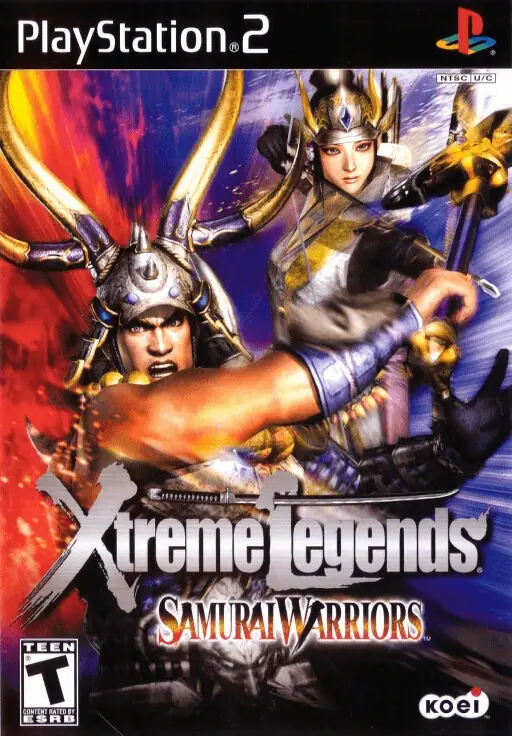
Xtreme Legends was met with average reception; GameRankings gave it a score of 72%, while Metacritic gave it 72 out of 100.
State of War was met with mixed reception, as GameRankings gave it a score of 65%, while Metacritic gave it 64 out of 100.
Legacy
The game's success led to numerous sequels released under the Samurai Warriors title. The series has sold over 8 million copies worldwide as of August 2021.