
The articlegameplay, story, development, reception
Gameplay
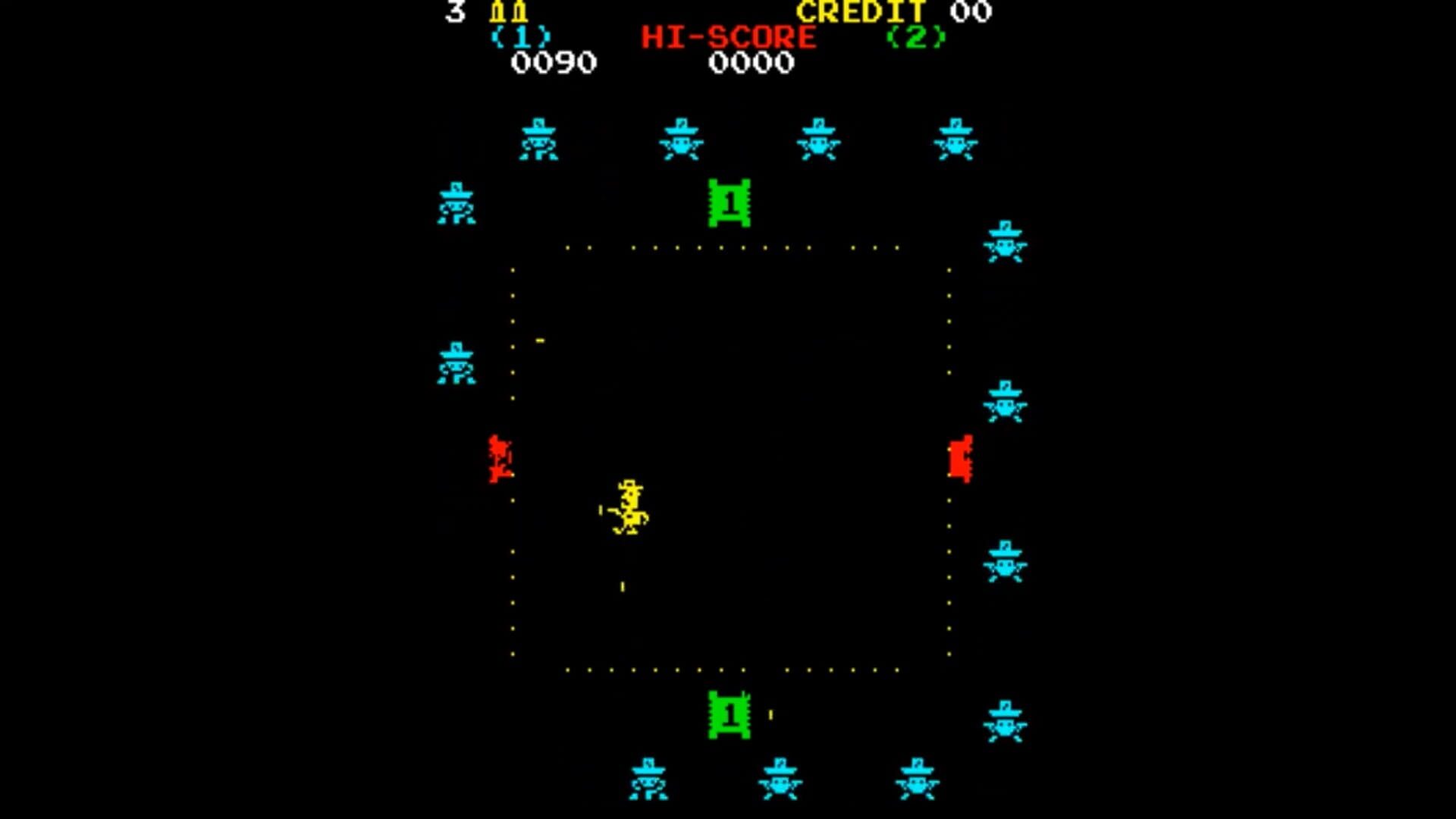
The game's concept is Nintendo's first damsel in distress theme, predating Donkey Kong (1981). The player controls Mr. Jack, a sheriff, against a gang of attacking bandits, to defend the town and rescue Betty, the captured woman.
Sheriff distinctly features two separate controls: a joystick for movement, and a dial control for aiming and firing, a configuration unusual for arcade games and nonexistent in consoles at the time. The joystick moves the character and the dial aims and fires, each in eight separate directions, allowing Mr. Jack to walk in one direction while shooting in another. The movement joystick is set with a considerable time delay before moving.
16 bandits (also referred to as "gangs") surround the outer rim, marked by a dotted "fence". Bullets from either Mr. Jack or the bandits can destroy the fenceposts, and they can function as defensive walls or aiming obstacles for the player. Larger barriers also exist on the midpoint of each side of the screen, and bullets from either Mr.
Jack or the bandits will slowly erode these. The top and bottom barriers display the current level number.
The basic action taken by the enemy bandits is to walk around the outer rim while firing bullets at Mr. Jack, but they will sometimes enter into the central area, along with a change in game music. Mr. Jack must avoid touching the bandits, dodge bullets, and shoot all 16 bandits to complete each level.
Occasionally, a condor flies along the top of the screen in much the same way as the UFO in Taito's Space Invaders. Shooting the condor awards the player a random amount of bonus points.
At the end of every round, a brief cutscene is shown. Depending on how many rounds the player has completed, this cutscene either shows Betty being chased by the bandits or reuniting with Mr. Jack. Whenever the latter is shown, the player's score is doubled.
Development
The game was developed by Nintendo R&D1 in 1979, designed by Genyo Takeda with art by Shigeru Miyamoto. Some sources assert that Ikegami Tsushinki also did design work on Sheriff.
Reception
The game was a commercial success in Japan, where Sheriff was among the top ten highest-grossing arcade games of 1979.
In 2012, 1up wrote that Sheriff put Nintendo on the right track as a game developer.
Legacy
In 2003 it was re-released as part of WarioWare, Inc.: Mega Microgames!, released for the Game Boy Advance. In WarioWare, Sheriff was included as both a microgame and as a minigame ("Wario's Sheriff") in which Wario takes the role of the sheriff. Standard controls apply to the microgame version, but in the minigame version, the L/R buttons can make the sheriff face in the opposite direction without moving. The time delay for moving the sheriff was removed, and the sheriff's walking speed is greatly increased from the original. When the player's points double after completing a certain number of levels, the sheriff also gains extra lives, considerably reducing the game's difficulty.
Mr. Jack has appeared in the Super Smash Bros. series starting with Super Smash Bros Melee, in which he appears as one of the many collectible Trophies in the game. Mr.
Jack later returned in Super Smash Bros. for Nintendo 3DS and Wii U as an assist trophy where he fires a succession of eight bullets in a random order on the battlefield at the enemies of the summoner. He appears again as an Assist Trophy and Spirit in Super Smash Bros Ultimate.


