Ludography
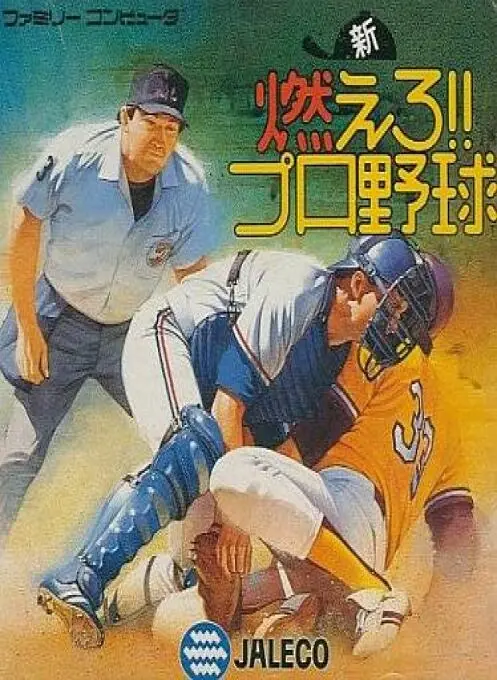
Shin Moero!! Pro Yakyū cover

1989 · Jaleco · Sports

Shin Moero!! Pro Yakyū

Nintendo exclusive

The third game in TOSE/Jaleco's NES Baseball series and the sixth Moero game overall. Though most of the Moero!! Pro Yakyuu games were released in the US as Bases Loaded, this one was not.

Shin Moero!! Pro Yakyuu (New Burning!! Pro Baseball) is the sixth of Jaleco/TOSE's Moero!! series of sports games (it's occasionally referred to as Moero 6!!

Shin Moero!! Pro Yakyuu) and the third in the series to be associated with baseball. The first two Moero!! Pro Yakyuu games saw localizations in the US as Bases Loaded and Bases Loaded 2, but Shin Moero!!

Pro Yakyuu was skipped. What eventually became Bases Loaded 3 was instead the fourth Moero!! Pro Yakyuu game, Moero 8!! Pro Yakyuu '90 Kandouhen.

The biggest difference between the previous Moero!! Pro Yakyuu/Bases Loaded games and this one is the slanted perspective for batting and pitching. Instead of the camera being behind the batter or pitcher, the player can see both from an angle, with the two situated diagonally from each other. Likewise, the baseball diamond is shown at an angle making it appear more like a square, with the rest of the field stretching outwards. Despite this new perspective, the game controls similarly to previous Bases Loaded games.

A curious addition is that of the biorhythms, which tells the player how each athlete is feeling: If the athlete is having an off-game, one or more of these biorhythms will be low and the player will need to strategize around these dips. Though big in 70s sports punditry, the idea of mathematical biorhythms predicting an athlete's prowess in any upcoming game was all but discredited as pseudoscience by the time when this game came out.

Also known as
Moero 6!! Shin Moero!! Pro Yakyuu · Shin Moero!! Pro Yakyuu
Released
27 July 1989
Platforms
NES
Genres
Sports
Developers
Jaleco
Publishers
Jaleco
Modes
MultiplayerSingle-player
Country
Japan

About

Shin Moero!! Pro Yakyū (新・燃えろ!!プロ野球; lit. "New Flame!! Pro Baseball") is a traditional baseball simulation video game released for the Family Computer in 1989 exclusively in Japan.

Keywords

  • baseball

The articlegameplay, story, development, reception

Gameplay

This game is drastically different from the Japanese version of Bases Loaded II: The Second Season.

While the controls are nearly identical to Bases Loaded II, the camera angles are different for fielding. Graphics also look more realistic and more advanced due to the enhanced engine used to make this game. There are three statistics for the biorhythms: P-Physical, S-Sensitivity, and I-Intellectual. They affect the player in ways that can only be mentioned while playing him on the screen.

Positive numbers indicate that the player is better at one of the statistics. Negative numbers mean the player is doing poorly at one of the statistics. Zero is considered to be critical and indicates the statistic is a breaking point. Regular abilities are boosted by positive numbers (in addition to playing above his usual skill level) while negative numbers mean that a player will not play up to his potential.

Each team has a letter of the Latin alphabet associated with their name. It is assumed that each letter of the alphabet corresponds to a certain Nippon Professional Baseball league team. There are two leagues: the Western League (whose coast is the Sea of Japan) and the Pacific League (which has their teams based around the Pacific Ocean coast of the east). Each league co-responds to one of Japan's two major coastlines.
Releases by platformdates and regions as published

Releases by platform
PlatformReleasedRegions
NES27 July 1989Japan

Title IDsone per regional release, with its latest update

Title ids and disc serials by release
PlatformTitle IDRegionLatest update
NESJF-23Japan—

Box artone per regional release we hold art for

Games like this

Collections1 collection

Platform libraries

Description adapted from its source, CC BY-SA 4.0.