The articlegameplay, story, development, reception
Gameplay
Gameplay is similar to other RPGs in that it involves exploration and random enemy encounters, but its focus is not on combat but rather puzzle-solving to save party members from death. The main character, throughout the course of the game, can learn action commands such as "push", "crawl", "look above", etc., and these actions are crucial to save his comrades. If the main character fails to save a party member, not only does that person die and leave the party forever, he or she will come back to life in a mummified form to attack the party during the latter stages of the game. Different combinations of survivors result in different dialogue in the epilogue.
Story
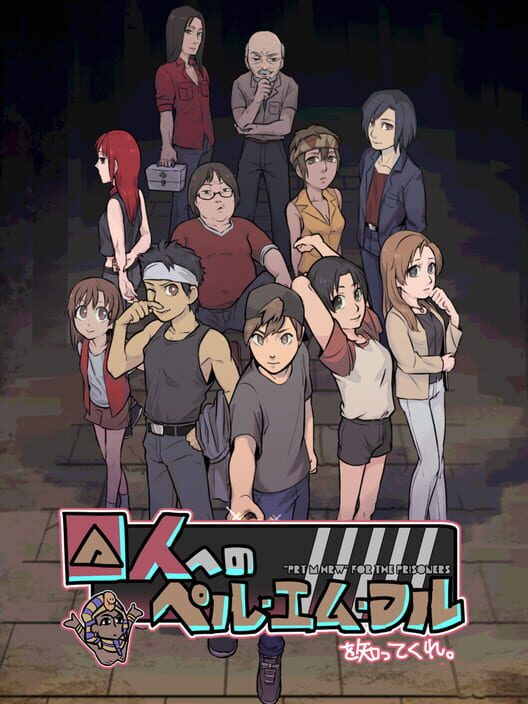
Professor Tsuchida, a leading expert on archaeology, goes on an unauthorized expedition into the unknown lower levels of the Great Pyramid of Giza with his assistant Kōji Kuroe. They soon realize that the underground ruins is full of death traps when the excavator they hired is decapitated by a thin metal wire. Professor Tsuchida, unwilling to back down, goes outside the pyramid to lure a Japanese tour group nearby to act as his human shield. Inside the pyramid, one by one, the members of the entourage become subject to Khufu's punishment for their faults, but the professor insists on heading deeper into the complex despite knowing the fatal dangers of the environment.
Development
Makoto Yaotani cited Corpse Party as a direct motivation to make Shūjin e no Pert-em-Hru, since it exceeded the boundaries of "what commercial games could not do" at the time, especially the depictions of splatter gore. Yaotani also drew inspiration from Indiana Jones, Sherlock Holmes, Father Brown, and the works of Junji Ito for the adventure, mystery-solving, and horror elements of the game.
Yaotani considers working around the limitations of game creation as an enjoyment, which was why he thought creating games in RPG Maker would be interesting. Since RPG Maker Dante 98 II only supports 16-bit colours, Shūjin e no Pert-em-Hru was set inside a dark pyramid so the colour palette could be narrowed. The skills menu of Dante 98 II, originally designed for in-battle commands like in typical RPGs, was adapted to contain the "action commands" from which the player can choose to use as the story progresses.
Reception
In August 1998, the game was given the Platinum Award for the "Internet Contest Park" monthly contest held by ASCII. The prize was ¥150,000, and Shūjin e no Pert-em-Hru became the only game to receive the Platinum Award for that contest — which ran monthly from July 1998 to June 2002. The award's judges praised the game for its original gameplay, its detailed graphics, its suspenseful plot and its intricate characterization. The game also ranked fourth in the annual popularity poll in 1998, and ninth on the popularity poll for all years, both for "Internet Contest Park".
Shūjin e no Pert-em-Hru also won the Third Ascii Entertainment Software Contest in the "Ascii Maker Product" category, giving its creator ¥1,000,000 as prize. The game was then covered in magazines like Tech Win and Nikkei Click.
Remaining largely unknown in the west, in 2014, fan translation group Memories of Fear released an English translation of the game. Hardcore Gaming 101's Luca Pane praised the game's atmosphere, characterization, gameplay and spritework. Destructoid's Andrea Gonzalez said the game "holds up well for its age" and called it a "gem emerged from the sands that buried it". Game Rant's Ritwik Mitra also stated it was "one of the most underrated and chilling horror games that more players should check out".